
The YouTube algorithm has a knack for surprising me with recommendations for videos I never knew I’d be interested in. A recent suggestion had me watching a fascinating talk on the history of the Pith helmet. Learning about its practical design for sun protection and air circulation, I felt I needed to head to the market right away and get one for my next jungle expedition.
As I donned my fetching new hat, I felt washed with feelings of the age of exploration, when the world seemed unknown, full of fantastical tales and mysteries waiting to be told.

And so today, I want to write about the topic of cryptids – the type of mysterious creatures believed in by many despite a lack of widely accepted scientific evidence. From the Loch Ness Monster to the Abominable Snowman, these elusive beings defy conventional explanation. I enjoy tales about cryptids despite being a non-believer myself.
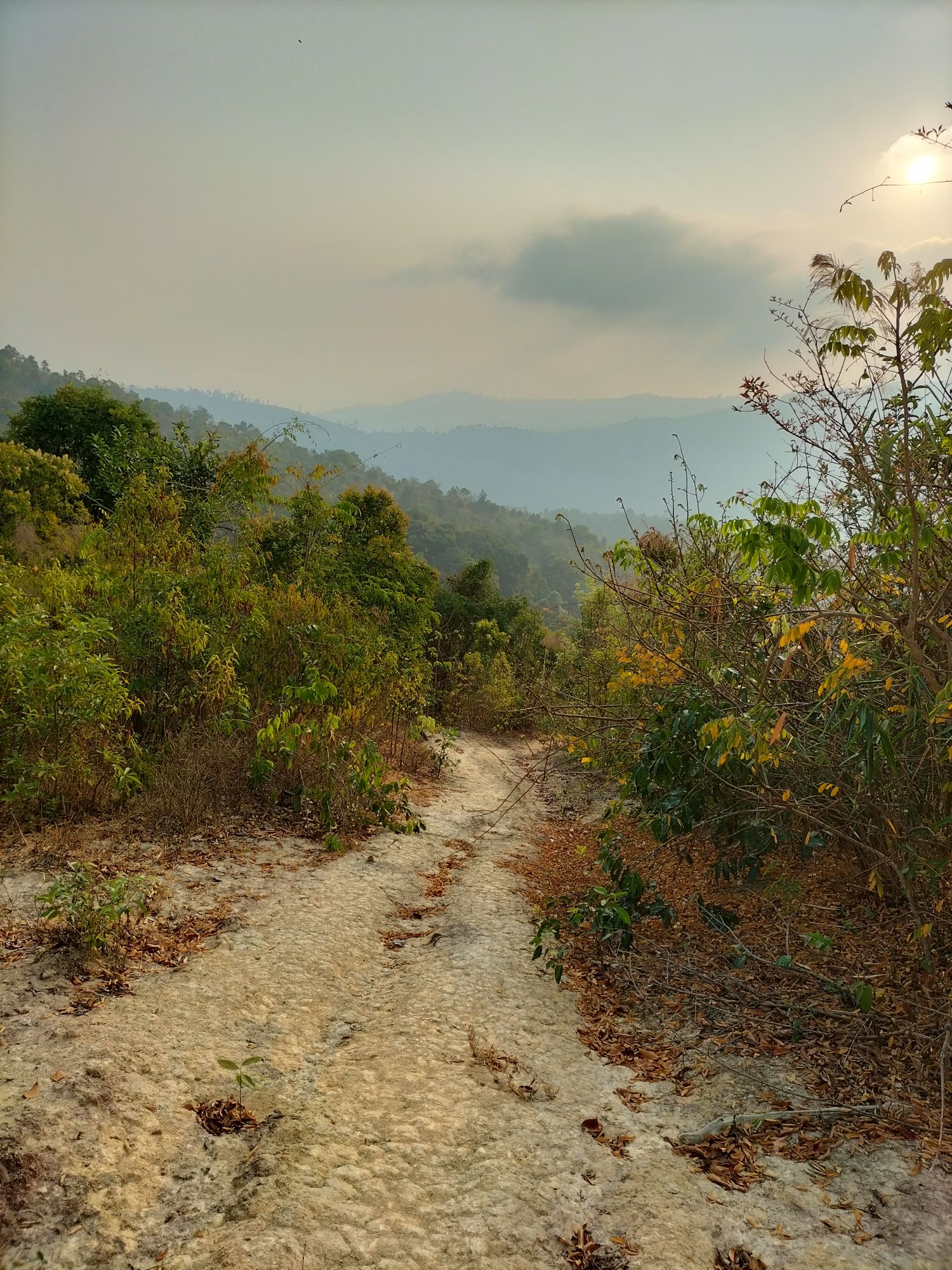
Vietnam’s Central Highlands with their sparse population and untamed jungle host more cryptids than one might anticipate. Join me as we embark on a journey through the local lore of Gia Lai, where whispers of cryptid sightings add an air of intrigue to the lush landscape.
Người Rừng
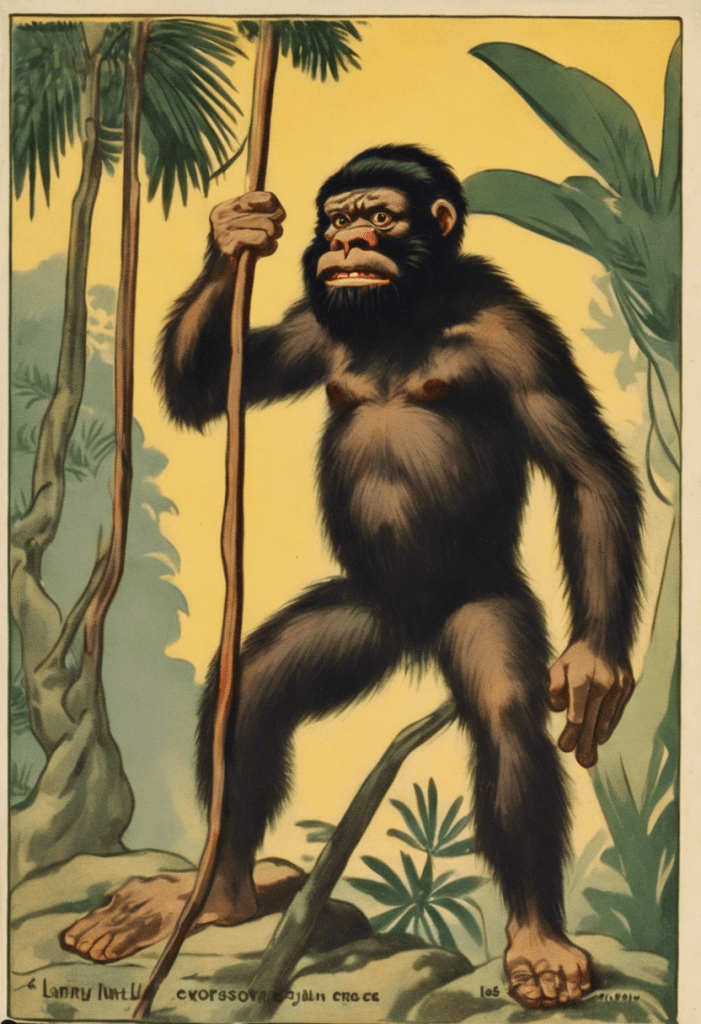
From deep in the untamed jungle comes a creature I am very interested in: Người Rừng, also known as the Rock Ape, Batutut, Ujit and more. These illusive primates are characterized as short hairy humanoids with tails, and have be reported in the west for as long as westerners have been present here. Some French scientists believed they had come across a primitive type of human or a “missing link”.
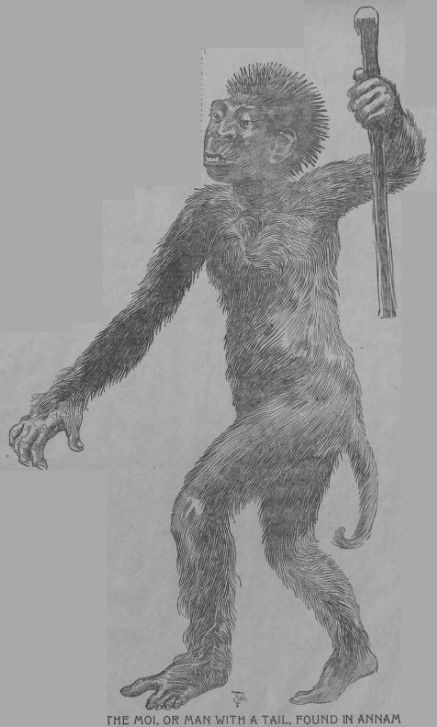
Picture the year 1947, French explorer D’Enjoy dons a pith helmet before venturing deep into the heart of Kontum’s jungle. Amidst the lush foliage, he witnesses beings that defy explanation. The indigenous Jrai people, stewards of the land, speak of these creatures as neither fully human nor monkey and say the creatures have long been known locally.

The Vietnam War brought more people than ever into the untamed Central Highlands and set the stage for further encounters with these inexplicable creatures. Soldiers on both sides share chilling tales of crossing paths with creatures that match the descriptions of Người Rừng. One account from American GIs describes a figure with a long, cucumber-shaped head, draped in fiery red fur. In 1974, a determined North Vietnamese general leads an expedition into the wilderness, driven by the quest to unveil evidence of these elusive beings. He finds unusual footprints deep in the jungle.
Looking ahead, I’m hoping to delve deeper into the fascinating world of Người Rừng in a more comprehensive piece. I plan to gather insights from interviews with some locals. Stay tuned for updates.
Kra-Dhan

On to the next mysterious jungle primate: in 1961, the renowned British biologist Ivan T. Sanderson spun a tale that piqued curiosity. He wrote of a monkey known as Kra-Dhan, that is said to have taken a life in Kontum back in 1943.
Could this Kra-Dhan be linked to the Người Rừng? When I first came across the term Kra-Dhan I thought that it was yet another name for the Người Rừng (as I had seen plenty already). However, Sanderson’s source paints a different picture – Kra-Dhan was explicitly described as a monkey, not a humanoid figure, which is a recurring theme with the Người Rừng.
Unfortunately, the source of Sanderson’s info remains a mystery. Despite my efforts, I’ve not found any earlier source or any source in Vietnamese for the 1943 death. If anybody out there have a lead, don’t hesitate to reach out! Together, let’s unravel the threads of this cryptic jungle puzzle.
K’Ting Voar
In 1888, French explorer Boulangier introduced the world to the deer-like K’Ting Voar. Also known as the Vietnamese Spiral-Horned Ox, this formidable wild ox, captured the imagination with its unique prowess – preying on venomous snakes with apparent impunity. According to local lore, the K’Ting Voar possesses a remarkable ability to repel snake venom and even employs saliva as a projectile to dislodge its arboreal prey. Some Khmer people in the past believed the Kting Voar’s horns held mystical properties, and wore them as talismans against snakebites.
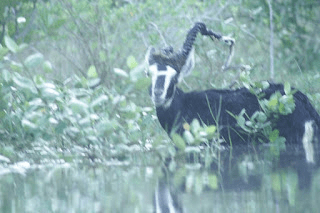
The K’Ting Voar’s presence gained wider attention in the West when biologist Wolfgang Peter stumbled upon unusual skulls in a market in Ho Chi Minh City. The extraordinary horns led Peter to speculate that they belonged to a previously undiscovered species. Though subsequent DNA analysis disproved the notion, the discovery sparked a surge of interest, prompting a flurry of scholarly papers (for example this source I used) delving into earlier sightings of Kting Voar. To this day the jury is out regarding the existence of this unusual bovid.
Three Legged White Tiger

Amidst the depths of my research into the Annamite Highland’s mysterious cryptids, a fascinating tale emerged – one that may not fit the traditional definition of a cryptid, but certainly captures the essence of intrigue and wonder and reminds me of tales of The Beast of Bodmin that fascinated and terrified me as a child. This tale is of a three-legged white tiger very close to where I now live.
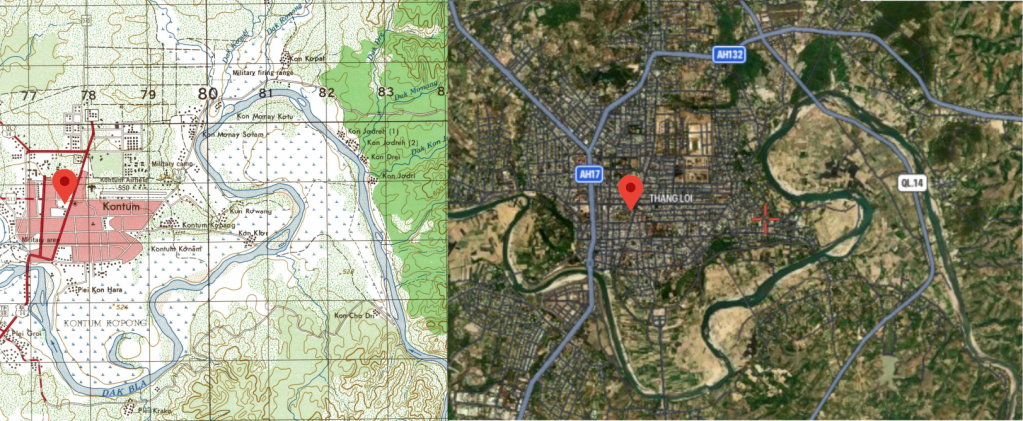
In 1932, a three-legged white tiger began wreaking havoc in Quang Trung in what is now the city of Kon Tum but at the time was on the edge of the wilderness. Its presence struck fear into the hearts of locals as it terrorized livestock until, unexpectedly, it sought refuge within the confines of a Buddhist temple. Miraculously, upon entering the temple, the ferocious beast underwent a profound transformation, its demeanor shifting from aggression to serenity.
The Temple today is said to contain a bas relief of the tiger, I will have to visit soon and see for myself. As recently as 2008 tigers have been reported to bother farmers in Kon Tum.
source on the three-legged white tiger

Conclusion
“in May 1992 during a joint survey [was] carried out by the Ministry of Forestry of Vietnam and WWF in north-central Vietnam. The team found a skull with unusual long, straight horns in a hunter’s home and knew it was something extraordinary“
For jaded readers like myself, the above excerpt might seem like it comes from a hoax, but this skull turned out to belong to the dear-like Saola, a species that was accepted by the scientific community in 1993. Described as one of the most spectacular zoological discoveries of the 20th century, the Saola serves as a reminder that there could still be mysteries waiting to be uncovered in this part of the world. So, as I set out on my treks and camping trips with my pith helmet, I’m keeping my eyes – and my mind – open.
 Eastward Ho!