Three days after the typhoon, I wandered down to The Social in Quy Nhơn, an expat hangout I’d assumed would still be closed—the street had been pitch black the night before—but it was suddenly lit up like a Christmas tree. We hauled wooden armchairs onto the pavement and sat there in the warm, dry evening, drinking craft beer, sharing pizza, and swapping grisly typhoon stories, like one from an expat who’d watched his windows blow out and his fridge lift off the floor before spending the night hiding in the bathroom.
Talk turned to the recent overhaul of Vietnam’s provinces, which has seen Bình Định merged with Gia Lai. One woman said she’d grown up in Bình Định expressed sadness at seeing the name retired, and a few others nodded in agreement. A foreigner tried to soften it by pointing out that at least Quy Nhơn remained unchanged. However, if you’ve been reading this blog very carefully you will know that both place names have been changed multiple times throughout history.
The first recorded name for the area was the Champa city state of Vijaya. After Lê Thánh Tông’s southern campaigns against Vijaya in the late fifteenth century, the area was annexed as Hoài Nhơn prefecture and placed under Quảng Nam province, today better known for Đà Nẵng and Hội An. In 1602, Nguyễn Hoàng renamed Hoài Nhơn prefecture to Quy Nhơn, the first recorded appearance of the name, though it still referred only to the administrative region, as there was no settlement at the site of the modern city and Quy Nhon castle was at Châu Thành. To further highlight how changeable names can be in Vietnam, from 1651 to 1742 it was temporarily renamed to Quy Ninh.
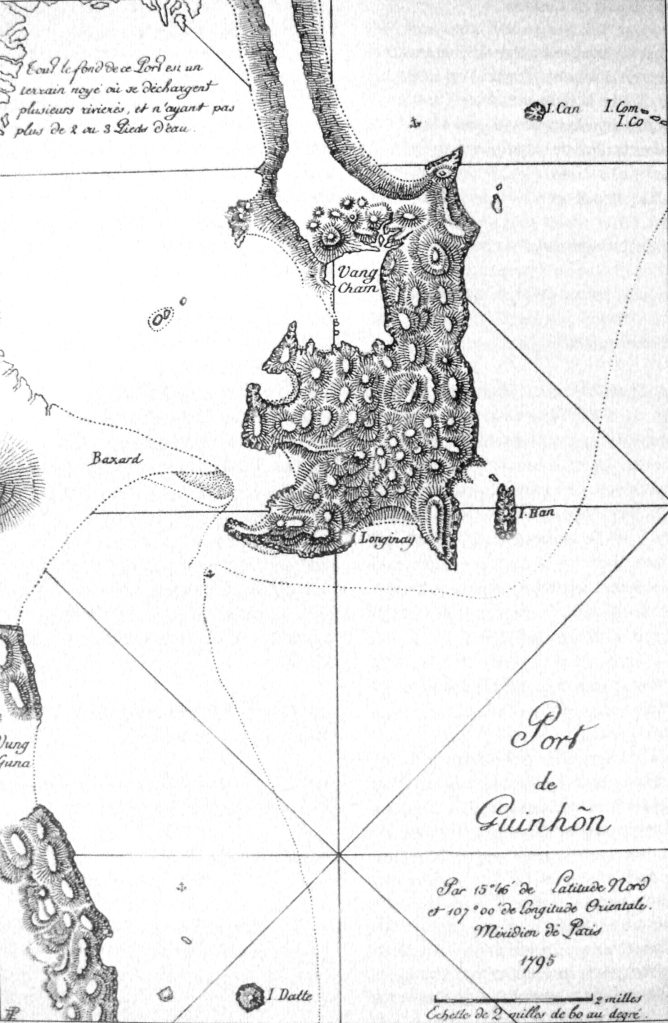
A decisive shift came in 1801, when Nguyễn Ánh captured the area after the Battle of Thị Nại and renamed it Bình Định, meaning “pacification” or “subjugation”. This was the name Minh Mạng later adopted when he elevated it to provincial status in 1832. Quy Nhơn, at its present coastal location, only emerged much later, officially established as Quy Nhơn Town in 1898 at the mouth of Thị Nại, likely because newer, larger ships could no longer navigate the lagoon. For most of its history, it made more sense for the port and administrative centre to sit further inland, a bias that still shapes travel today. The main railway line, for example, bypasses the city entirely, reflecting the fact that An Nhơn, not Quy Nhơn, was still considered the provincial heart when the line was built.
When it came time to say goodbye to Bình Định, I flew out of Phù Cát Airport, built by the Americans as a major wartime airbase near the then still-important town of An Nhơn. The long taxi ride out of Quy Nhơn city felt oddly more tolerable with a clearer sense of why the airport lies so far from the coast. As the plane took off, I looked down to see whether I could spot Bình Định Ward beside Phù Cát Ward, because contrary to what the lady at the expat bar had said, the name Bình Định is still used. The 2025 Bình Định Ward includes An Nhơn town, where the name was first used all those centuries ago.
 Eastward Ho!