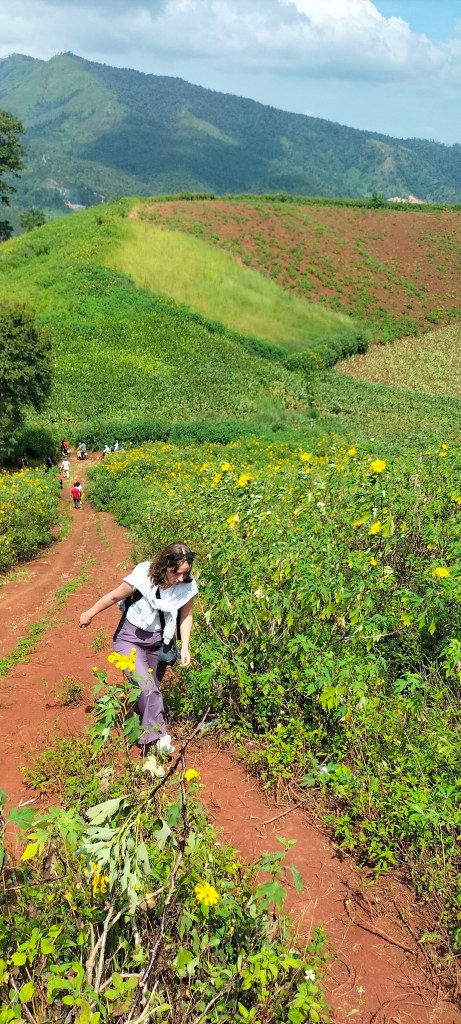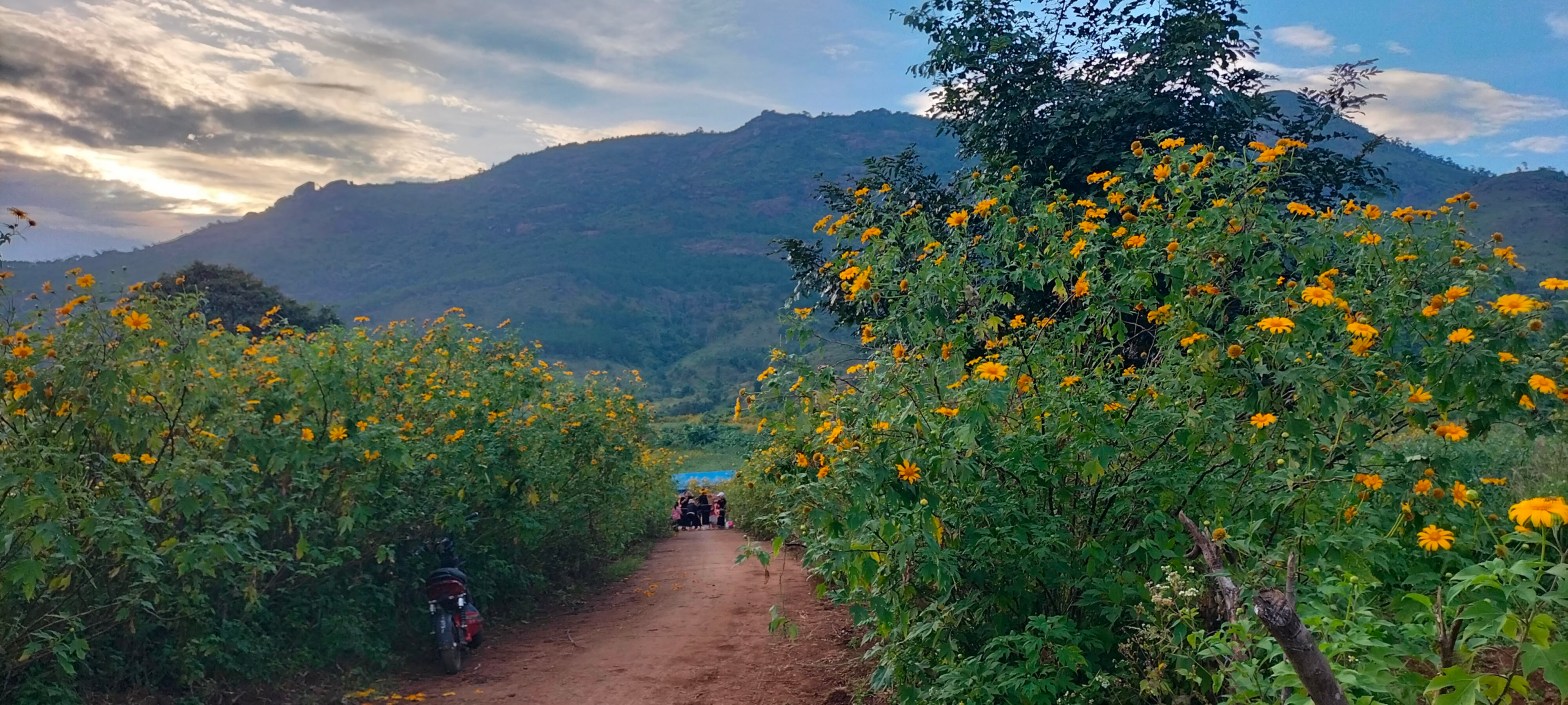

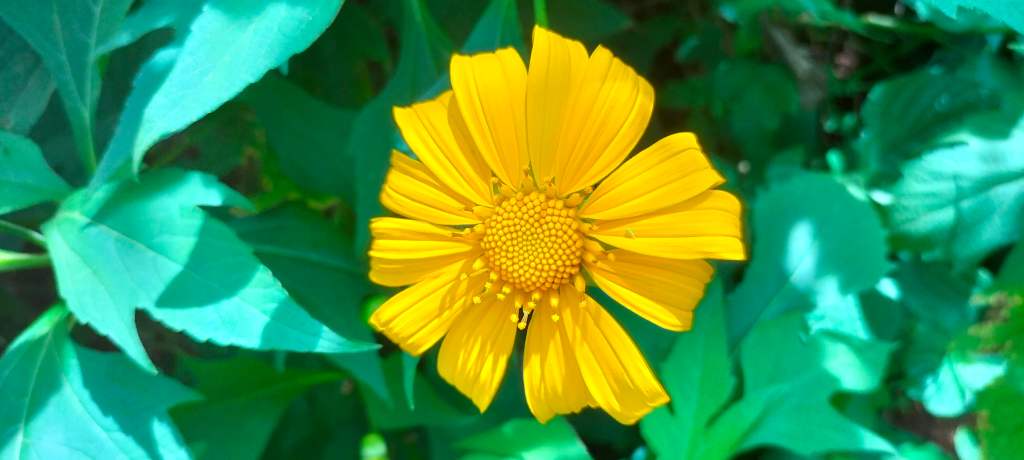
“Teacher Will!” a small voice calls out. I turn and scan the bustling crowd to see a group of my former students grinning and waving yellow flowers, dressed in striking black Jrai clothes with intricate brocaded trim. They’re selling dã quỳ wreaths, made from the bright yellow tithonia diversifolia flowers. The occasion? The annual Chu Dang Ya Flower Festival. Established in 2017 (source), this festival draws visitors from across Vietnam to witness the mountainsides bloom in early November, at the end of the rainy season.
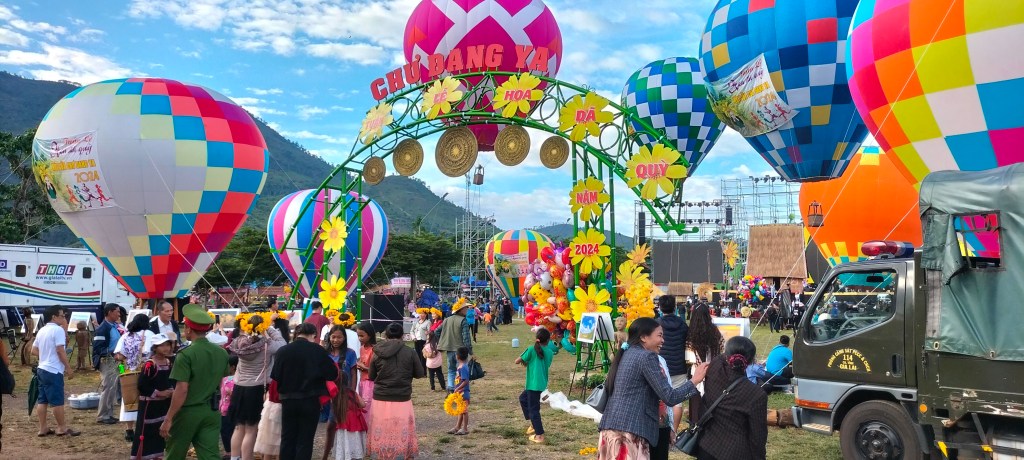
The girls are locals of the village that hosts the festival – a Jrai village about 20km north of Pleiku. They know me from the summer school I taught here this year. So of course, I buy a flower wreath. These flowers are so delicate that they start wilting almost immediately after they’re picked, so they have to work fast, making and selling the wreaths quickly before they fade. “Am I beautiful?” I ask them in Jrai as I put the wreath on my head. They laugh and assure me that I am.
My friends Jack and Jimmy, longtime expats, had different views about the festival’s authenticity. Jack described it as “a bit of a tourist trap,” while Jimmy had declared it “not worth the trip.” I decided to go anyway, having missed it during my four years in Pleiku (partly due to it being canceled during COVID), if only for something to write about. But as I walk through the grounds, I find something genuine in the community atmosphere. Despite the inevitable influx of outside vendors, I’m surrounded by familiar faces—some are my students and their families; others are friends who’ve come up from Pleiku like me. It reminds me of a village fête in England.
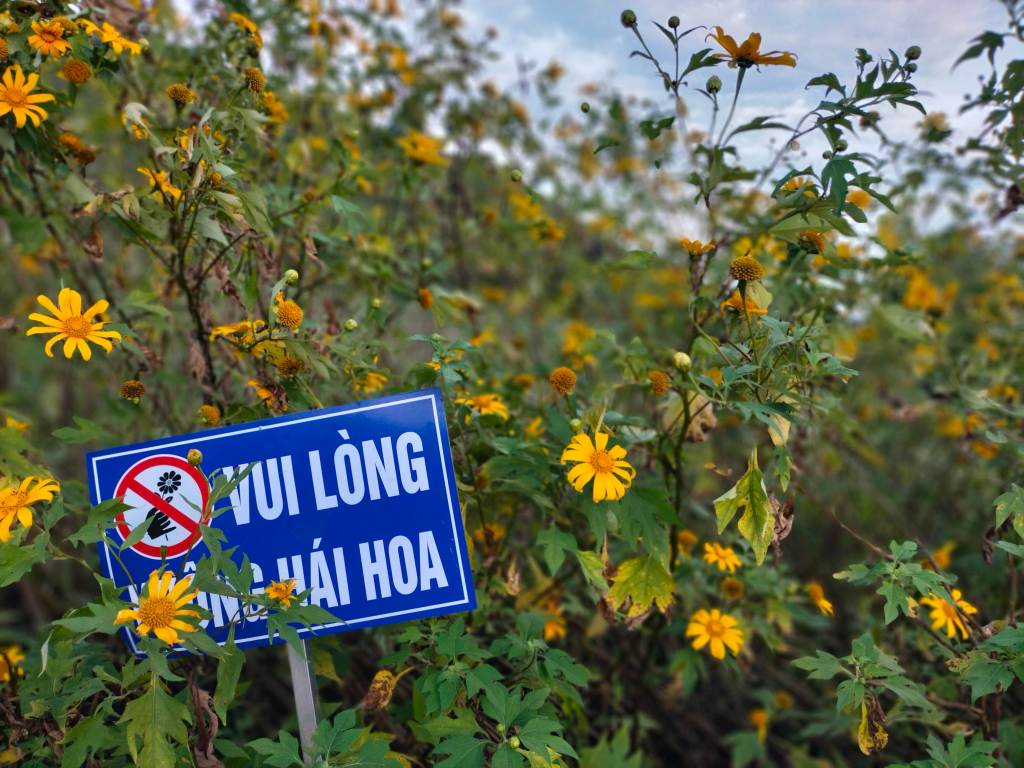
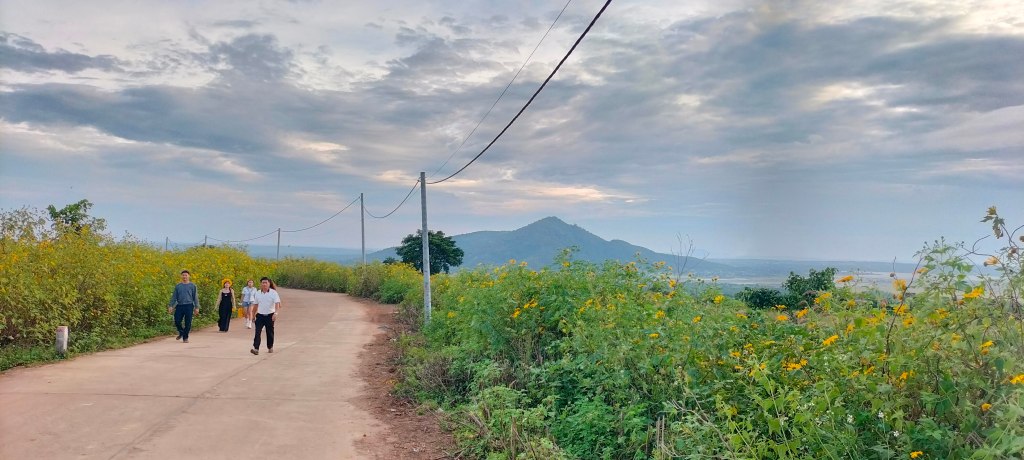
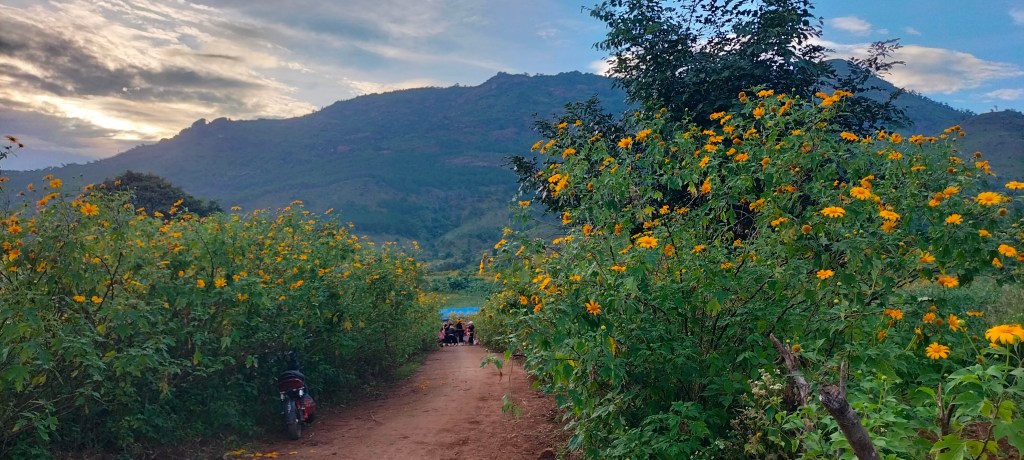
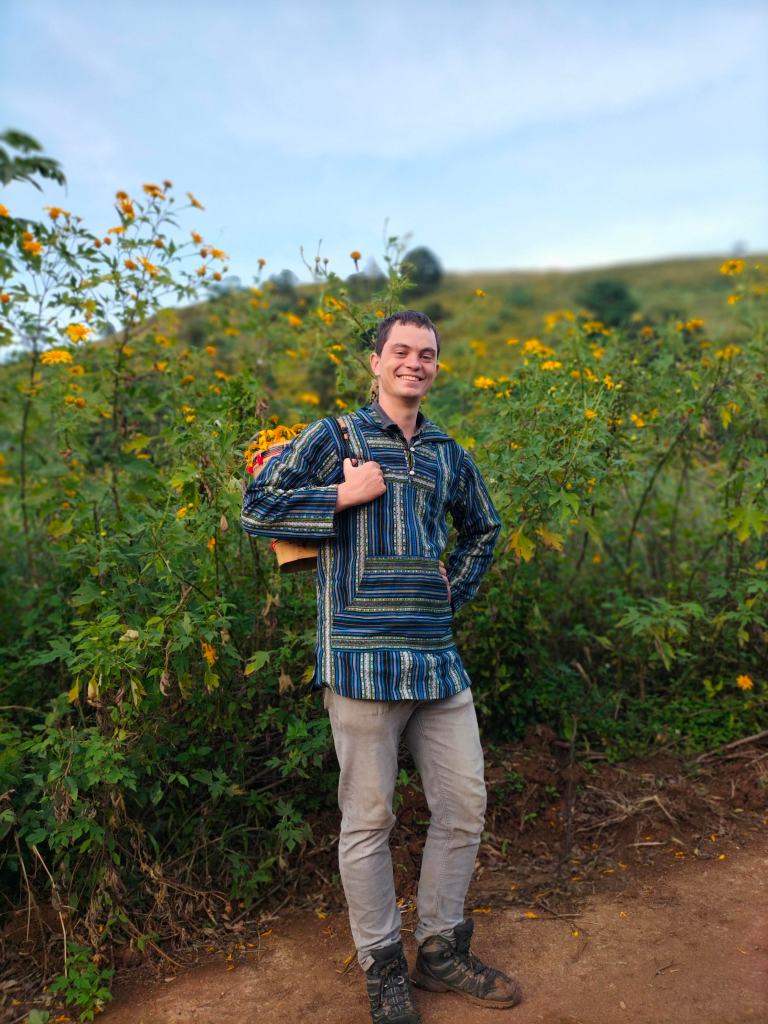
As I wander through the festival field with a large stage and up the winding road to the volcano there are hundreds of visitors taking taking portrait photos – this seems to be the main attraction for a certain type of visitor. People say that by the end of the festival, there are barely any flowers left on the plants as they’ve all been picked. However, for many locals the dã quỳ flower has become a symbol of Gia Lai province. Some expats have even gone as far as getting dã quỳ tattoos to commemorate their time in Pleiku. I don’t know how many people here know that the flower is not unique to Pleiku; Dalat even has their own Flower Festival which predates Pleiku’s (source). Although it is not native, the dã quỳ is a hardy flower and it has shown potential in raising the soil fertility in soils depleted in nutrients (source).
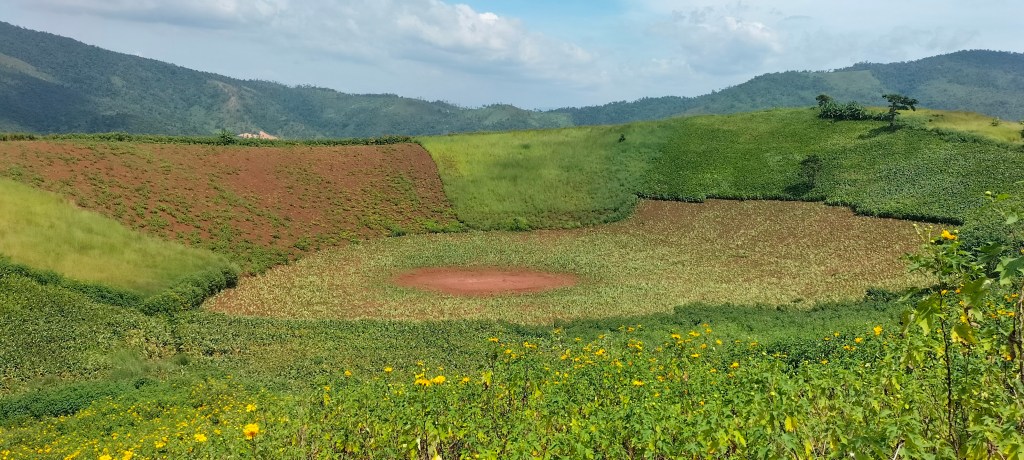
Though the city dwellers love the sight of the flowers, many rural locals are less impressed.
“Hoa dã quỳ … I used to hate them when I was little. It turns out now they are the tourist attraction. I hated the smell and the feeling when I touch them. And at the time we had those wild flowers everywhere. I didn’t appreciate it. I was into those fancy flowers I couldn’t touch.” – Helen Nguyen, friend of the author, 4/11/2024
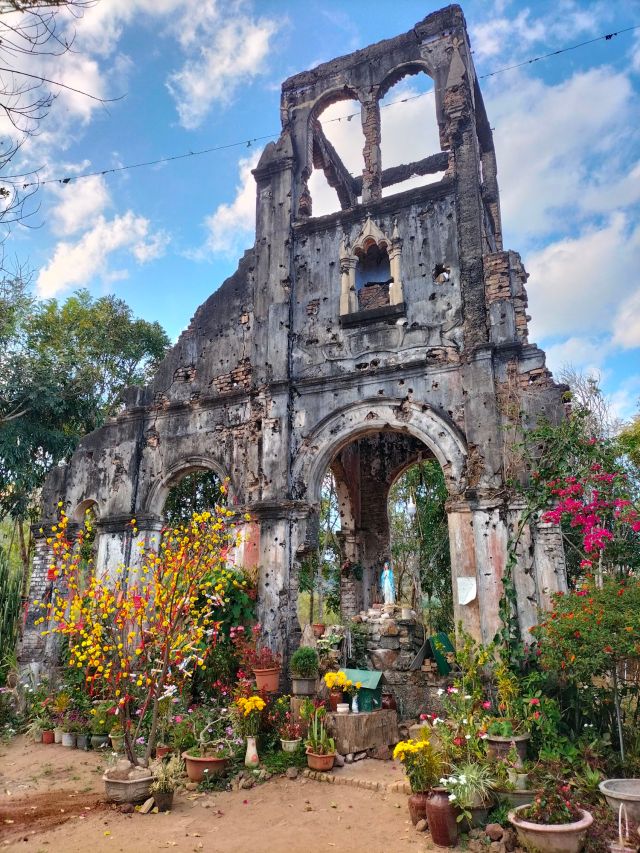
As well as researching the local flora, I’ve been looking into the local history lately too, with help from Brother Hiep, a local seminarian who helped me during the summer school. The village is important because it was the first Christian village of the Jrai people. According to the tale his mother would tell him when he was young (and supported by church records), the village was established by freed slaves under the guidance of French missionary Father Gabriel Nicolas (source). This seminal Christian community for the Jrai people became a refuge, the location chosen because of the ring of mountains that surround it – protecting the inhabitants from nearby slave-trading clans. Nicolas’s church, built in 1905, endured until it was destroyed in 1972 due to the war. Today, a single wall remains, serving as both a site for quiet Christian reflection and a tourist attraction.
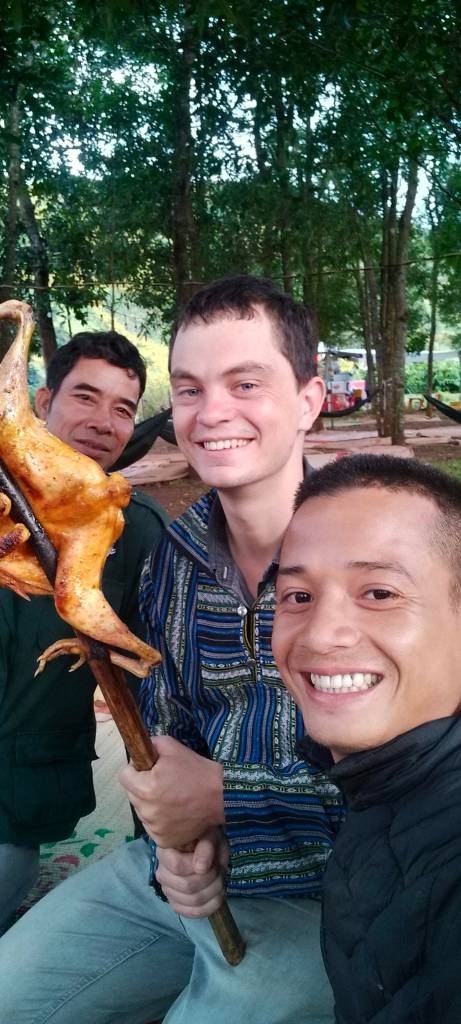
Eventually, between photo requests from Vietnamese holidaymakers and absorbing the festive buzz, I start to think about the one festive aspect I haven’t tried yet: the food. Before I can choose from one of the many food stalls, though, a group of locals sitting on a straw mat in an orchard waves me over to join them. I accept, joining them sitting cross-legged as they pour me a shot of rice wine in a shared glass, which they pass to the left, in the Jrai way. One man, dressed in an old Cambodian police jacket, insists on getting me a whole roasted chicken on a stick. I try to share it around, but he shakes his head, puts on a serious face, and says, “It’s only for you.” So I dig in.
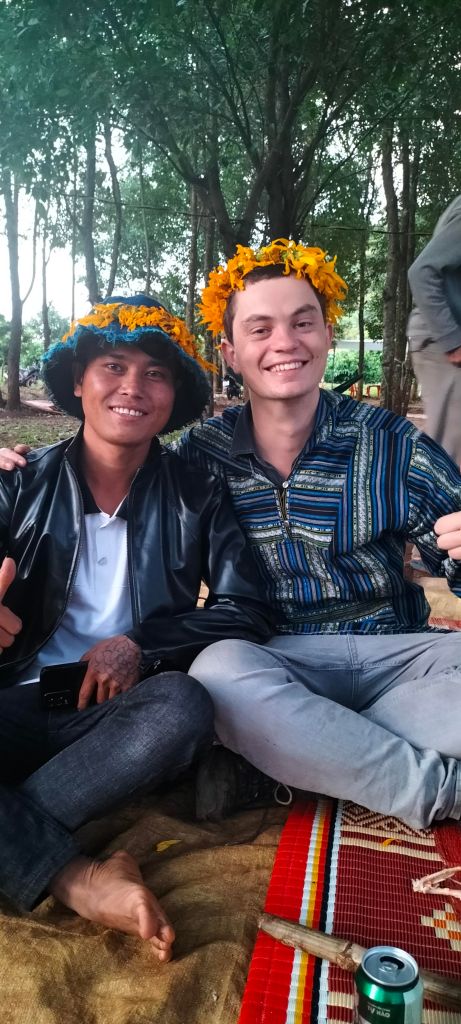
The men casually ask a few questions that make me wonder if I’m being tested—‘What’s the name of the priest again?’ or, ‘Did you see him today?’ (I hadn’t; he was away in Saigon for four days.) They relax a little, maybe satisfied that I am indeed a friend of the community, and I win more of their trust by using what few words of Jrai I know. The conversation turns to local history, and I seize the opportunity to ask about the nearby church ruins and the village’s origins. One elder, born in 1951, confirms how the village was originally a settlement for freed slaves. With limited access to resources, they had to be resourceful—flavoring food primarily with ginger, which covered the forested mountains and gave the mountain its current name, Chu Dang Ya, or “ginger mountain” in Jrai. I try to absorb the details, but some phrases are lost in translation, and I feel as though there’s still so much I don’t know. I do catch a bit about salt shortages and subsisting on monkeys and cassava leaves, a sobering lesson in the struggles these first settlers faced.
As the sun sinks behind the prominent peaks to our west, my host insists on packing me some sticky rice in bamboo to take home. He also insists on giving me a lift back down the slope by moped, rounding off my visit with much unexpected kindness. For all the opinions about the festival’s authenticity, the dã quỳ seems to me to be an apt symbol here—they fade quickly, but their roots are resilient, nourishing the soil. This festival may have its commercial aspects, but it’s also a time for the community to come together. For anyone considering a visit, I’d say go. It’s good for the community, and as far as experiences go, this one’s a festival I’d return to.