The performance felt inauthentic. The dancers moved in mesmerising synchronicity beneath psychedelic red and green spotlights while the audience watched with phones raised. The dancers wore white traditional clothes and headdresses. The over-produced pre-recorded music clipped occasionally as it blared from the speakers. It was a well-polished cultural show.
I felt that something was off and decided to walk out.
I had an instinctive feeling that it was disingenuous. I’ve travelled a lot since quitting my office job seven years ago and I’ve often found myself looking for experiences that felt authentic to me. There was probably some self-satisfaction in that too: the feeling that I was seeing the “real” culture while other tourists were getting a superficial version, designed to make money. I had never paused to reflect on what authentic actually meant to me and or considered that authenticity could have different meanings. Nor had I questioned my assumption that turning culture into something for sale was necessarily bad.
“Can’t wait to head back,” said the text, accompanied by an animated loop of a dancing cat. Cami was coming back to Vietnam for the first time in two years. She had previously spent time in Pleiku on a work placement, where she became part of the group of expats and English speakers in the small provincial city. Now she was returning for a holiday, and at the same time, Independence Day had given me a five-day weekend. I wouldn’t be able to make it up to Pleiku so we agreed to meet in Đà Nẵng — a beach city in central Vietnam.
I spent five years living in Pleiku and it still shapes nearly my entire social life. And so even in Đà Nẵng, me and Cami met an old Pleiku friend Austin, and his partner Tien.
“Where are you from?” Tien asked Cami as we tucked into Greek food for lunch.
“Oh, I’m from Sarawak in Malaysia,” Cami replied.
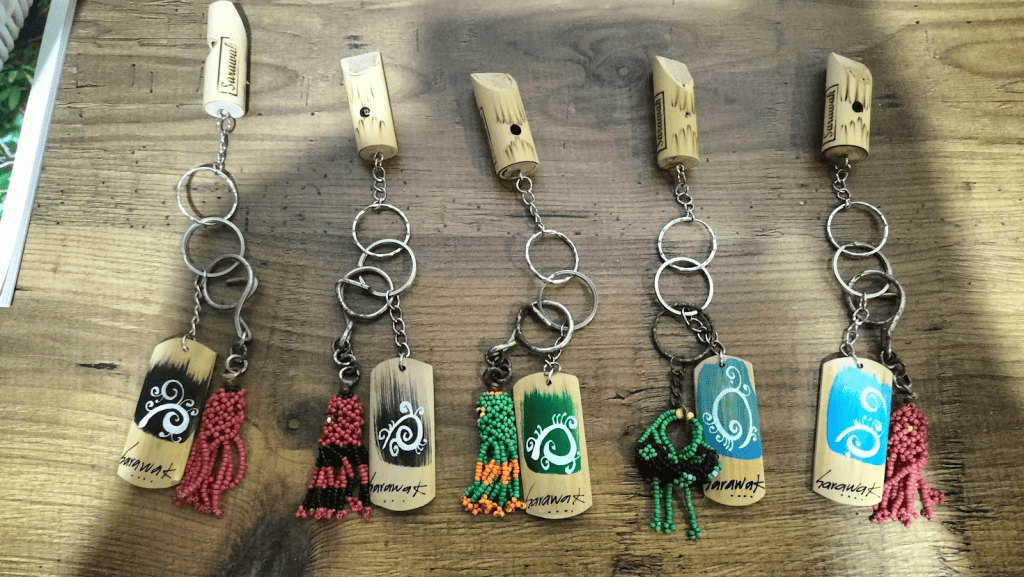
Tien’s face showed a spark of recognition. She picked up Austin’s keys from the table. Hanging from them was a whistle like a PE teacher might have but made from bamboo, on it was the word Sarawak.
“Where did we get this?”
I reminded her that it was a gift from me. I’d picked it up when I’d visited Cami in Kuching earlier in the year. I gave several of them out to my Pleiku friends.
Cami explained to us the cultural significance, including that the whistle was inspired by bird-call whistles used in Sarawak — a traditional craft.
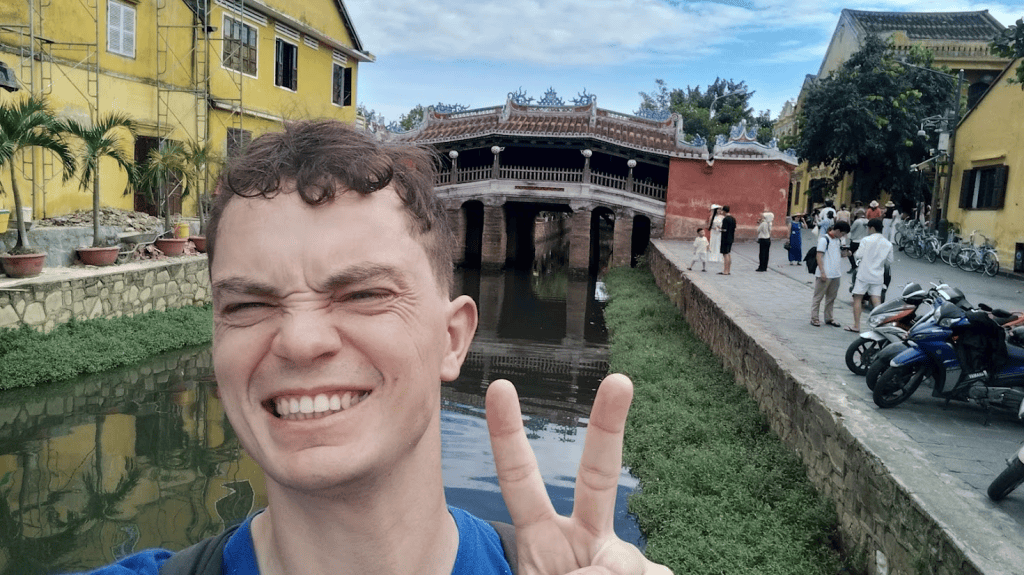
Cami and I spent a day in nearby Hội An, a UNESCO world heritage old town. We failed at bargaining down the prices for souvenirs, Cami got chopsticks for her parents and we both bought fridge magnets for full price. Looking around one old town house, Cami read the Chinese characters carved into the old buildings for me, making use of her impressive language skills. It helped me experience the place differently than if I’d been travelling alone.
At one point we came across an exhibition of photographs of Vietnamese ethnic minorities. We wandered through rooms gazing at the photographs of ethnic children and elderly people who silently stared back. Each piece was accompanied by an explanation by the French photographer, telling us what we were looking at.
It was interesting to discuss this with Cami, who identifies as Melanau, an ethnic minority in Malaysia. The exhibition even featured photos and clothes from ethnic minorities in Pleiku. We agreed that we felt the exhibition was not particularly empowering for the peoples it featured.
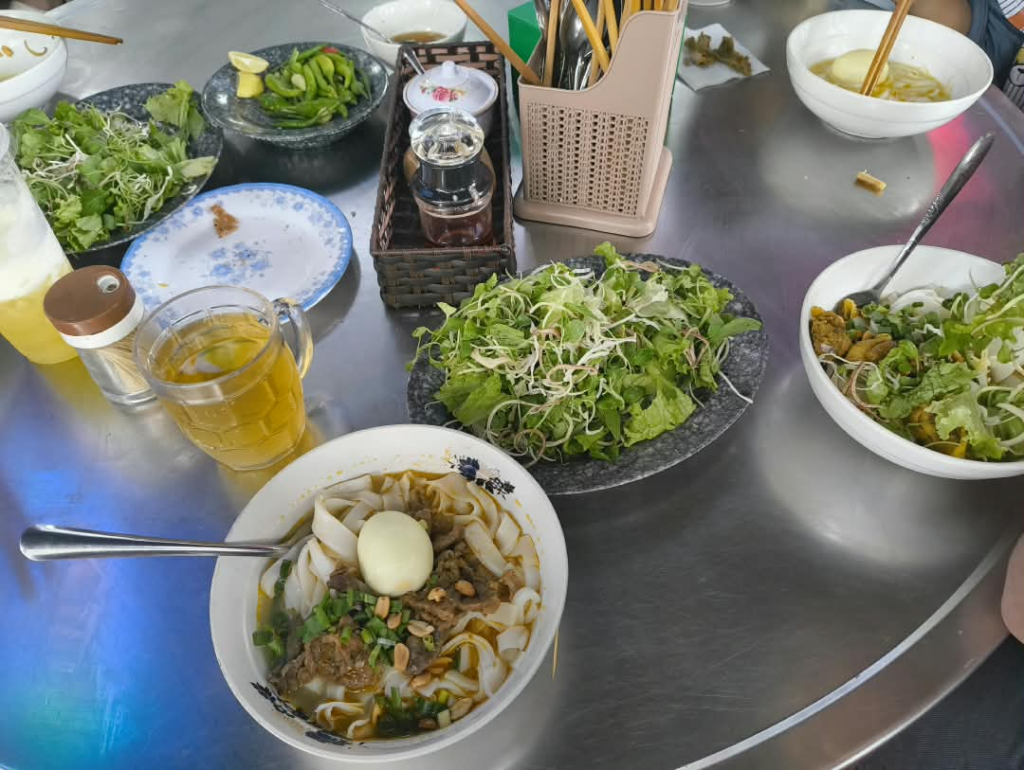
As well as seeing the usual sights, we tried a variety of foods. I looked up what to eat in Vietnamese, figuring that doing so would show us authentic Vietnamese food rather than dishes catering to western tourists that would dominate search results in English.
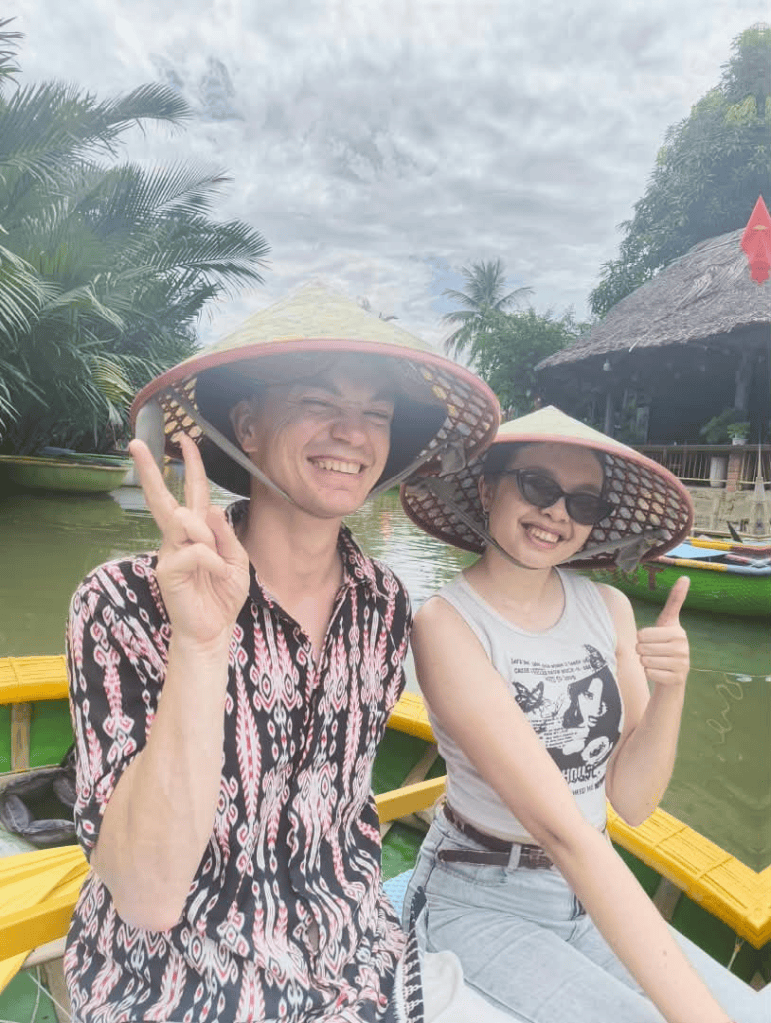
We took a trip to ride the basket boats through the nipa palm forest. Basket boats are small round coracles you can find on beaches around Vietnam’s coast used for fishing. However, I would later describe the Hội An experience to Austin as being like a funfair back home; you are taken from person to person, each trying to separate you from some money, one person will spin your basket, another stands on a coracle and serenades guests with a Chinese pop song. There are even people selling drinks from boats. The boatman reminded Cami to keep her arms inside the vehicle at all times. Cami said nipa palms reminded her of home. Near her village they have to avoid the nipa forest because it’s home to crocodiles.
The next morning, I was on my own: Cami had flown home and Austin was preparing for the new school year. So, I took a motorbike and tore out of Đà Nẵng and headed inland down winding country lanes towards Mỹ Sơn, a UNESCO World Heritage site.
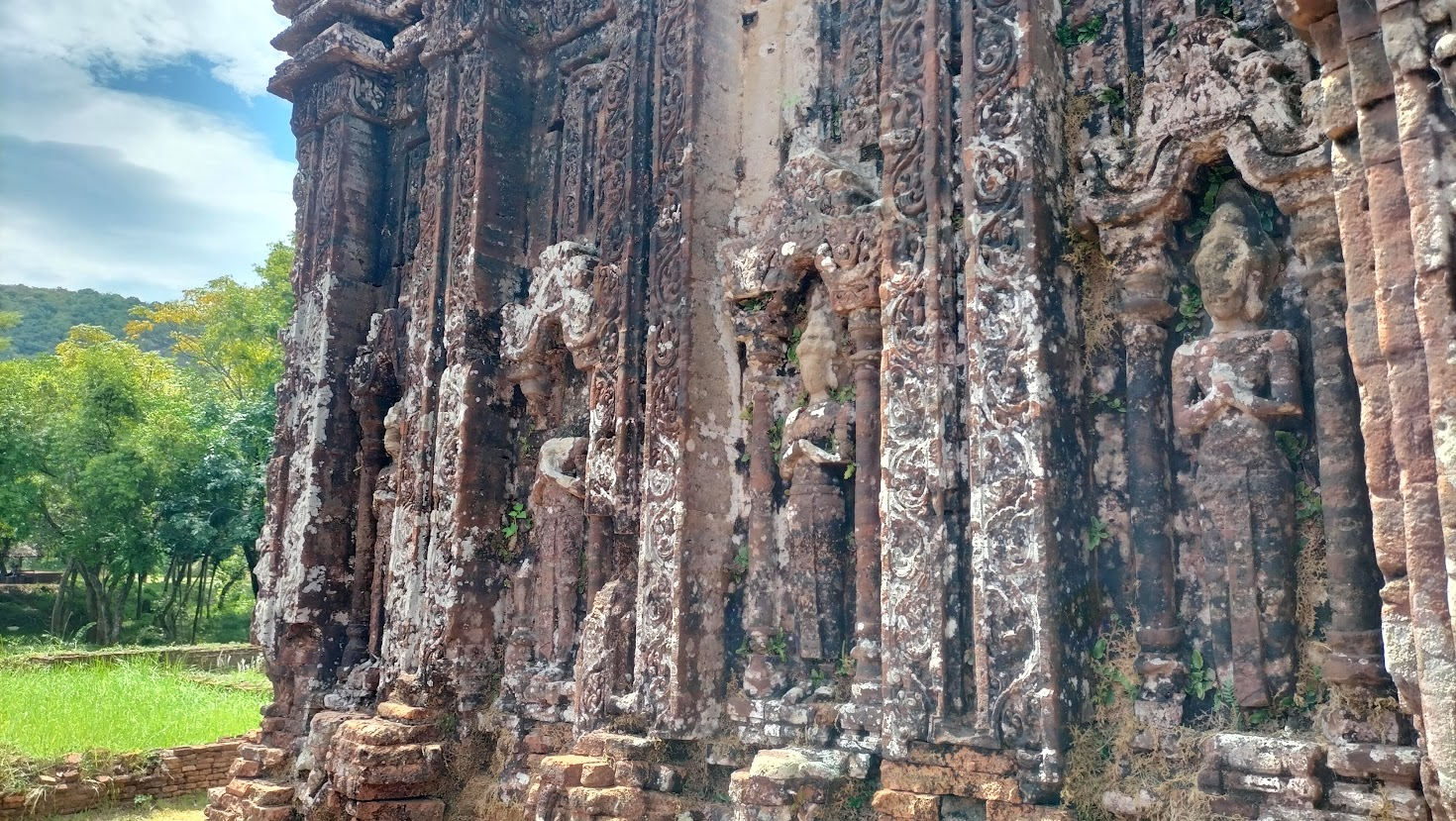
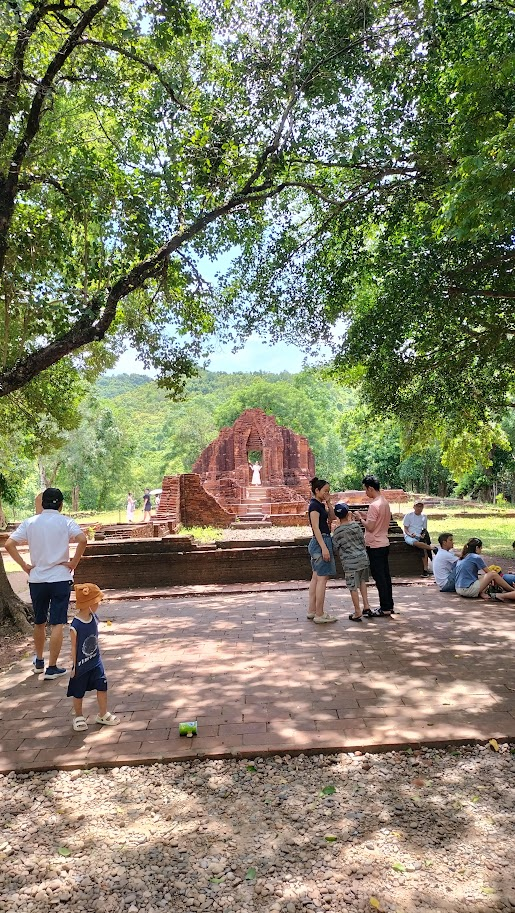
Mỹ Sơn is one of Vietnam’s main tourist attractions and one of the most sacred sites of the Cham civilisation. The ruins are scattered around sparse woodland, connected by paths winding past trees and streams. I parked up, bought my ticket and climbed onto an electric shuttle bus.
I’ve visited quite a few Champa sites around Vietnam, and the individual towers weren’t the largest, most well-preserved or most ornate I’d seen. What was impressive was the way Mỹ Sơn kept unfolding. One cluster of ruins gave way to another, then another beyond that. Some of the buildings showcased intricate carvings displayed inside. I thought about how people had carved such elegant, curving letters into the hard stone. I imagined the nerves of the craftsperson reaching the final letter of a long stele, knowing that making a mistake would mean having to start again.
At one point I overheard a group of Indian tourists exclaiming to their tour guide:
“It doesn’t look Chinese.”
It’s easy for me to forget that not everybody knows as much as me about the history of South Vietnam. Not everybody knows that this land was once a country with its own language and followed diverse religious traditions including Hinduism. The moss-covered, orange brick temples are more similar to Angkor Wat than anything you can find in Hà Nội.
Before reaching the main cluster of temples, I came across a pavilion hosting a cultural dance performance.
I started to wonder what I was actually watching. Were these dances traditionally performed by Cham people, and what had they meant in their original context? Had something been taken from that context and reshaped for tourists? The performance didn’t fit my expectations of what I’d find at the archeological site. These questions were going around in my head as I walked away from the performance to examine more mossy brickwork.
By the time I left Mỹ Sơn, I was thinking about my own experiences of travelling and the places where I had felt that I had encountered something more authentic. Maybe it was because of Cami’s visit, but Sarawak kept coming back to me.
I’d spent time there earlier that year, including visiting Cami in Kuching, and some of the cultural experiences there had felt very different from what I’d just encountered in Vietnam. Was Sarawak actually more authentic, or had I simply recognised it as such because it matched my own expectations of what an authentic cultural experience should look like?
I started looking for some answers. I found a 2023 book by scholar Quảng Đại Tuyên, whose discussion of Cham tourism seemed to confirm my suspicions. He argues that traditional rituals can lose their meaning when they are removed from their proper time, place and ritual order for tourists.
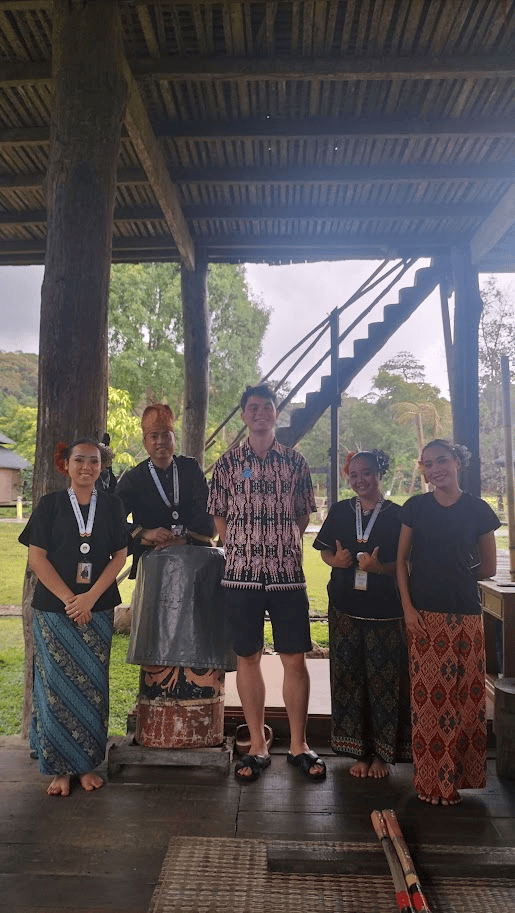
I reached out to a teacher I met in Sarawak, Win, for her opinion. In her village, which isn’t a tourist destination, she felt that traditional culture had largely disappeared. In other villages, tourism had given people a reason to continue practising and promoting their traditions. “If it’s not Gawai season,” she text me (Gawai is a famous harvest festival), “the villagers will only present the tourists with welcoming dance and serve them traditional food.”
She continued “When it is Gawai season, then the villagers will show the tourists how they celebrate Gawai just like back in the old times. This includes Gawai marching, some rituals, traditional performances, feasts, etc. The original tradition mostly shown when there is a traditional festival going on. Other than that, they live normally.”
British academic Stroma Cole has done work on tourism and ethnic communities. Cole argues that tourism can foster cultural pride, identity and political influence. In some circumstances, tourism may not simply be something done to a culture, but something communities can use to their advantage.
I also came across the book Ethnic and tourist arts by Nelson Graburn which describes the evolution of traditional art into souvenirs which must be cheap, portable and easy to understand. However Graburn describes that some people still buy traditional fine arts which are considered more authentic as status symbols. I thought about the little bamboo whistle I’d bought in Sarawak.
There are a lot of must-see destinations in Vietnam I’ve still not seen after seven years here. I get gently teased at work because every break, while everyone else is heading off to explore somewhere new, I usually return to Pleiku. I’ve still never been to Hạ Long Bay, Phong Nha or Ninh Bình.
There was a time when I’d have said I knew the authentic Pleiku. Because I have friends in the ethnic minority groups, I have many times in my five years there been invited to peek behind the curtain, to see parts of people’s lives that aren’t on any tourist itinerary. But the more I think about it, the less comfortable I am with making a judgement about what kind of tourism is “real”. What can someone reasonably expect to experience on a short visit? Maybe a cultural experience adapted for tourists isn’t necessarily worthless. It helps the local economy and gives people a reason to keep practising and presenting traditions that might otherwise disappear.
I think the important question is who gets to decide how that culture is presented. Is it a French photographer passing through or is it the people themselves?
I did have a lovely time in Đà Nẵng and Hội An. I will probably eventually visit Hạ Long Bay and Ninh Bình. And I’m keen to return to Sarawak during Gawai. And I’ll probably buy some little souvenirs to bring back for my friends in Pleiku.
As I sit writing this, I open a drawer and dig out the little bamboo whistle and give it a little toot.
References
- Cole, Stroma. “Beyond authenticity and commodification.” Annals of tourism research 34.4 (2007): 943-960.
- Graburn, N. H. (Ed.). (1979). Ethnic and tourist arts: Cultural expressions from the fourth world. Univ of California Press.
- Tuyen, Q. D. (2023). Heritage Conservation and Tourism Development at Cham Sacred Sites in Vietnam : Living Heritage Has A Heart (1st ed. 2023.). Springer Nature. https://doi.org/10.1007/978-981-99-3350-1

