
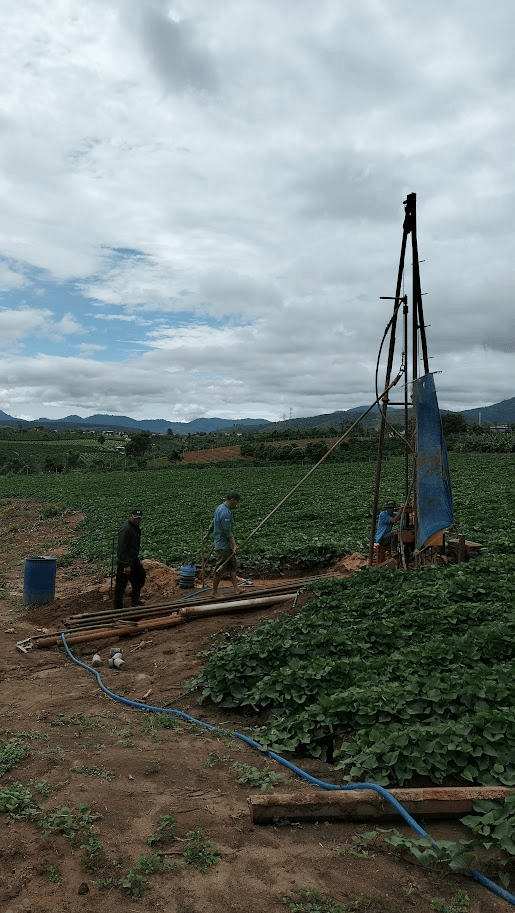
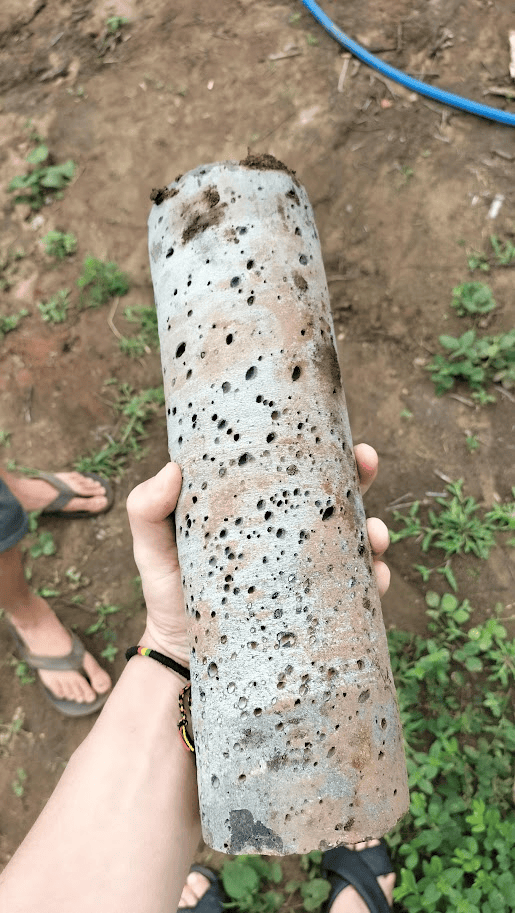
The drill rig was put-putting in a field of sweet potatoes when Kevin picked up a cylinder of rock and handed it to me. It was surprisingly light, full of little air bubbles from the volcanic rock. A hired team were drilling for water deep below the surface. This July, I had wanted to escape Ho Chi Minh City and get some friends together for my birthday in the cool high-altitude province of Gia Lai that I called home for 5 years. But Kevin said that with a young child and another on the way he couldn’t leave the farm, but invited me and Jack to head out to him instead; so we did. The farm sits on the slopes of a green valley east of Pleiku City, were the Ayun River winds past the foot of a jungle-covered massif.
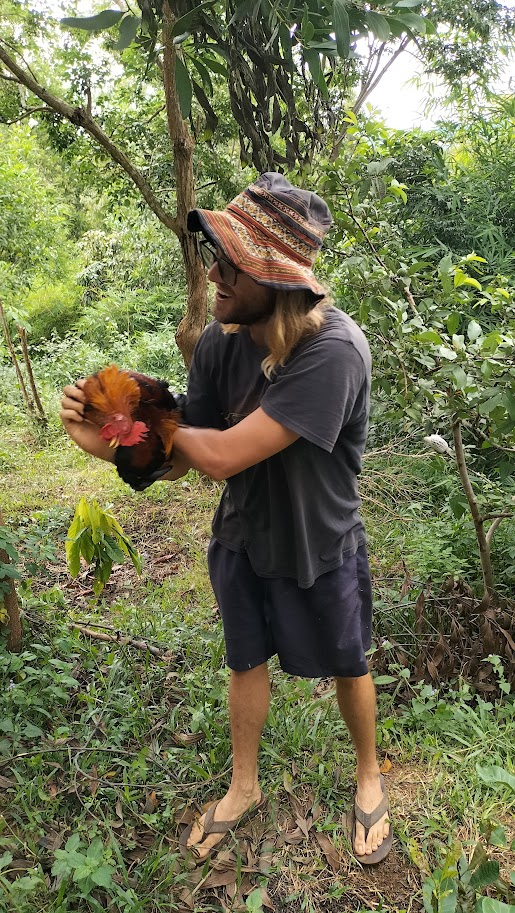
Kevin and Trinh are great hosts. Despite being pregnant, Trinh kept us well fed, while Kevin kept the drinks flowing; from locally made kombucha to traditional Vietnamese rice wine infused with various ingredients, including some less conventional ones… For my birthday dinner, we had chicken. More specifically, we had chicken that had been running around Kevin’s farm until Jack had caught it.
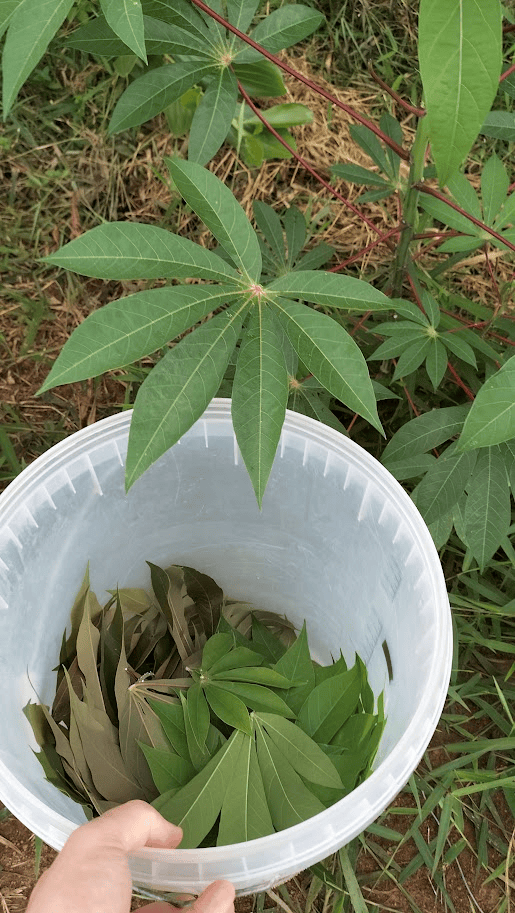
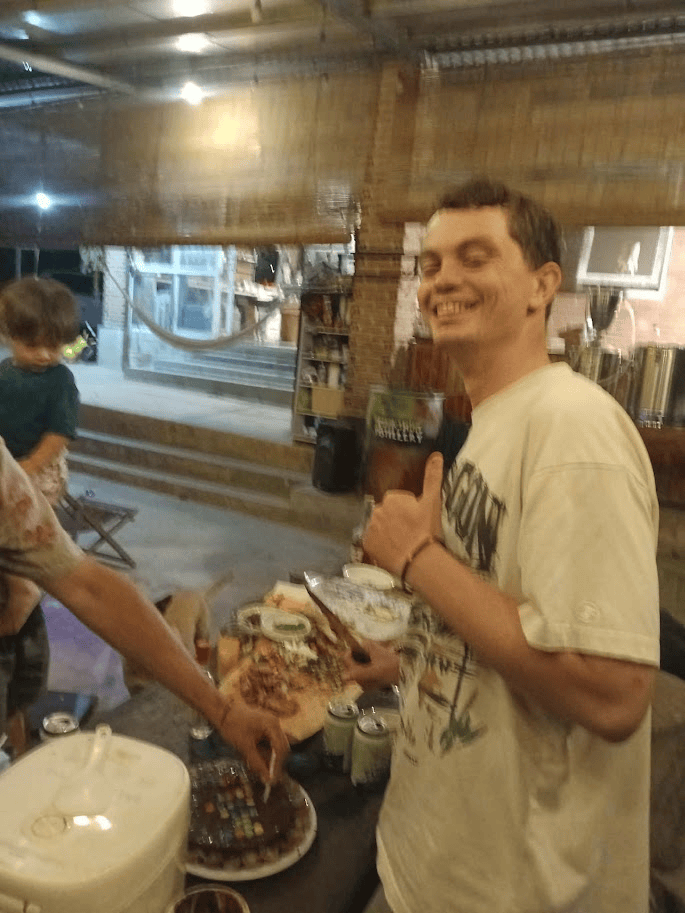
Kevin also gave us jobs to do around the farm. One day we picked cassava leaves for lá mì, a traditional local dish made by boiling the leaves. Another, Jack and I picked passionfruit. As we were working, I brought up a favourite topic of the millennial generation: post-apocalypse survival strategies. I remarked that Kevin’s setup was very well placed for the next societal collapse. There was food, water, firewood, Kevin’s impressive ability to make things.
“What would your job be in a post-apocalypse scenario?” I asked Jack.
“Definitely cooking,” he replied.
That seemed like a pretty good answer. I didn’t have one of my own. I always feel particularly useless when we visit Kevin. And I’m not a very good cook. I lack the hands-on skills that would be important if the system I take for granted disappeared. I have a degree in mathematics. I suspect it would be of limited use if I suddenly found myself living in an agrarian society.
I tried to imagine explaining my education to a group of children sitting around a campfire after society had collapsed. I remember one exam question in the module on fluid dynamics started: “The Discworld is a flat disc on the back of four elephants, on the back of a turtle in space…”
At university I thought I knew what useful knowledge looked like. “Underwater basket weaving” was an expression we used for a course we didn’t think was particularly valuable. We felt that maths, science and engineering were “real” subjects and a lot of others weren’t.
I’m now older and less willing to make that kind of judgement. I can count on one hand the number of times that things I learned at university have come up outside of academic mathematics. You could argue that I learned to solve logical, systematic problems; skills I would later use in my role as a programmer and while working in a bank. But I’m not sure what value that added to society.
Perhaps this is why the first assignment of my current university course, a PGCEi, has been bothering me so much. It asks a deceptively simple question: what is the aim of education? Is it to prepare students for work, to pass on culture and knowledge, to help them live happy lives, or something else entirely? The more I think about it, the more the question send me spiralling down rabbit holes.
Thankfully, to procrastinate on difficult assignment writing, I can misuse my access to the university library to dig deep into things that interest me like the culture of Gia Lai. I lived in Gia Lai for five years and have several Bahnar friends and past students. One paper I found by Trần Hoài, A Bên, A Hung, Đỗ Trường Huy, and K. David Harrison (2024) is about the basketry of the Bahnar minority people, and it turned out to be fascinating. The paper is available here, so if you have any interest in Bahnar culture or language, I recommend giving it a read. Baskets are an important part of Bahnar culture, but not because people lack access to alternatives. It’s certainly easy enough to go to any market in Gia Lai and buy a plastic tub. But, as Trần Hoài et al. (2024) explore, making and using baskets has cultural significance, as it does in many cultures around the world. I was also interested to hear some of my friends’ perspectives when I talked to them about it.
Following the references from that paper led me, somewhat unexpectedly, back to mathematics. Beyond the Basket Case (Martin, 2018) explores how differential geometry can be used to model woven structures. I studied differential geometry during my bachelor’s degree. Apparently, I studied theoretical underwater basket weaving, and never even learned how to make a basket.
A GiaLaiTV report on Bahnar culture in Kbang includes the following song:
Anh đã giỏi đan cái gùi
He can make a basketmà anh không giỏi về đánh đàn
but he can’t play musicthì em là con gái, có thương anh
so if I, a maiden, love himcũng không ưng cái bụng cả đời em cho anh.
I still wouldn’t give my life to him.
On the surface, the song seems to be disparaging of basket-making skills. A man might be able to make a basket, but if he can’t play music, that isn’t enough to make him husband material. However, the way I see it, the assumption made by the song is that basket weaving is equivalent to being capable and dependable, of having something useful to contribute.
Our use of “underwater basket weaving”, on the other hand, rested on a very different assumption. We used it to describe a subject as pointless, because we had tacitly decided that basket-making was less valuable than doing maths or science.
Our ideas about what counted as achievement had been shaped by the British education system. Do well at school, get into a good university, preferably a red-brick one, and then get on a graduate scheme. That was what success looked like; that’s what education was for. Maths and science were “real” subjects; basket weaving was a joke. But perhaps that idea of education doesn’t hold water.
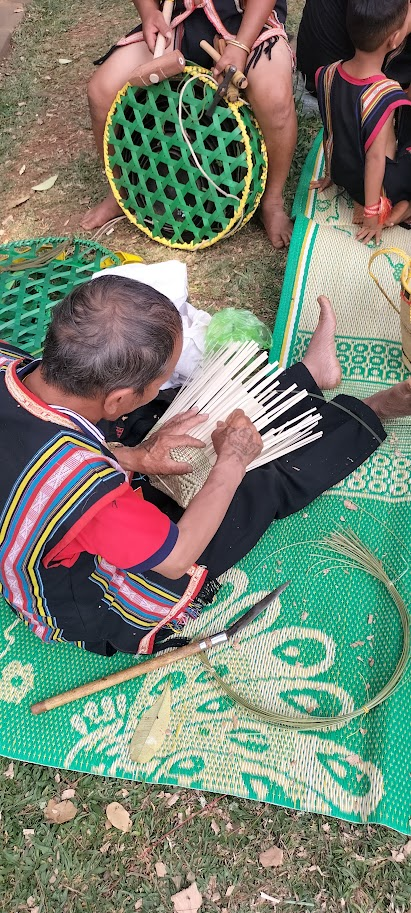
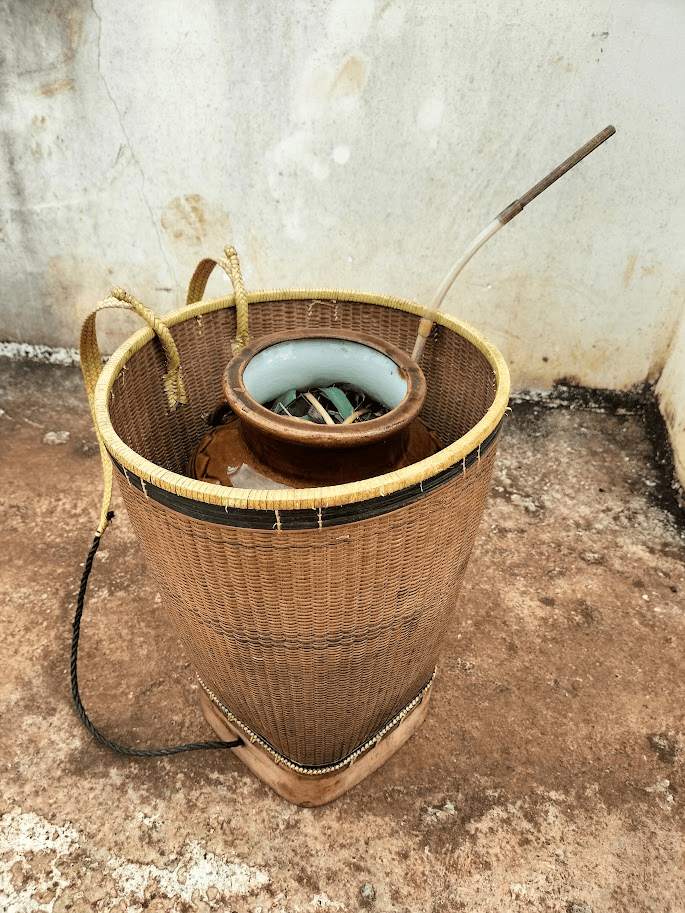
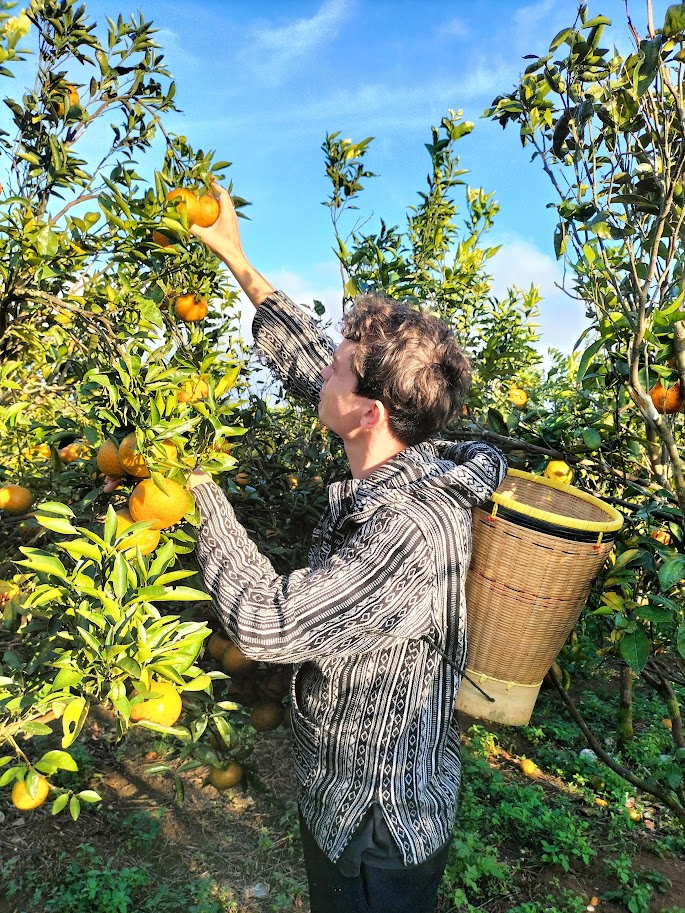
I’m writing on an overcast Monday in August. Yesterday, I took the two new colleagues, who will be teaching maths, to the Saigon History Museum. They are new in Saigon and still finding out about their new home. For me, though, I wanted to look at the collection of baskets from Gia Lai.
After wandering around the museum, we went to the pub, where they talked about their degrees and the world of work at hedge funds and other “City” jobs. How much has their formal education shaped their worldview? Meanwhile, my mind had drifted elsewhere. I think I’ve finally decided what my post-apocalypse skill will be. I’m going to look for a course on basket weaving, underwater or otherwise.
References
- GiaLaiTV. (2024, August 15). Tìm về khúc hát dân ca của người Tây Nguyên. GiaLaiTV. https://gialaitv.vn/tim-ve-khuc-hat-dan-ca-cua-nguoi-tay-nguyen/
- Martin, A. G. (2018). Beyond the basket case: A principled approach to the modelling of kagome weave patterns for the fabrication of interlaced lattice structures using straight strips. https://www.academia.edu/download/89868847/AAG2018_Ayres_et_al_BeyondTheBasketCase.pdf
- Trần Hoài, A Bên, A Hung, Đỗ Trường Huy, & K. David Harrison. (2024). Baskets of wisdom: Bahnar basketry, folk taxonomies, and the maintenance of upland environmental intelligence in Vietnam. Sociolinguistic Studies, 18(3–4), 433–466. https://doi.org/10.3138/ss-18-3.4-0006


interesting perspective on modern western educational paths… let’s see what Andy Burnham is planning for us?
LikeLike