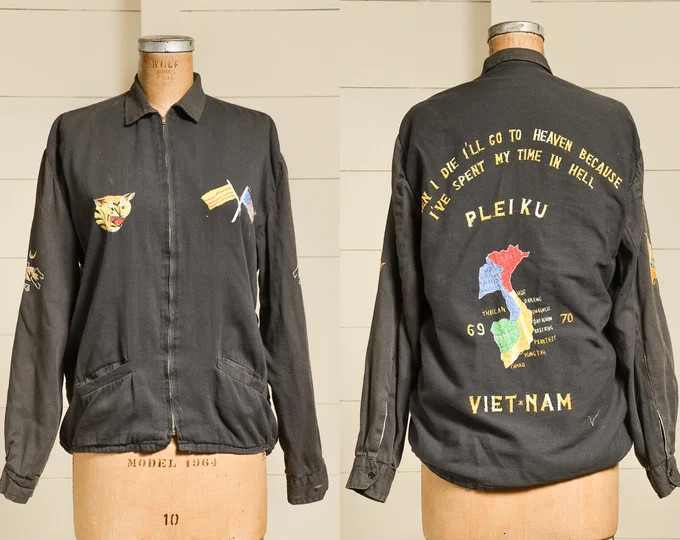
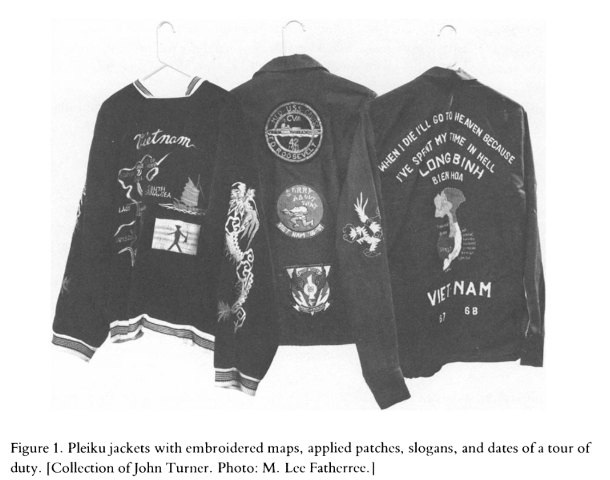
The history of the type of jacket called a “Pleiku Jacket” starts in the aftermath of the Second World War. At that time, the remnants of parachute capes found new life as they were transformed by American soldiers into what came to be known as souvenir jackets. These jackets, inspired by baseball jackets of the time, often showcased intricate Japanese designs, reflecting the cultural exchanges of the era – dragons and tigers were particularly popular.
This trend continued through the Korean and Vietnam Wars.. It was here in Pleiku that these jackets truly made their mark. Handmade by skilled Indian tailors, these creations became known all over Southeast Asia as Pleiku Jackets. Not only did they put the small town on the map but also left a lasting impression on the culture of the Vietnam War, both in Vietnam and back in the United States.
“One of the most visible forms of material culture of the GI experience in Vietnam were the embroidered jackets known as “Pleiku” jackets – decorated jackets featuring dragon designs, stylized maps, flags, eagles, and verses. Decorated “tour” jackets, whether they be “Pleiku” jackets (names for the established practice of making these jackets in Pleiku, Vietnam) or decorated working jackets worn by sailors, were visual testaments to membership in both a branch of service and a distinct smaller unit.”
“Souvenir jackets were not only made for GIs to wear; children’s sizes were also produced. Decorated with city names, with the dates of a tour of duty, a map of Vietnam, and with American and Vietnamese flags, these silk jackets carried the words, “My Brother is in Vietnam.” Sent home to younger brothers, these jackets appeared on playgrounds during the wartime years – although they were rarely worn due to the antiwar sentiment at home”
source: C. KURT DEWHURST The Journal of American Folklore Vol. 101, No. 399 (Mar. 1988), pp 48
“the almost universal slogan on tour jackets, “When I die I’ll go to heaven, because I’ve spent my time in hell,” followed by the city in which one served and the years of one”
source: STEPHEN SOSSAMAN, The Journal of American Folklore, Vol. 102, No. 403 (Jan. – Mar., 1989), p. 76 (1 page)
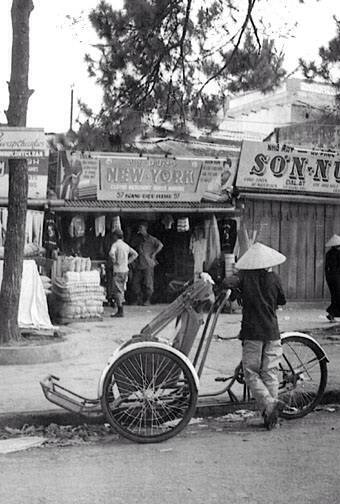
Soldiers browse the Pleiku Jackets for sale at “New York”
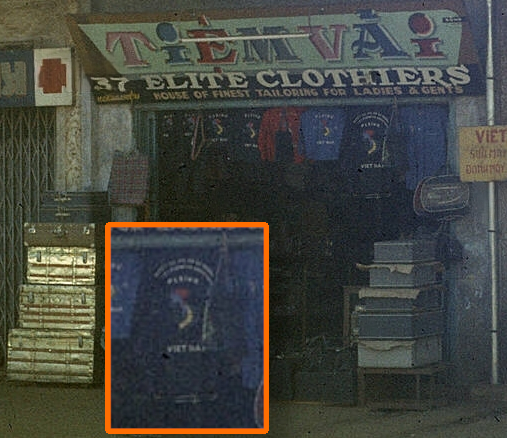
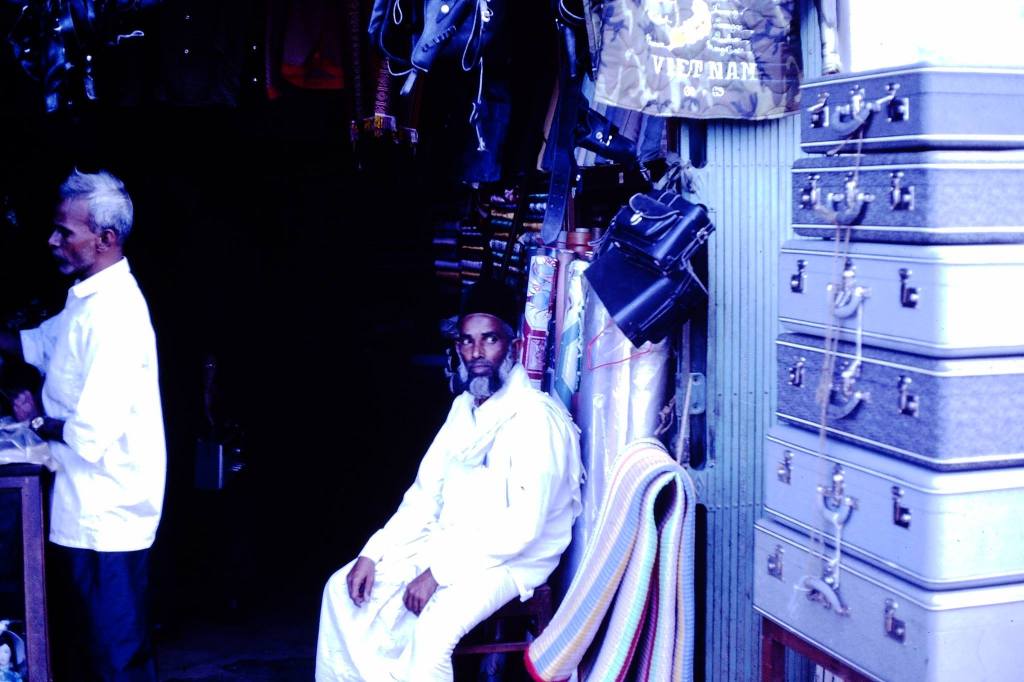
Indian Tailors of Pleiku
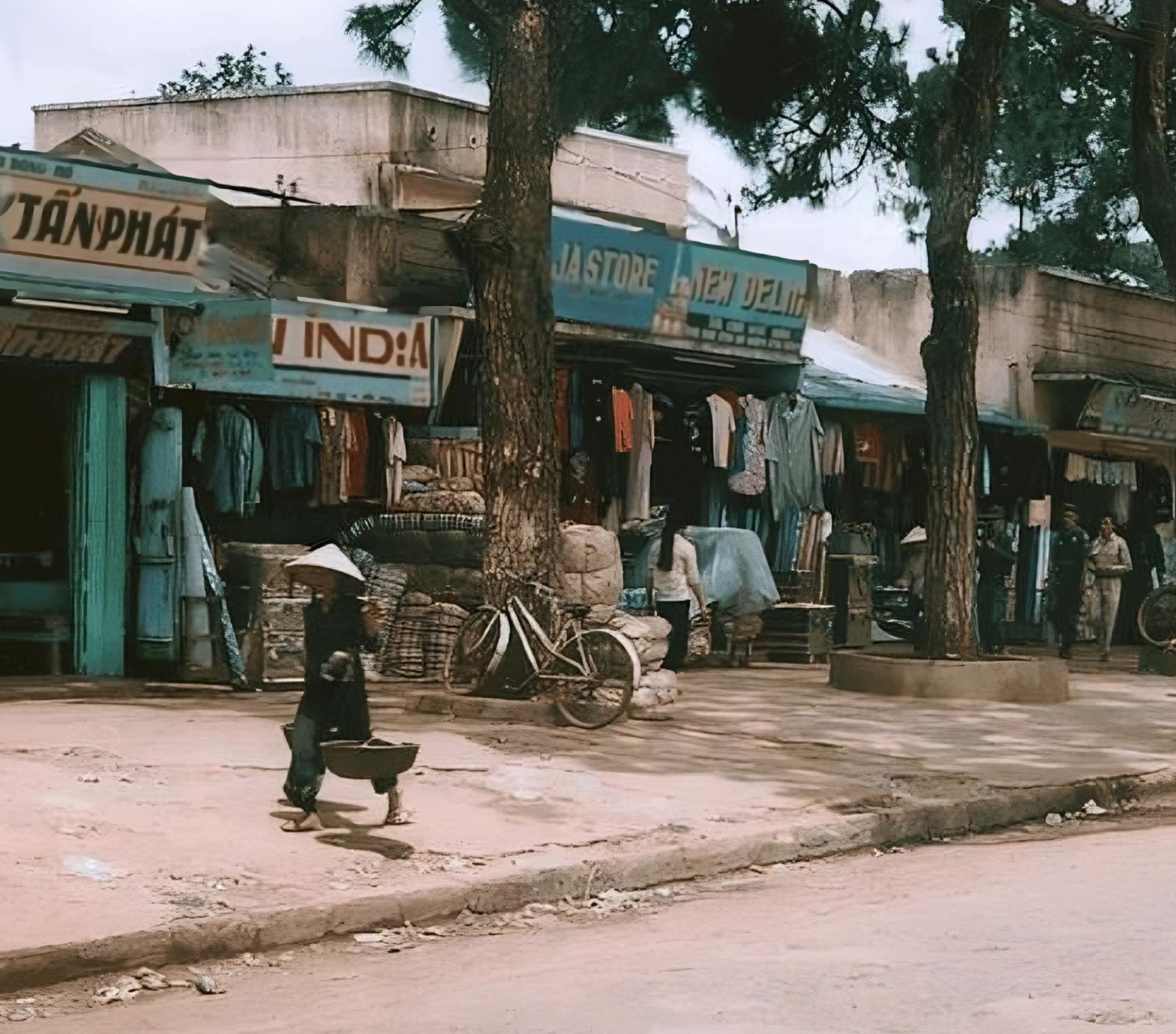
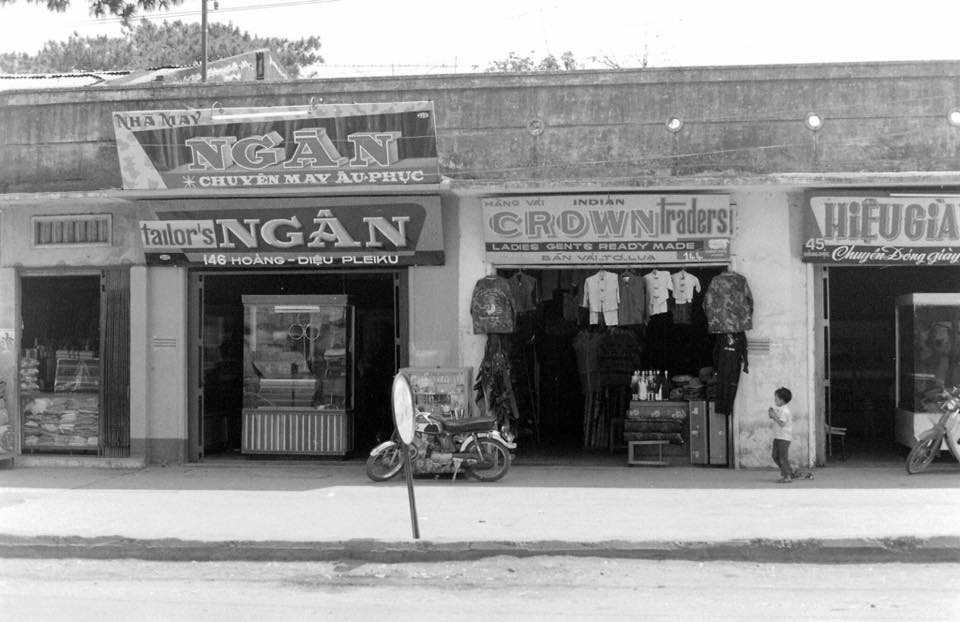
“The main drag had a series of textile shops owned and managed by the Indians of dark complexions.“
David Grant Nobleon his time in Pleiku in 1962 (Saigon to Pleiku 2020)
Tailor in Pleiku. Pleiku Jacket visible top right, at the back some Bahnar or Jrai patterns are visible
These stores called India, and New Delhi were probably Indian tailors. Black Pleiku Jackets visible in the shop called New Dehli
Indian Crown Traders – ladies gents ready made. Hoang Dieu Street (today called Hung Vuong)
Patches
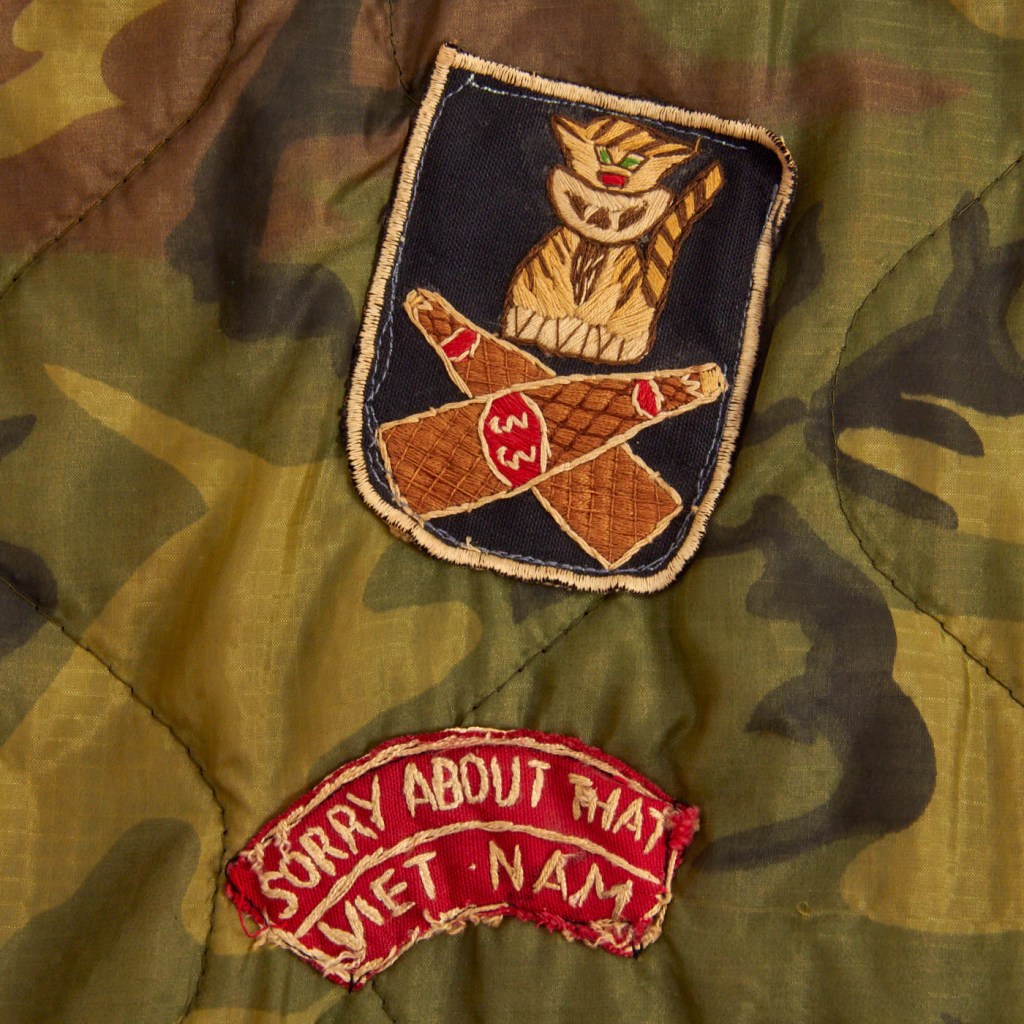
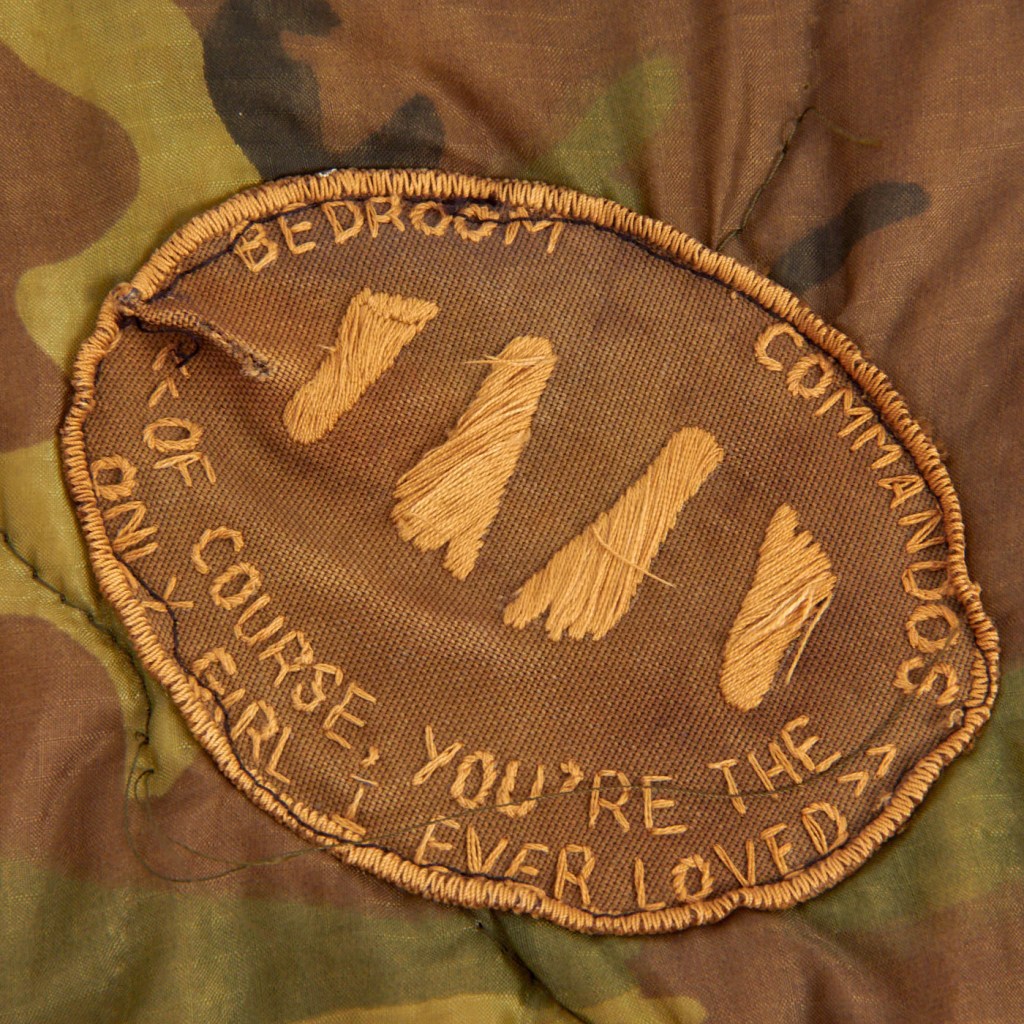
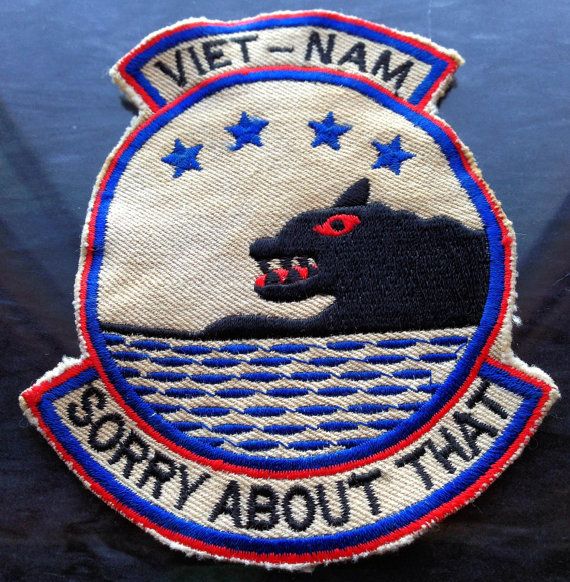
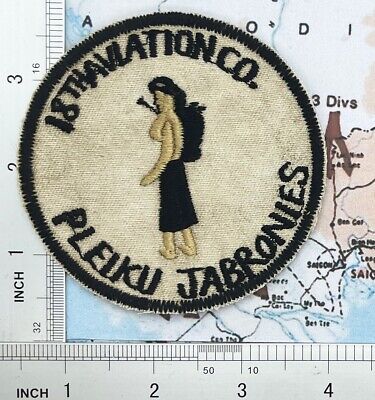
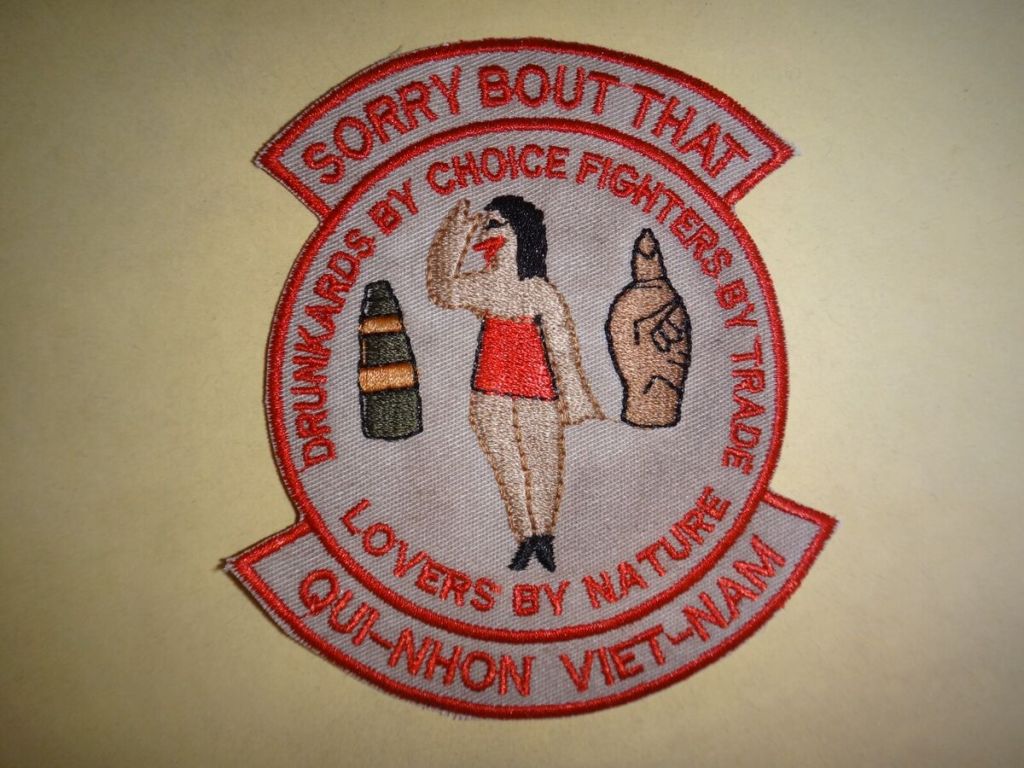
Soldiers often went further to customize their jackets with patches, turning each Pleiku Jacket into a unique memento of their service. These patches added a personal touch, reflecting individual experiences, affiliations, and sentiments. These customizations made each jacket a distinctive piece of history, capturing the diverse and personal stories of those who wore them. A poular motif on the patches was the phrase “Sorry about that”.
33 Beer is now 333.18th Aviation Company – Pleiku Jabronies (near Hàm Rồng mountain 1964-66)
“If we were bombing “those gooks back into the Stone Age,” well buddy, sorry about that. While attached to a Marine Corps group, I heard the phrase repeatedly used by “grunts” whenever the conversation swung to destruction of hamlets or civilian casualties. The attitude was . . . well, that happens, there’s nothing I can do about it; sorry about that” – Andrew Shinnick
After the War
“I only wore my working jacket once after I left the Navy in 1967. I went to a bar in West Palm Beach shortly after being discharged. I was with a friend who had not been in the service. He was uncomfortable about my wearing it, but he didn’t say a word until later. At the bar, I was immediately singled out by several young patrons. No one said anything directly to me, but I couldn’t help but hear the comments . . . the usual “Baby Killer” crap I read about. I was astounded.. . .I was terribly embarrassed and then angry. I never wore the jacket again.”- Andrew Shinnick
“there are not a whole lot of them [jackets] around because they were shed like snakeskin at the departure gate at Tan Son Nhut, dumped in trash cans at the Oakland outprocessing center, and kindly left for the Salvation Army pickup by parents who cleaned out their son’s closet. The memories are just too strong” – John Turner
If anybody has a photo from the 60s or 70s of someone wearing a tour jacket please get in touch, I can’t find any photos online and I’d love to include one
As a self-proclaimed tea nerd, it’s quite an oversight on my part that I haven’t delved into how deeply Pleiku’s identity is steeped in tea until now. Tea production in this region is a cornerstone of Pleiku’s identity today, with roots tracing back to the era of French colonization.
Setting the Scene
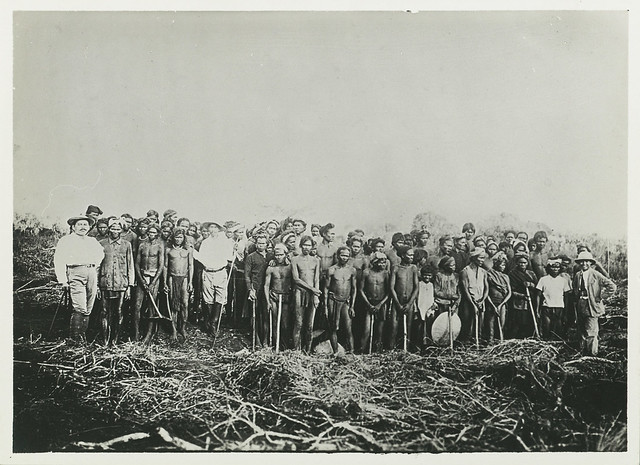
Our tale begins in 1925, over three decades since Vietnamese emperors yielded to French colonial rule. Despite this shift, the Tay Nguyen Plateau remained a wild frontier, though the French – themselves recovering in the aftermath of World War I – were slowly making inroads. At this time, the region was largely autonomous, with ethnic Vietnamese sparsely scattered amidst the predominantly Montagnard population. In this year the infamous Pleiku Prison was constructed to help maintain French authority by hook or by crook.
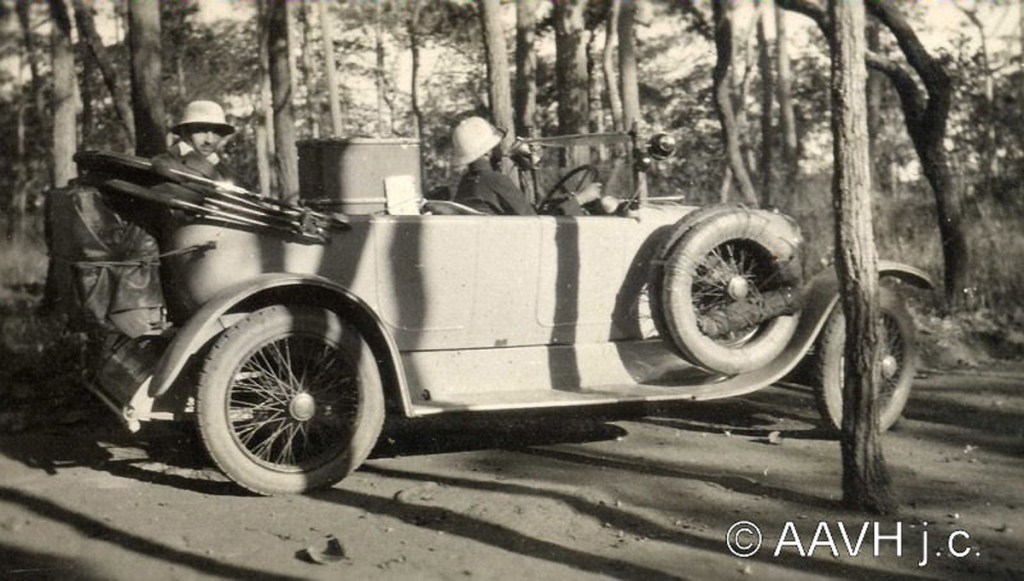
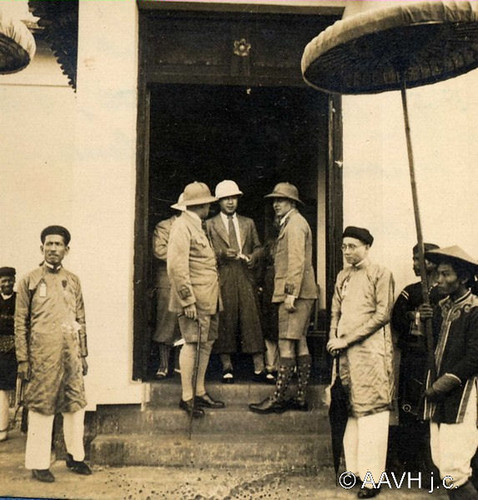
Nature reigned supreme in this domain, with rivers teeming with crocodiles and jungles prowled by tigers and pythons. Within this daunting landscape, pith-helmeted Frenchmen boldly embarked on endeavors to establish tea plantations and impose their version of “civilization” upon the wild highlands.
The Moï province of Kontum occupies, in Center-Annam, a medium altitude plateau (600 to 900m) whose richness in “terres rouges” tempted so many colonists that the General Government of Indochina considered it necessary to carry out a preliminary investigation on the state of health of agricultural operations in this region. The local population being relatively sparse and having reduced working capacities, it was likely that they would quickly need to call on imported labor whose fragility is common knowledge in colonies… The first priority was therefore fixing the climatic characteristics and pathology of a region whose development was going to require the immediate mobilization of thousands of coolies from Tonkin or the more populated lowlands. – “LE PALUDISME [malaria] DANS LA PROVINCE MOI” Archives des Instituts Pasteur d’Indochine 1928
In fact, the region has only been open to colonization through effective pacification and the development of roadways since 1924 under the leadership of M. le Résident Fournier. In 1926, more than one hundred thousand hectares of land were, after prospecting, requested in concession by French and foreign planters.
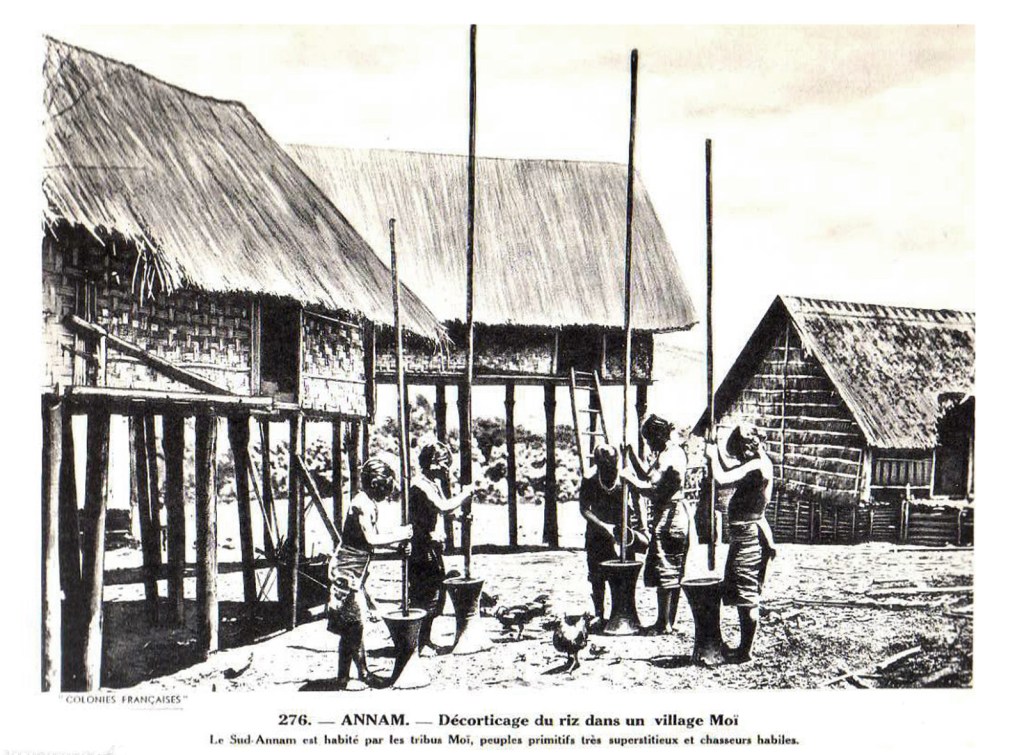
As we know, the Moi people do not have much sympathy for immigrants. Since a large number of immigrants are employed in certain plantations, this often leads to conflicts and ends in regrettable ways. This is how the minorities attacked a bus on the road: Three passengers were killed by poisoned arrows and several others were injured. Acts of sabotage were also carried out on a rubber plantation (referring to the Dak Joppau plantation in An Khe – NQH). After these events, a militia was sent to suppress the rebels, but the Montagnards fled and retreated into the forest. As punishment, it was decided to use planes from Bien Hoa (NQH: newspapers wrote from Bien Hoa according to the information they had) to suppress them. A military squadron was assigned to bomb several villages of the Montagnards.” ( Une révolte chez les Moïs , 1929, p.11830).
Tay Nguyen residents as seen by the French
Pith helmet: check! Wind in the Willows car: check! Aventure: en avant! Di Linh, Lam Dong, 1925
CATECKA (Chè Bàu Cạn)
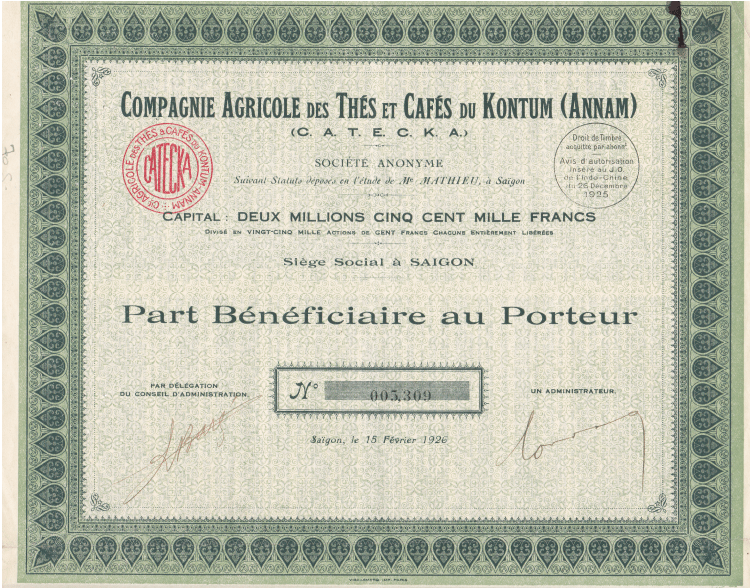
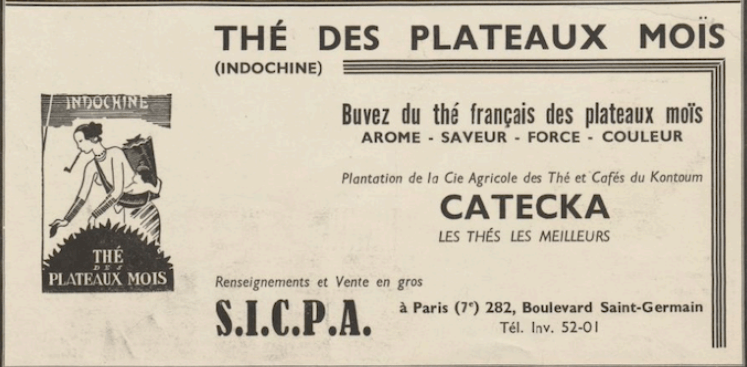
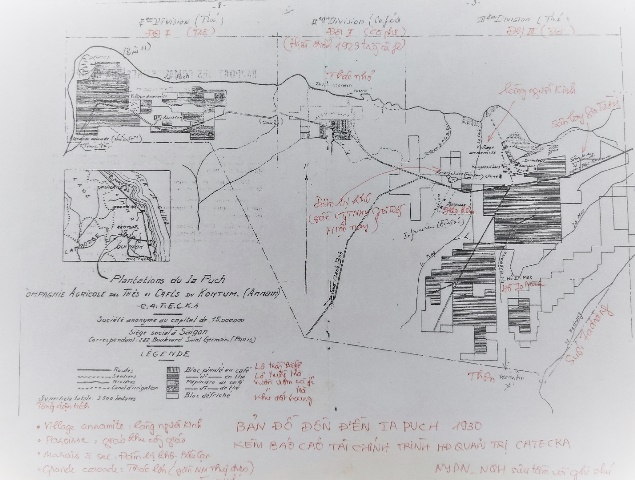
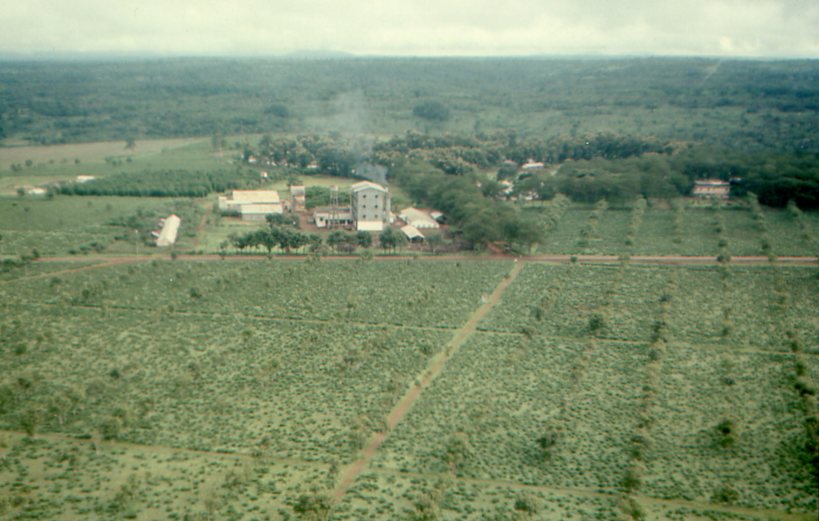
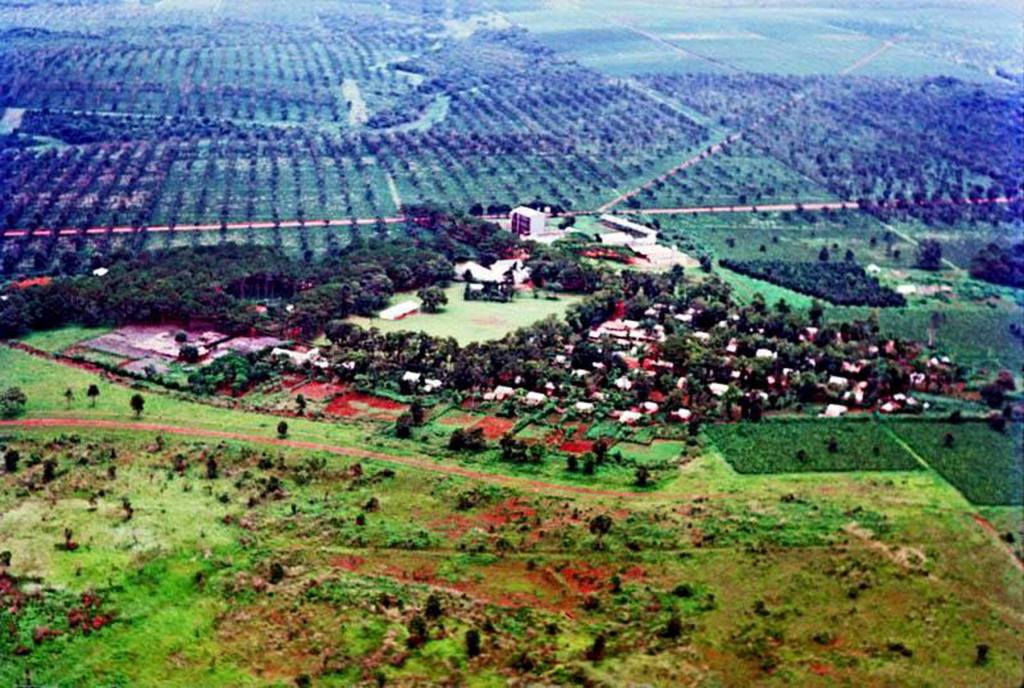
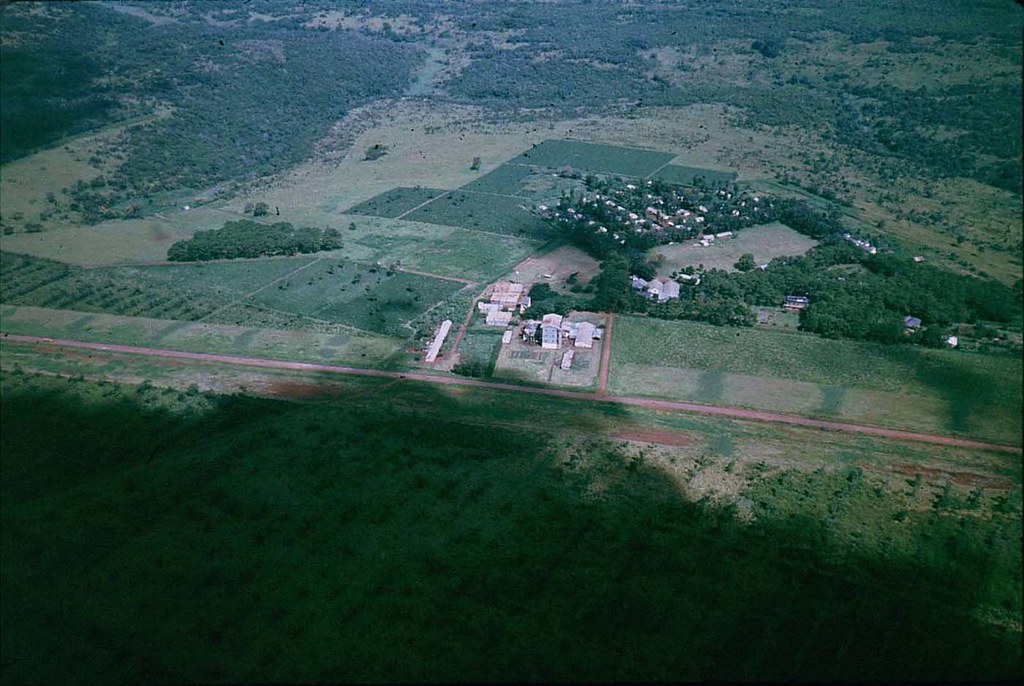
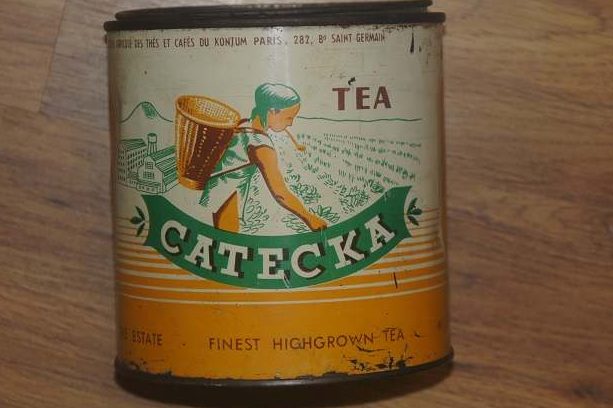
Amidst this backdrop, the most renowned tea plantation of the era emerged: CATECKA (Compagnie Agricole des Thés et Cafés du Kontum Annam) situated near Bàu Cạn and established in the same pivotal year of 1925. Thanks to the Gia Lai Museum for some wonderful resources (1, 2, 3) so I didn’t have to dredge through too much French for my research.
Catecka, Bau Can tea department, employed about 800 coolies – source
The harsh labor regime at Bau Can plantation made the material and spiritual lives of workers extremely difficult and miserable, with poor food, poor health, and constant illness. Plantation workers were severely exploited, beaten, berated, fined, and female workers were raped. They also poisoned workers with alcohol, tea, opium, and gambling, causing them to fall into debt. Once they borrowed money, the debt would be passed on to their children. Entire lives were tied to the plantations; slaves to the French owner.- Gia Lai Museum
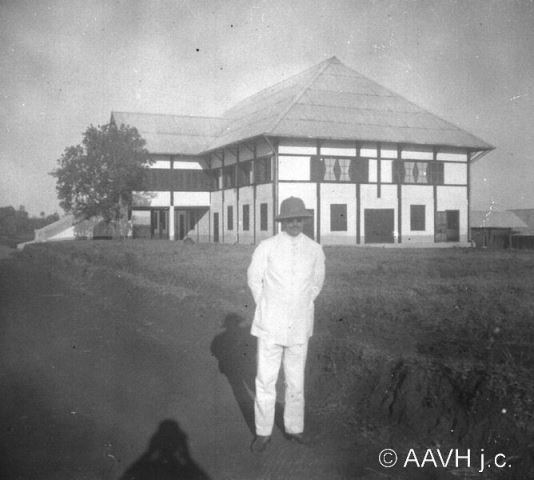
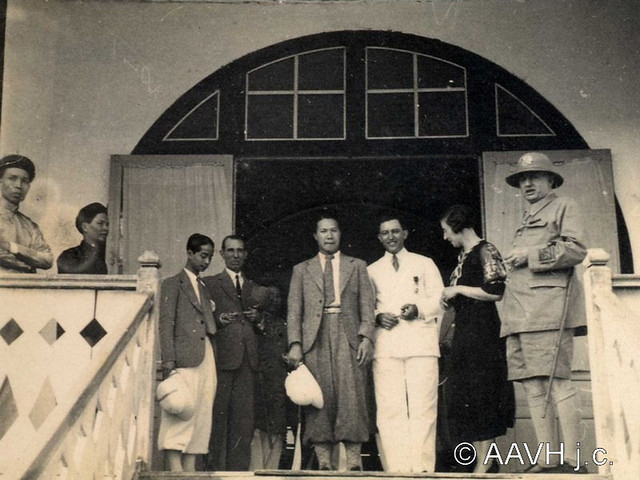
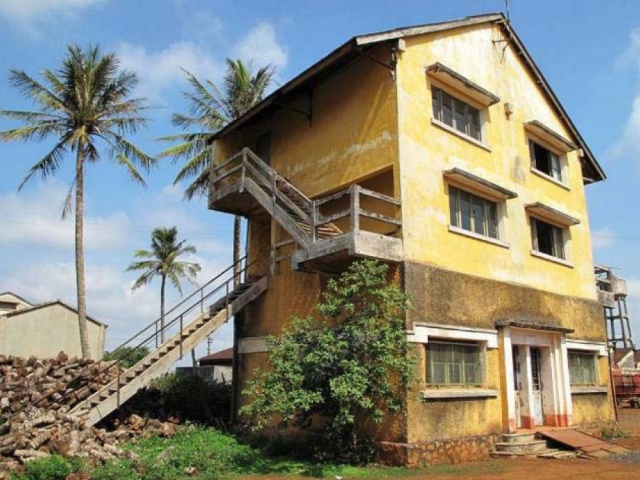
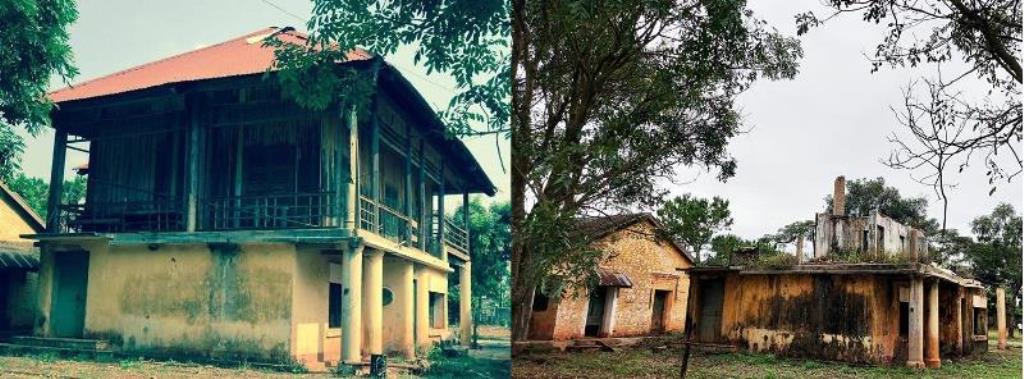
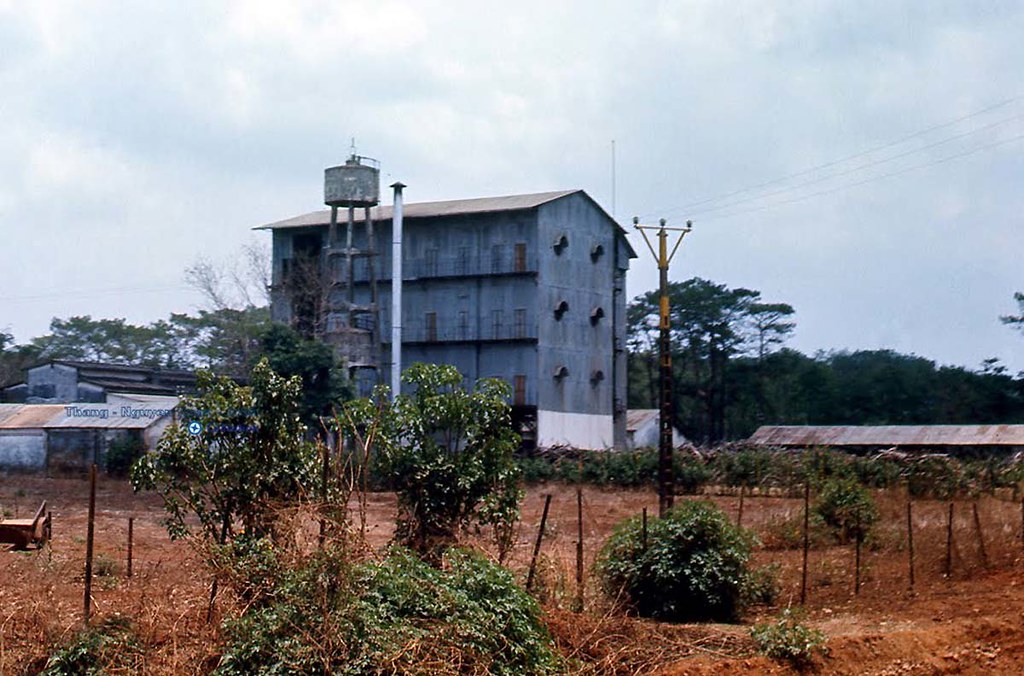
Dutchman Van Mannen at CATECKA’s main house in 1928The last emperor of Vietnam Bảo Đại visiting CATECKA with the director Jean Marie Auguste CHOISNEL in February 1933.love to see some good pith helmets in usesome kind of bond?prett racist ad from 1937plan from 1929French tea processing building, photographed in 2011directors house. I don’t have dates for these photos but the right is after a fire in 2022
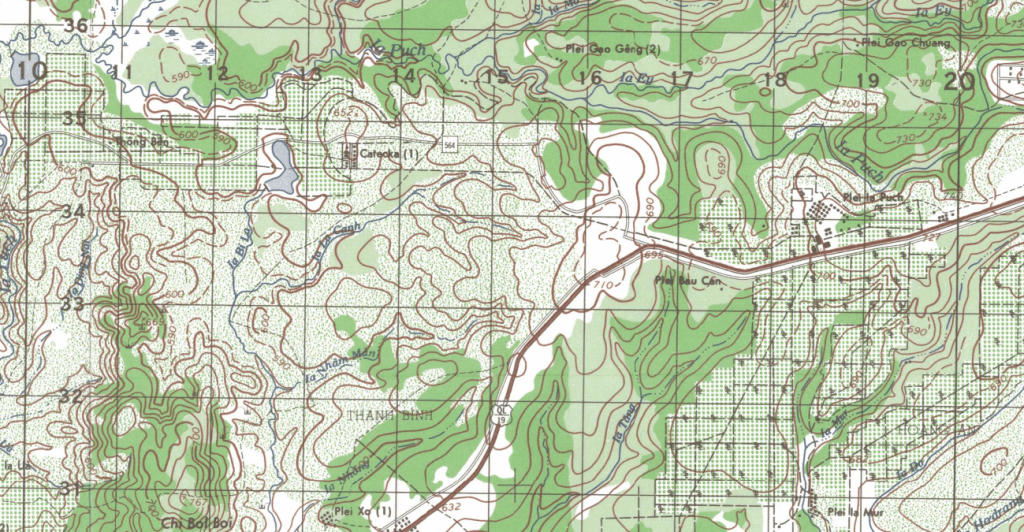
Fast forward to 1962, where the acronym has seamlessly transitioned into the word “Catecka” (as seen on the map). Our next insightful source comes from David Noble‘s fascinating book “Saigon to Pleiku.” In his memories, during his visit with the US military, Noble met the then manager, a Frenchman named Claude Salvaire. Notably, Catecka was then a supplier of black tea leaves to none other than Lipton Tea.
“There, under the influence of gin and tonics, he regaled us with stories, his favorite being about his tiger hunts on the property. Trophies on the wall bore evidence of his shooting skill. His hunting method, he told us was to tie a live goat to a tree out in tiger territory and wait in a blind through the night. When he heard the sounds of a tiger killing the goat, he would shoot it” – David Noble
It’s fascinating to consider a Frenchman like Claude overseeing a business in what essentially was the wild west, particularly in the aftermath of the Điện Biên Phủ conflict. Undoubtedly, it must have been a chaotic and unpredictable era.
“These French are a weird crowd. They are the dregs of the French Empire who have not wanted to return. As far as I’m concerned, anyone who would choose to remain in this country must have a pretty damned good reason for not going home. And most of them do. Either they ran into big trouble in French and sought refuge in Indo China long ago or they were adventurers and scoundrels in the Foreign Legion who deserted when the chips were down. They have free travel throughout the country since the VC [Viet Cong] don’t bother with them except to tax the plantations. Many of them have very colorful and unusual pasts.” – David Noble, 19th of February 1963
“Not a quarter-mile through the tea bushes from Brown’s tents stood a lovely white colonial mansion. The French plantation manager lived there, and if you strolled the road you caught glimpses of young women in bikinis taking the sun beside the swimming pool. The mansion had been neither mortared nor attacked the night before. Army intelligence said the French owners paid the Viet Cong a million piasters a year in protection money and paid the Saigon government three million piasters a year in taxes. The plantation billed the U.S. government $50 for each tea bush and $250 for each rubber tree damaged by combat operations. Just one more incongruity.” – We Were Soldiers Once…and Young– writing about 1965, published 1992
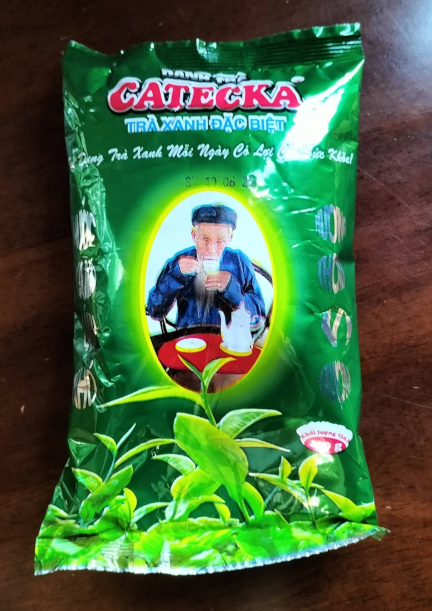
The legacy of the Catecka tea plantation endures to this day under the management of CTCP Chè Bàu Cạn. With a sprawling 450-hectare plantation, they continue to produce approximately 2,600-2,800 tons of tea annually (source). The name “Catecka” persists in some of the branding even in 2024, serving as a poignant reminder of its storied past.
“There was a huge tea plantation that was very close to the base camp and that was an area where the enemy could hide-out very easily. And it was a dangerous area” – Frank Farrell (2:20)
CATECKA Ia Puch as the Americans saw itCATECKA Ia Puch as the Americans saw itCATECKA Ia Puch 1965CATECKA Ia Puch as the Americans saw itA bag of CATECKA tea today
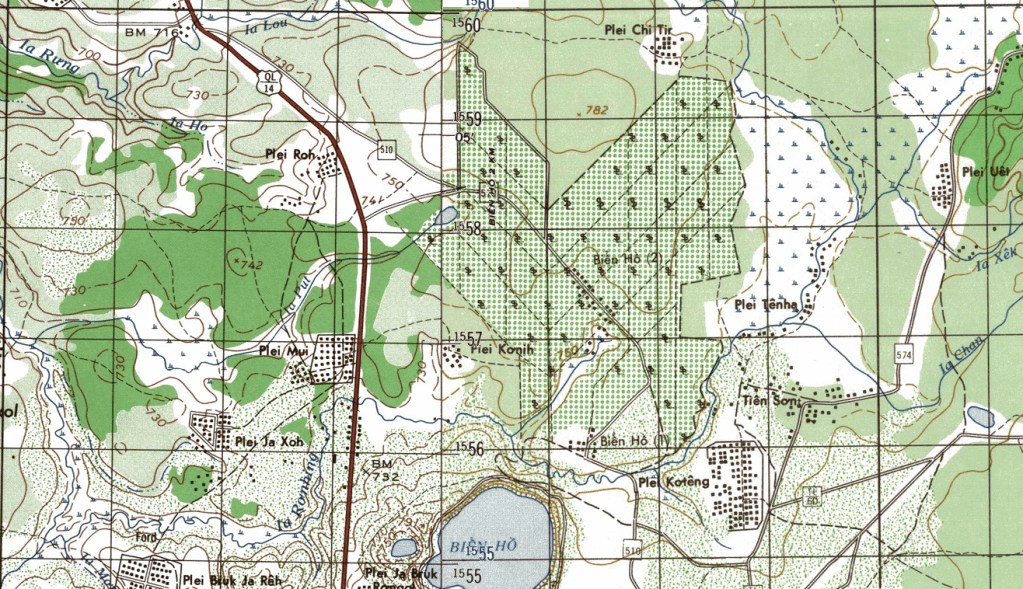
1970 1:50000 map showing Catecka and Ia Pech. Tea plantation is marked in the dotted green.
According to the manager, there are 600 women and 150 groups of tea pickers each day – From Bao Dai’s visit in 1933
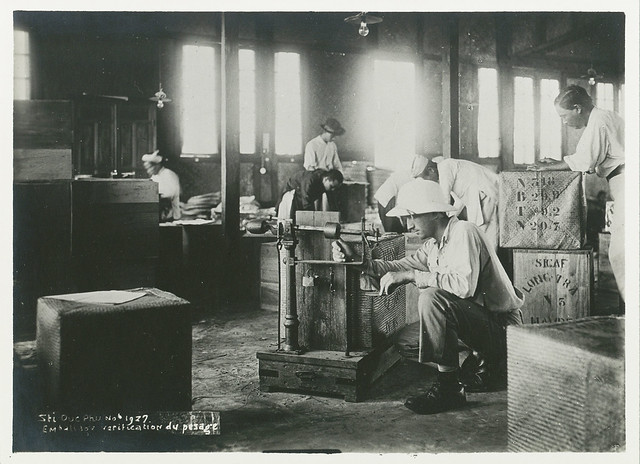
Biển Hồ Chè, perhaps more renowned today than Catecka for it’s tourism, shares a similar inception story. Established in 1925 under the unfortunate name STI (Société des Thés de l’Indochine), both companies capitalized on the expertise of a visiting Dutch Engineer named Van Mannen to kickstart their operations, particularly in the processing of black tea after harvesting. According to the newspaper L’Éveil économique de l’Indochine (Indochina Economic Awakening), issue dated January 6, 1929: by the end of 1927, Pleiku Bien Ho tea plantation had planted 500 hectares of tea trees (on an area of application is 2,810 hectares) at a cost of about $1,050 per hectare.
Sources about Bien Ho Che are much sparser during the war compared to CATECKA. However it was mentioned in 1969 meaning it was probably functional, or at least not totally destroyed.
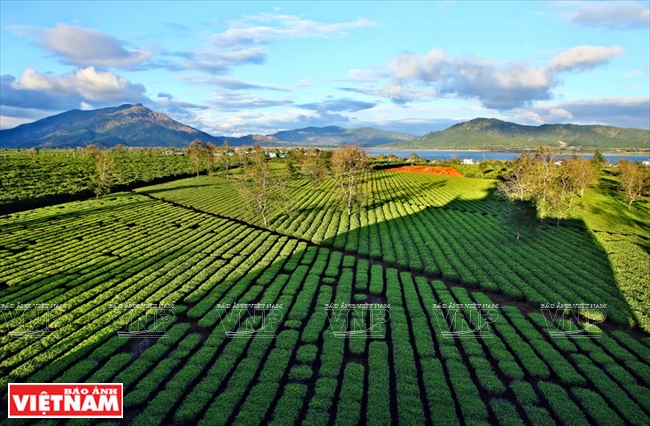
Bien Ho Che has become one of the main tourist destinations in Pleiku. Visitors flock not only to capture photos amidst the rows of low tea trees but also to admire the towering pine trees that line the roads, dubbed “100-year-old pine trees” by locals. Visitors can enjoy a freshly brewed cup of tea at one of the charming roadside cafes situated right beside the very trees that yielded the tea leaves.
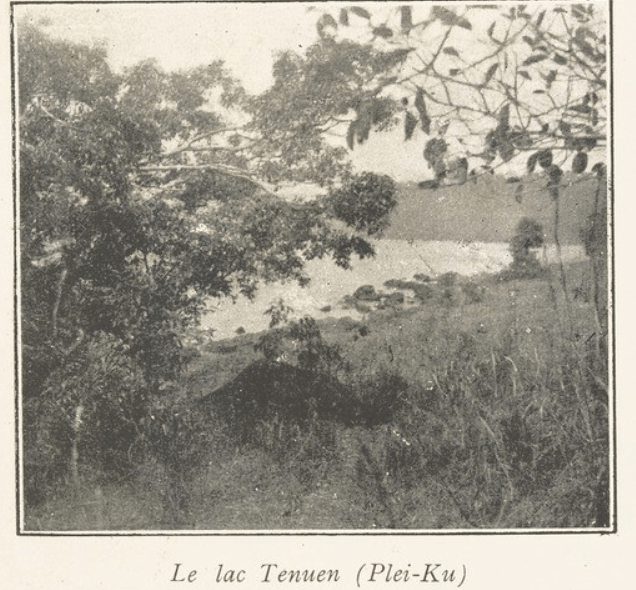
Bien Ho Lake, published 1926Van Mannen, the Dutch Engineer on the banks of Bien Ho lakeSICAF = Société Indochinoise de Commerce, d’Agriculture et de Finance. I can see where Vietnam got it’s love of an acronym…Jrai workers clear the land at STI
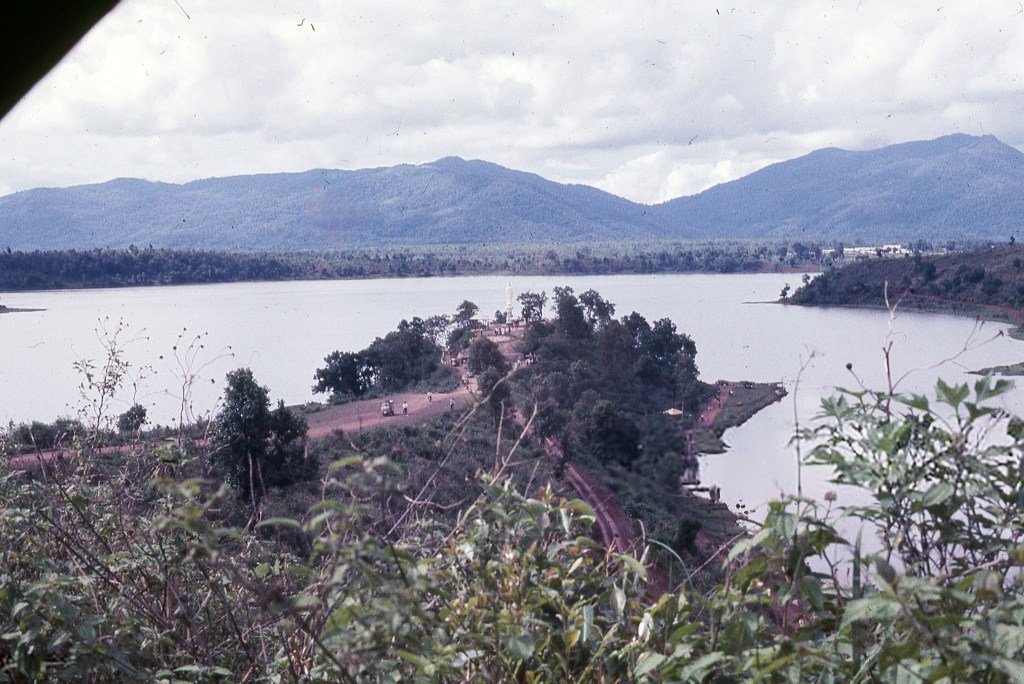
View over Bien Ho lake 1965, the buildings of the plantation can be seen in the distance on the right (also see map)
map showing the extend of the Bien Ho plantation in 1970 (dotted green).
The story isn’t all tea and biscuits; these plantations left an indelible mark on the natural environment and the indigenous way of life. Yet, after delving into their history, there is something to admire about their resilience. Rising from the wilderness and weathering two tumultuous wars, they’ve emerged as beacons of tranquility today. Despite their rocky past, they beckon visitors to escape the urban chaos and find solace in Pleiku’s serene landscape. I think these plantations serve as a testament to Pleiku’s ability to acknowledge its past while embracing progress.
There was another plantation at Dak Doa (in modern Dak Krong). I’m currently researching so if you’re interested, watch this space. If you can’t wait you can read the Vietnamese for yourself, or the french.
There’s a school of thought in English foreign language teaching known as TPR (Total Physical Response), advocating the use of physical actions to aid learning. One day as I pondered over suitable actions for my classroom, a revelation struck me – all the actions I could possibly need were already well defined: sign language! And so, for about a year now, I’ve found myself delving into the captivating world of British Sign Language (BSL), incorporating it into my teaching toolkit. Beyond the area of TPR, I’ve come to appreciate the invaluable addition of sign language to my toolkit, offering an additional dimension to communication. I believe this is particularly beneficial for very young learners or learners with special needs, enriching their educational experience and fostering a deeper level of understanding.
I find the subject of sign languages absolutely fascinating. The world of sign languages forms a rich tapestry just as intricate and diverse as spoken languages. The first thing to understand is that sign languages are each languages in their own right with which a user can express themselves just as deeply as they can with spoken or written language. BSL has unique grammar that sets it totally apart from the spoken English language and is totally different from it’s American Sign Language counterpart, but it does still share an affinity with sister languages in Australia and New Zealand. BSL’s lineage, tracing back to medieval times, boasts a heritage far richer than some of the other influential sign languages in the world such as French Sign Language.
BSL has a lexicon of both the obvious and the not-so-obvious gestures making up the signs. Take, for instance, the sign for “cricket” – a delightful portrayal of swinging a bat that’s always fun to do. And then there’s “train” and “robot” signs, where arm movements mimic the very essence of a kid playing make-believe. When I look up signs like this, it’s like duh, of course that’s how you do it! They’re the onomatopoeia of the sign language world. You might even find yourself inadvertently using them, blissfully unaware of their linguistic pedigree.
Now, onto the less obvious realm of sign language, where the challenge lies in encapsulating abstract concepts like color. Consider the sign for “red” – I think it’s ultimately based on the sign for the letter “r”. While it may seem a tad abstract, I’ve found immense value in incorporating such gestures into my classroom routine. Consistency is key, after all, even if it means looking silly in the eyes of my students as I dance my fingers around my body.
One thing I find curious is that some kids effortlessly grasp the nuances of handshape and precise movements, while others seem to channel their inner windmill. Many students are reluctant to use their hands at all and it takes a great deal of effort for me to get them to do anything – maybe they feel silly or that it’s not important. I’m not rigid about enforcing sign language; after all, it’s not the bread and butter of my teaching gig.
In the future, I hope to have the freedom to teach however I see fit and I’ll experiment with integrating the BSL alphabet into early education and continuing its use throughout students’ learning journeys. I believe this approach will not only enhance their English learning but also foster mental flexibility and increase the enjoyment of the class. Perhaps one day one of my students will find themselves in the company of a BSL native and think, “Ah, I know what that means! That’s how Teacher Will did it!”
In three distinct periods of my life, rain has brought unexpected joy. In primary school, it meant a lunch break of indoor play with Lego; during my stint at the carboot sale, it signaled a day off. And now, seated in a cozy café with Yumi and her Auntie “Green” Xanh, the heavens open above us, prompting cheers as rain pelts the roof signaling the end of a long harsh dry season.
Indeed, over the recent long bank holiday—Vietnam’s reunification day followed by Labour Day—Yumi and I found ourselves enjoying morning coffee when we heard a loud tokay gecko. Yumi shared with me that the Jrai people consider it a harbinger of imminent rain.
Rain plays a pivotal role in local cultures here. The Jrai in Ayun Pa hold a Fire King Festival, featuring a rain dance, while the Xodang people celebrate a “Water Drip” festival, highlighting the significance of water in their lives.
Here in Pleiku, where the norm is a comfortable coolness, the delayed onset of rain has cast a shadow (or not!) over our usually verdant plateau. As someone who typically revels in the warmth of the sun, even I had found myself longing for respite from the stifling heat that hangs heavy in the air, rendering it stagnant and oppressive. Returning from the equally sweltering Mekong Delta, I couldn’t help but notice the difference in discomfort – here, it felt as if I was living in a fan oven; turning on the fan at night only seemed to stir the hot air around, offering no respite from the stifling heat. Indeed, it’s not just Pleiku feeling the heat; across Vietnam, The specter of one of the hottest years on record looms large, its oppressive weight bearing down on the nation’s peoples and wildlife.
So, the arrival of the first shower signaling the start of the rainy season here in Pleiku is a tremendous relief. Last night, I enjoyed a restful slumber under the water-cooled roof, a very welcome relief!
Kon Tum with Henry
Cousin Henry made a brief stop in Pleiku on his adventure heading north. He and Grace had pre-booked and prepaid for a homestay online, only to discover upon arrival that the owners had double-booked! Fortunately, the hotel arranged alternative accommodations for them, and it all worked out in the end. When in Vietnam, I personally opt for spontaneity, finding a hotel upon arrival, as online reservations aren’t taken as seriously as in other countries.
Our next stop was my house, where Henry immediately bonded with my cat, snapping plenty of photos in the process. Then, we ventured to Yumi’s parents’ place, where her dad had prepared a massive 3kg rooster for us to feast on. Despite our best efforts, we couldn’t finish it all. We also indulged in his homemade wines, including one jar with a honeycomb inside and another made with bananas, both of which were very well received by our guests. After that we headed out to my Australian friend Brad’s new bar.
Bar flies
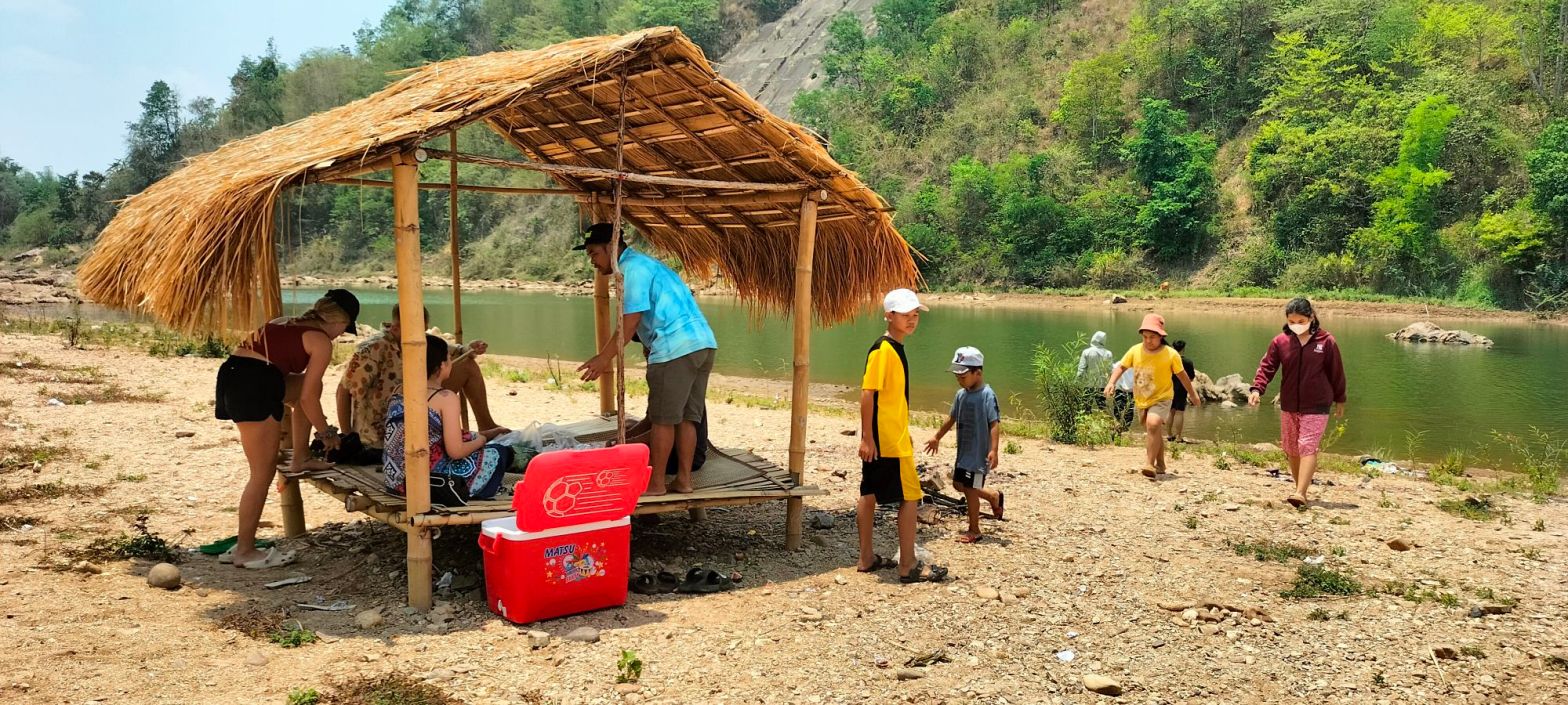
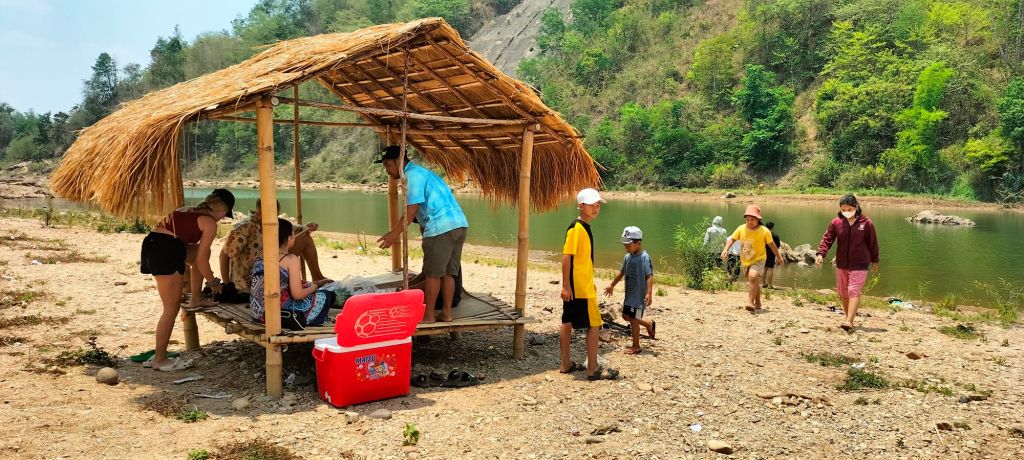
The following day, we journeyed to Kontum, where we joined some of Yumi’s cousins for a riverside picnic featuring traditional Bahnar cuisine. While the kids and I enjoyed a swim, Henry amused himself by skimming stones across the water.
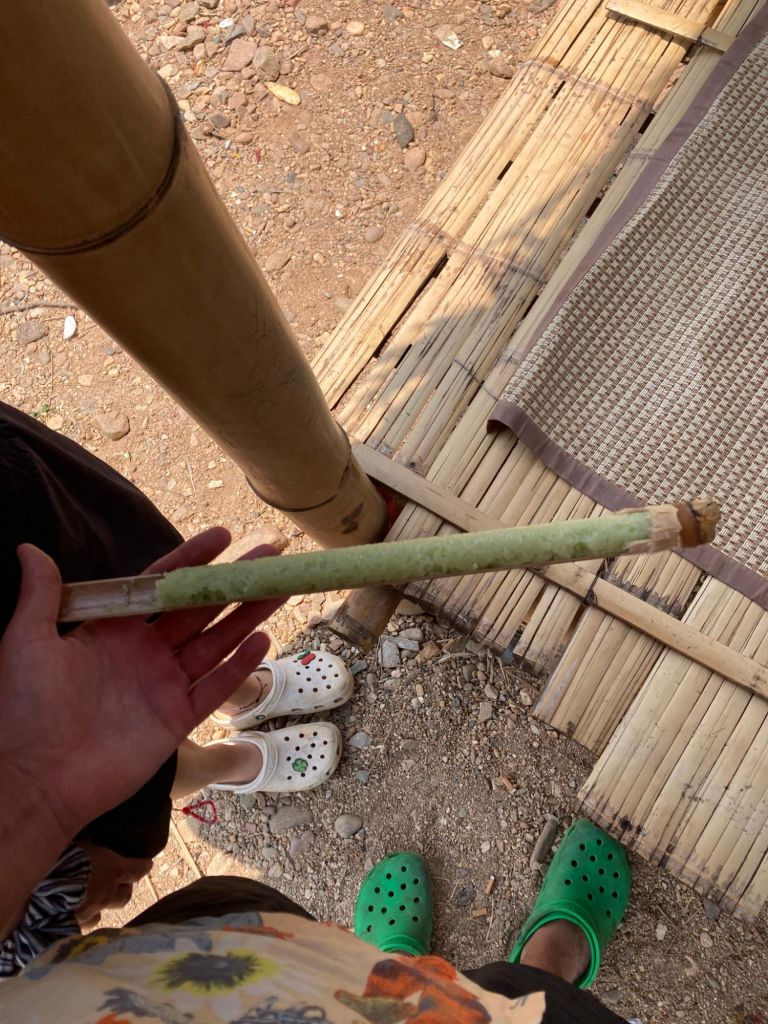
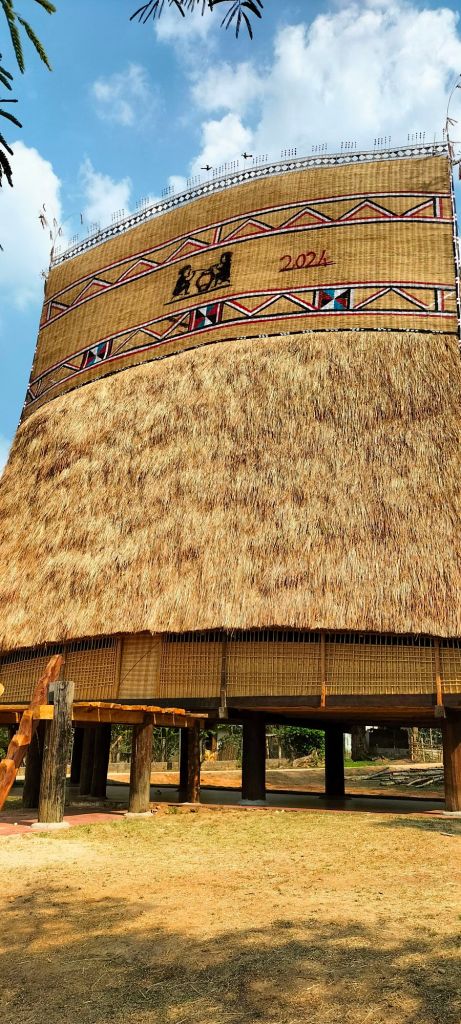
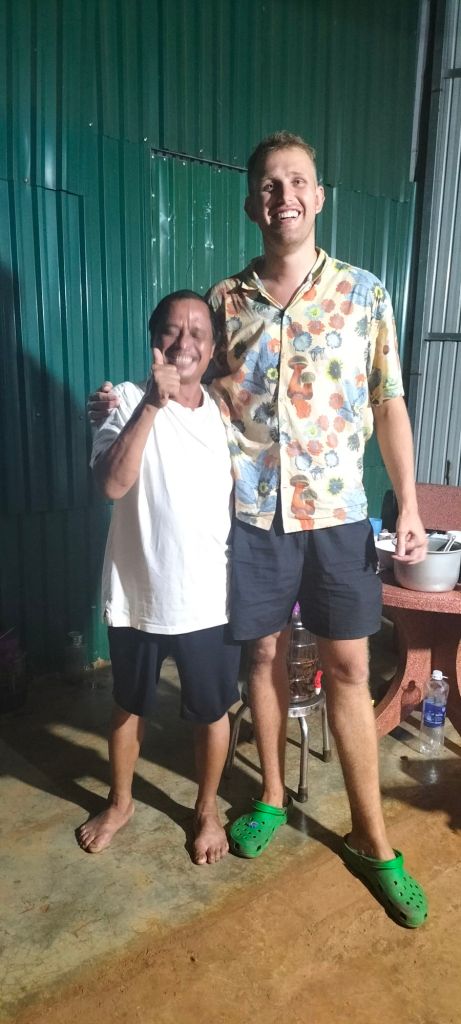
Regional specialty: com lam; sticky rice cooked inside bambooA Kontum communal house we visitedHenry with Yumi’s dad
After bidding farewell to Kontum, we parted ways with Henry and Grace, knowing this may be the last time we see them on this trip. I wish them a journey filled with unforgettable moments and enduring memories in Vietnam and beyond. I’ll be eagerly following their adventures on Instagram, holding onto the memories we’ve shared. Safe travels!
Somehow I managed to live in Saigon for a year without checking out nearby tourist attractions. So when my employer dangled the carrot of a free flight for an awayday and by coincidence my cousin Henry decided to drop into Vietnam, well, it was high time to rectify my lack of exploring. So, with the fresh tourist eyes for me to experience South Vietnam through, we set out for adventure.
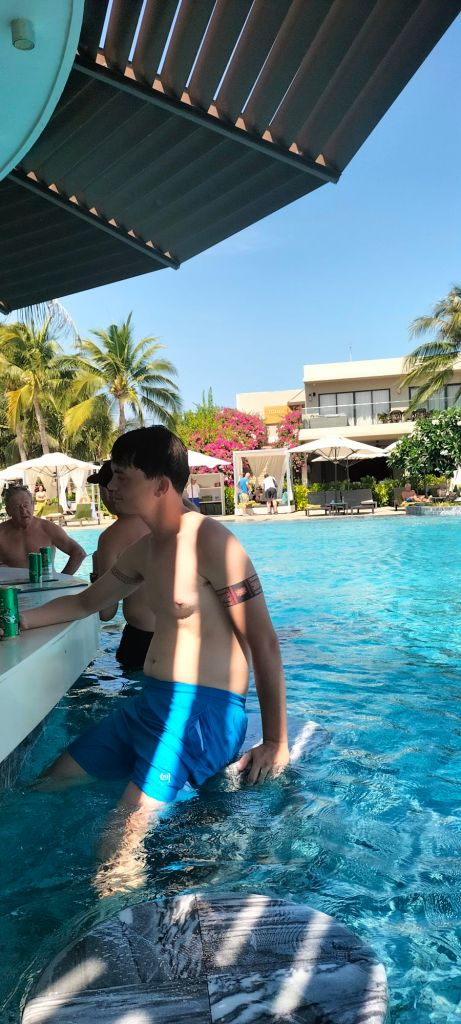
Ah, the typical work “awayday” – a blend of corporate obligations and organised “fun”. At least it included a reunion with an old pal, Jack, who in 2022 had swapped breezy Pleiku for the bustling streets of Saigon but helped me get my foot in the door at this company in 2023. Together with about 300 staff, we boarded coaches bound for a posh retreat near the coastal town of Vung Tau (I call it the Blackpool of South Vietnam). After a million corporate photo ops, Jack and I caught up over poolside beers – yes, there was a bar right in the water, talk about bougie!
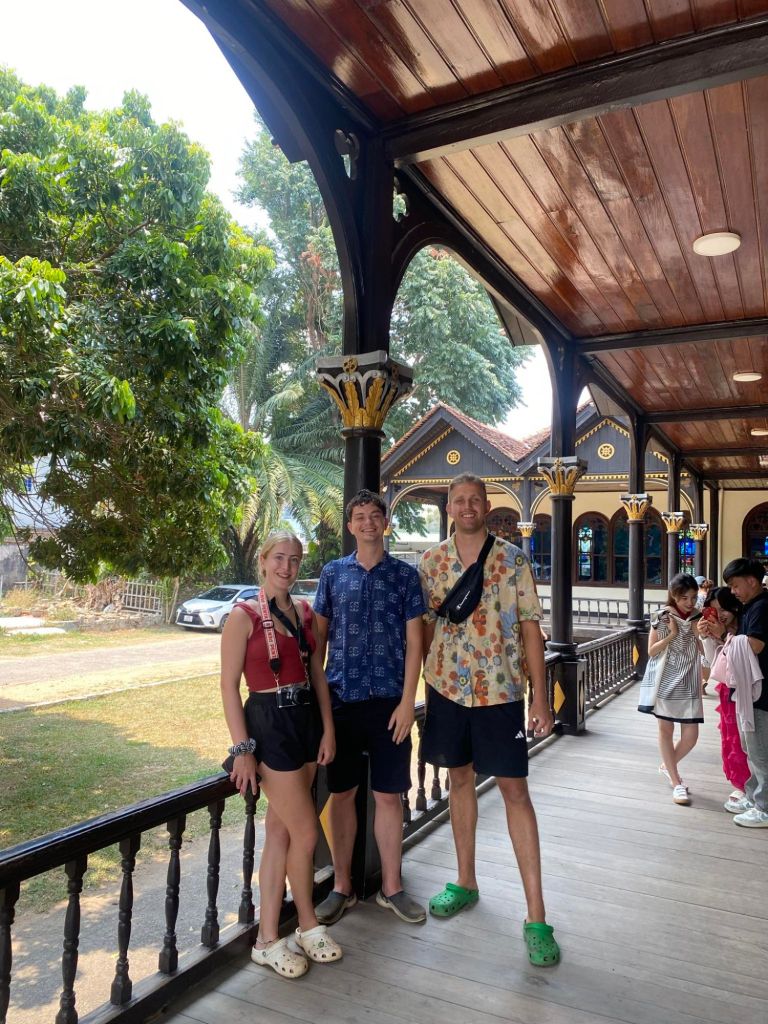
Me and Jack. Who forgot smart shoes and turned up in crocs!?
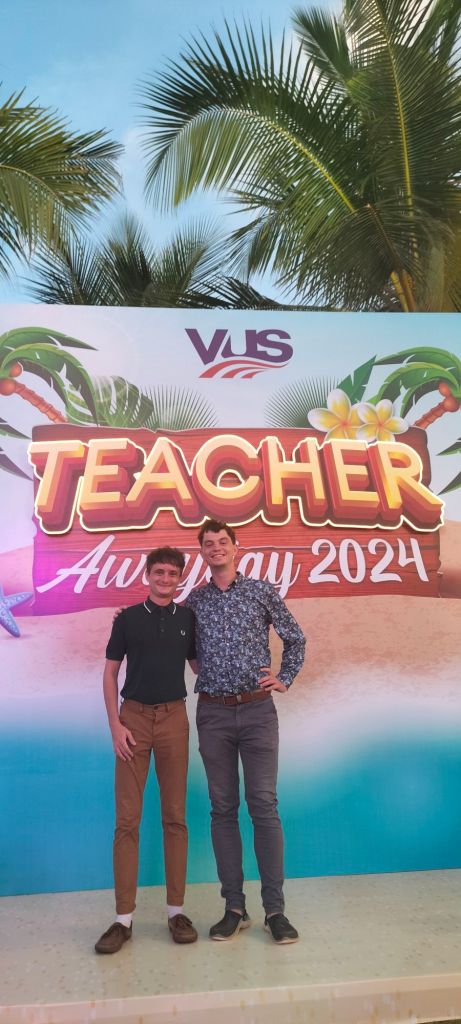
Come evening, it was time for VUS’s grand spectacle, the Gala Dinner. Think company cheerleading mixed with some cringy team-building games but also a buffet spread fit for a king. Post-dinner antics saw Jack and I liberating all the remaining beers, which we enjoyed on the beach, before heading to someone’s room for an afterparty. Undeterred when the security shut the afterparty down, we went for a late night paddle in the sea then rode around on one of the resort’s child-sized bikes until our liquid supplies dwindled, leaving us no choice but to bid adieu to the night and surrender to sleep’s sweet embrace.
pool bar, bougie!
Cu Chi
Our Saturday morning adventure took me Henry and Grace to the small town of Cu Chi just beyond the reaches of Saigon, where the echoes of the war still linger in the air. Apparently Cu Chi was a strategic hotspot nestled between Saigon and the Cambodian border that had a large American presence and unknown to them, a huge network of Viet Cong tunnels right below them.
Our trip was no ordinary commute – we opted for a boat ride up the meandering Saigon River, a delightful jaunt down memory lane for yours truly as we passed familiar places like Thao Dien, where I once taught maths. As the cityscape faded into lush greenery, we disembarked just outside modern-day Cu Chi, our aquatic voyage clocking in at a cool hour.
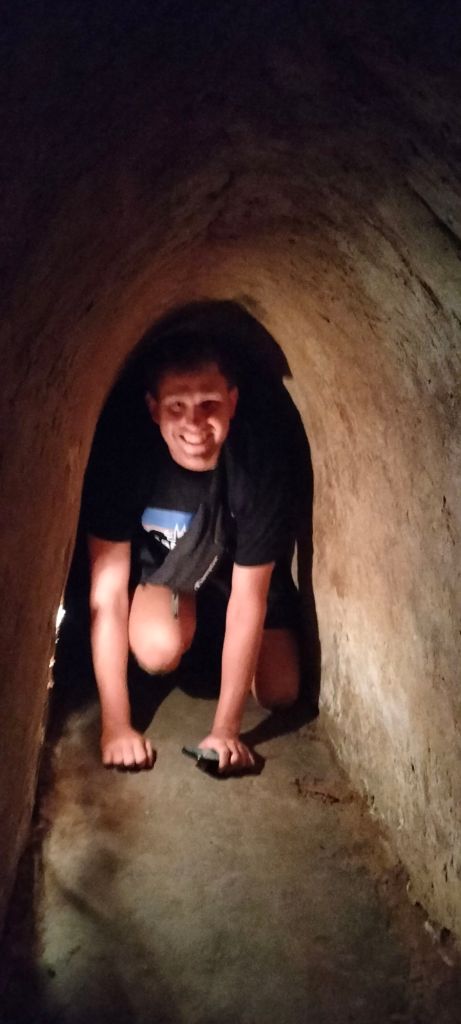
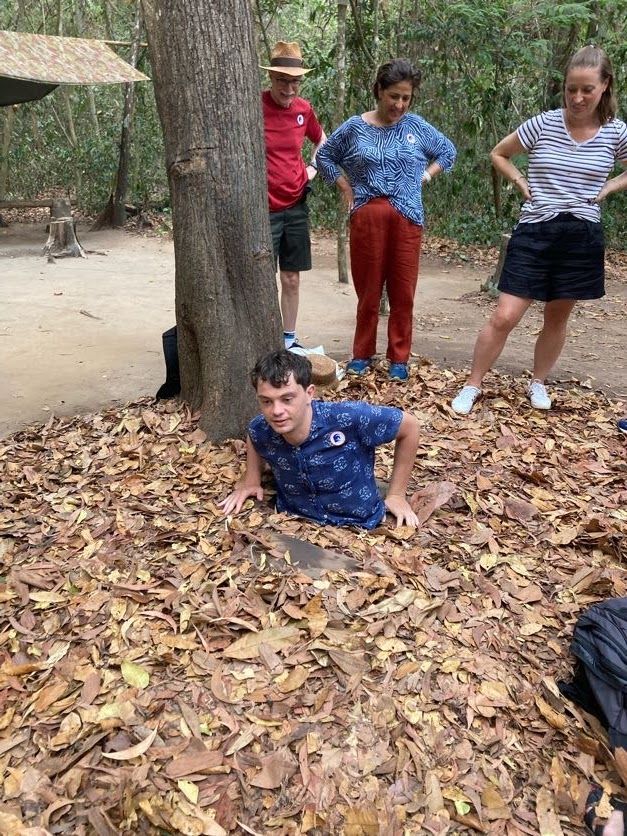
We got to go inside the tunnels which were very cramped and winding. They were designed so even the small Vietnamese soldiers couldn’t walk upright – you can imagine how 6’6″ Henry felt! These tunnels are definitely not for the claustrophobic. Air ducts, flood protection, and a plethora of ingenious features also awaited our eager exploration. In addition to the tunnels, we saw a selection of Viet Cong booby traps. Trust me, if it’s featured on the Wikipedia page for “Booby trap,” you know it means business.
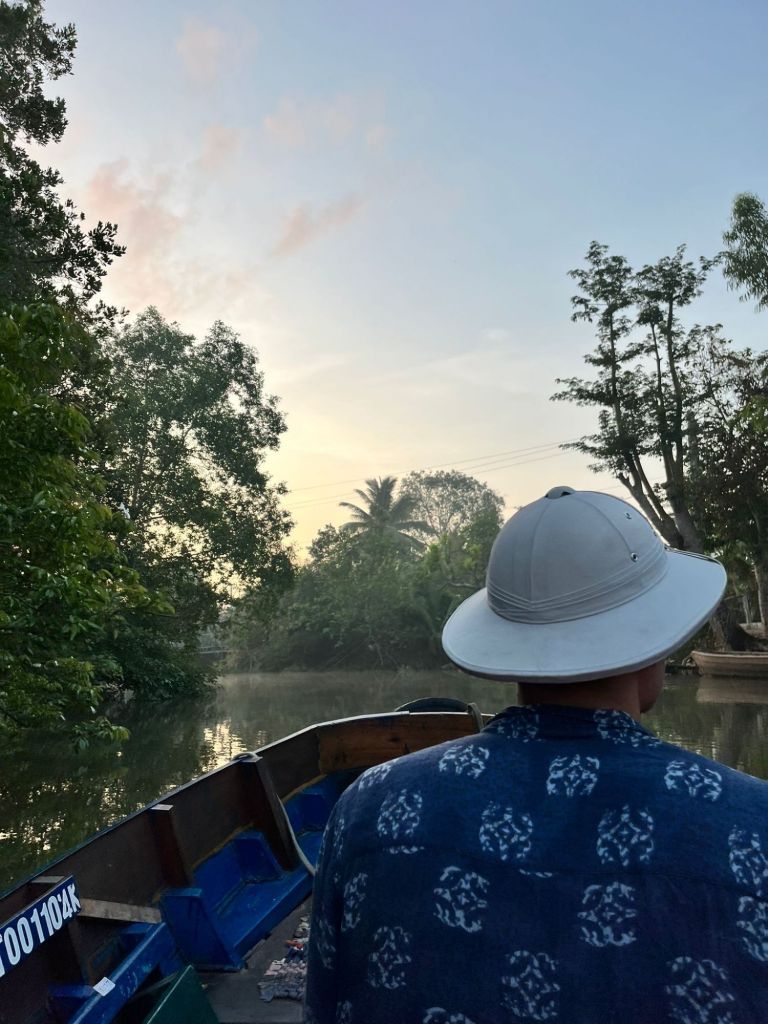
Next to the shooting range was a gift shop which sold a very tempting pith helmet. See if you can spot it in my photos below!
Wishing I’d eaten less buffet!
Mekong Delta
I had no idea where to start planning a trip to the Mekong Delta because I knew very little about the area. And so I booked us a guided tour and it turned out quite nice.
Our journey kicked off with an early morning pick-up from our Saigon hostel, whisking us away to the quaint charm of Can Tho. Our digs? None other than a slice of paradise itself – bungalows, pools, and all the trimmings of tropical indulgence.
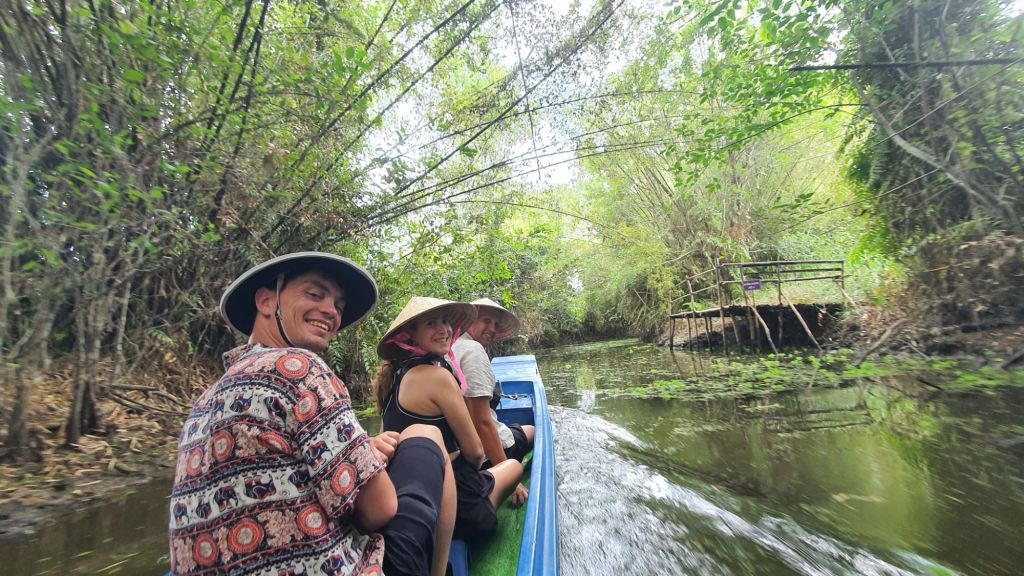
Our trusty guide, Sunny met us at the accommodation and took us to a nature reserve with little boats, where we were punted off into little streams to sea lots of wildlife. Our guide even coaxing Henry into some fruit-picking antics with a comically long net!
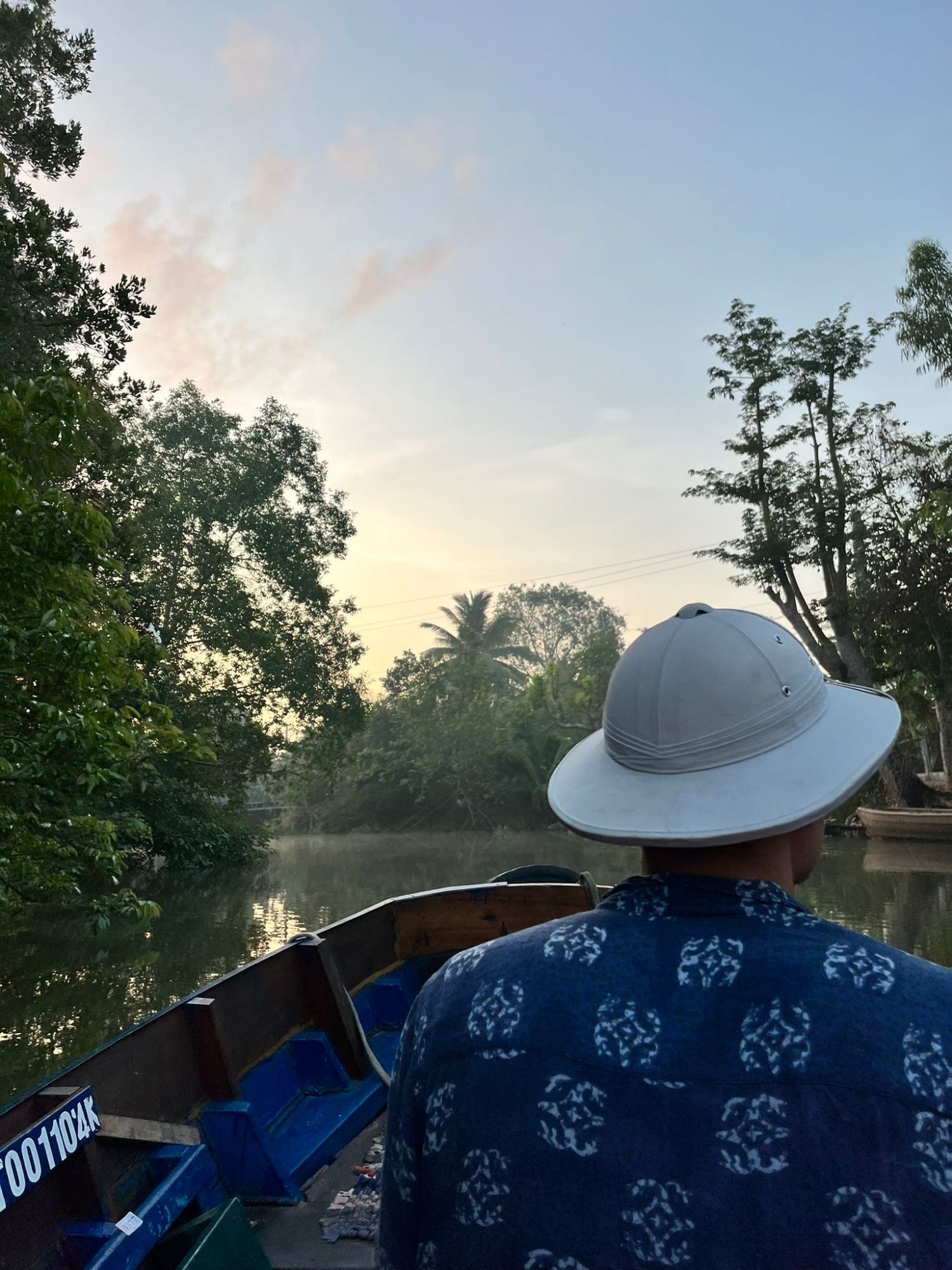
Canal in the morning
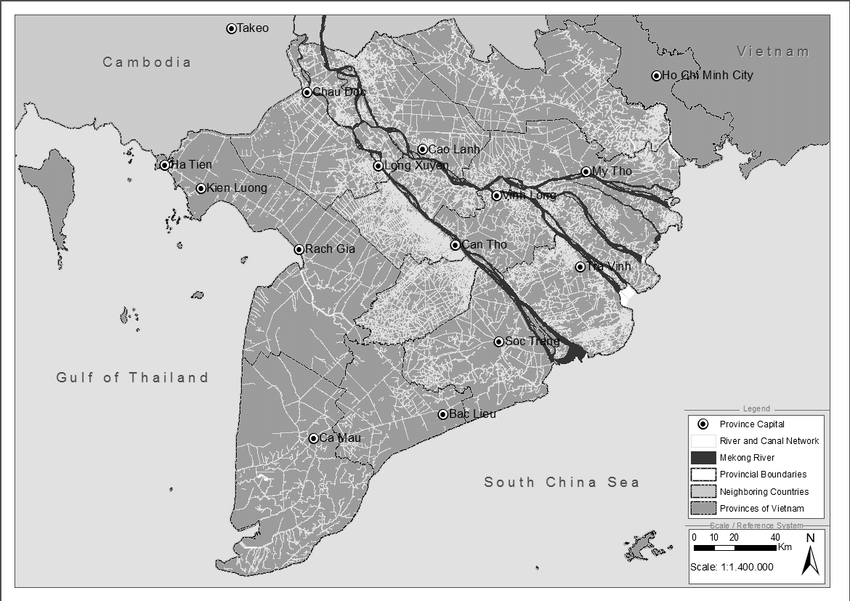
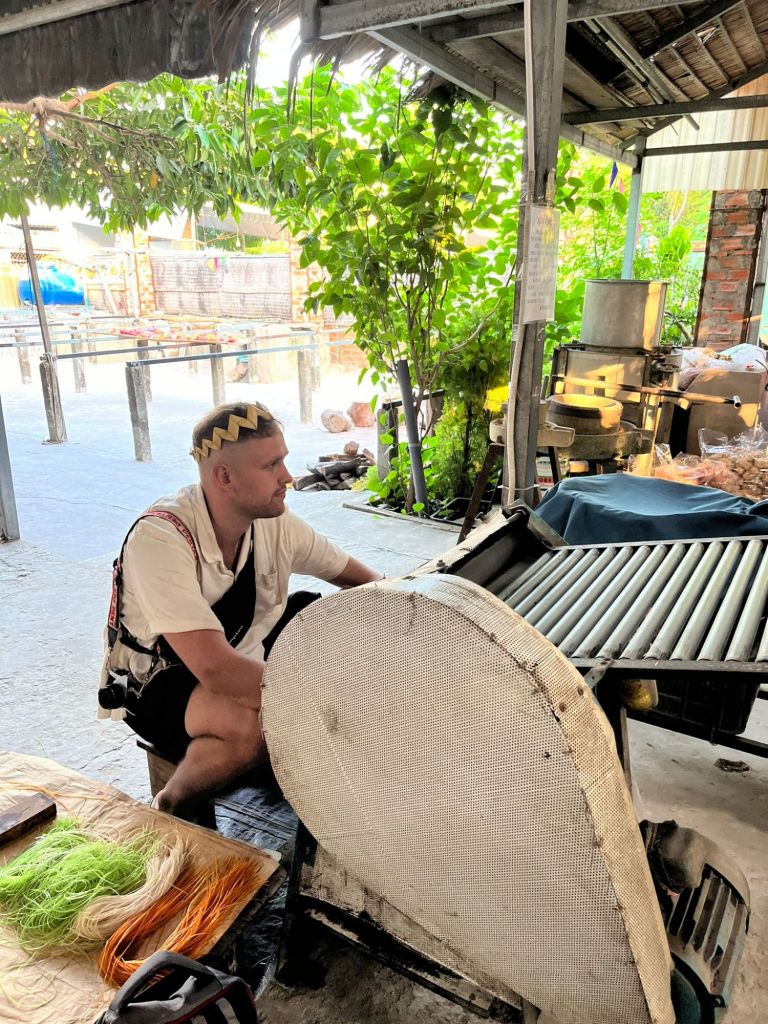
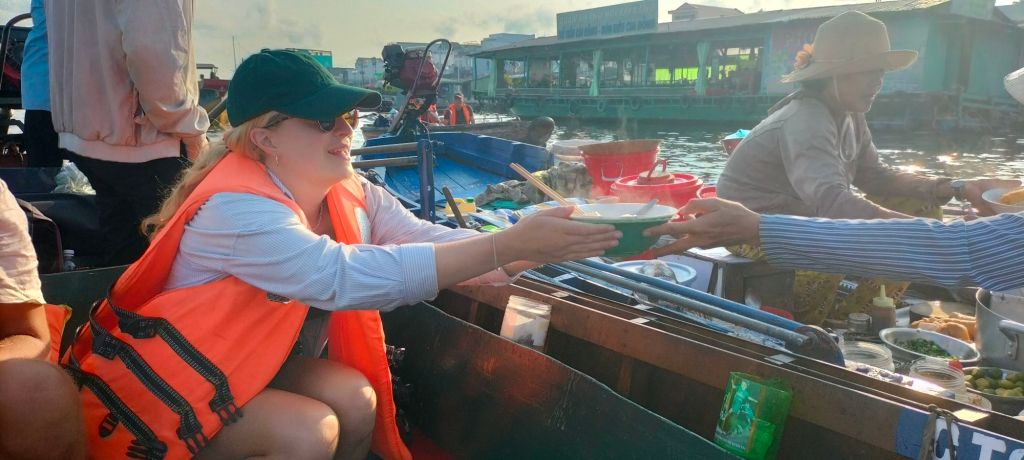
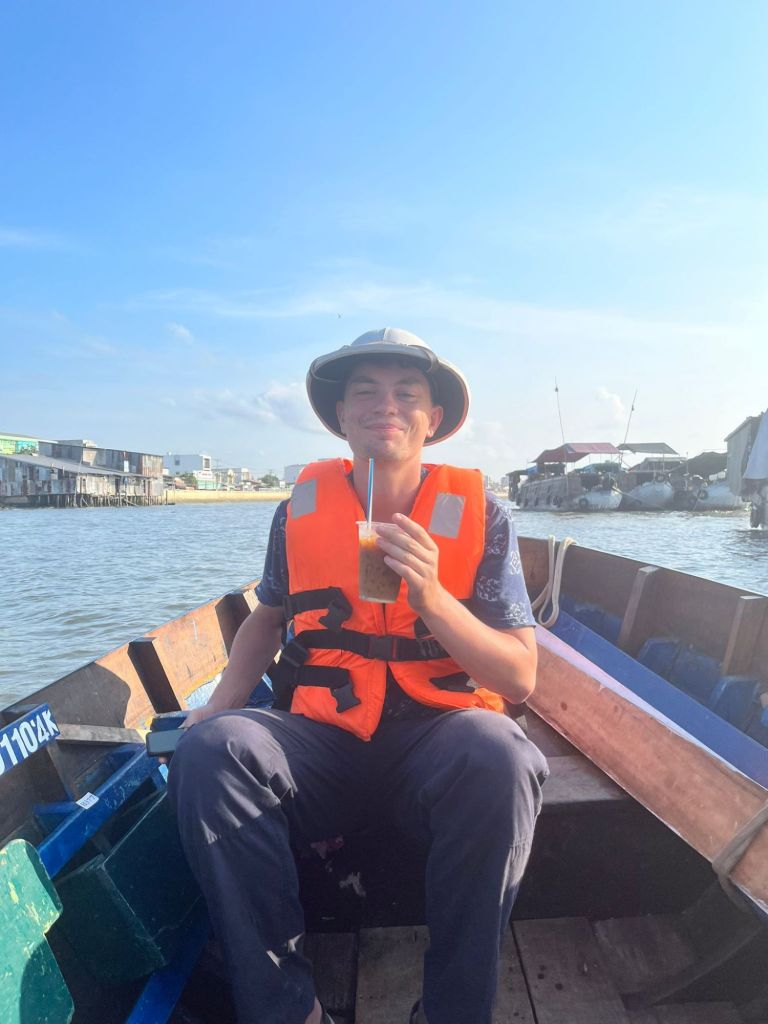
Day two dawned with a boat pick-up straight from our doorstep, navigating the labyrinth of canals that crisscross the Mekong Delta like a watery highway network (apparently work on the network started nearly 2000 years ago!). First stop was a noodle factory, where we rolled up our sleeves to craft some colourful noodles. Then, onto the famous floating market. The floating market is a bustling hub of commerce, where boats of all shapes and sizes gather from all over the region to sell wholesale produce. Some enterprising locals were selling piping hot noodles and coffee to fuel the hungry market-goers. It would have been rude to not try it!
map of the canal system. Started by the Funan civilization in 200CE and restarted under the Nguyen Dynasty until WWIINoodle factoryA different kind of drive thruFloating market coffee
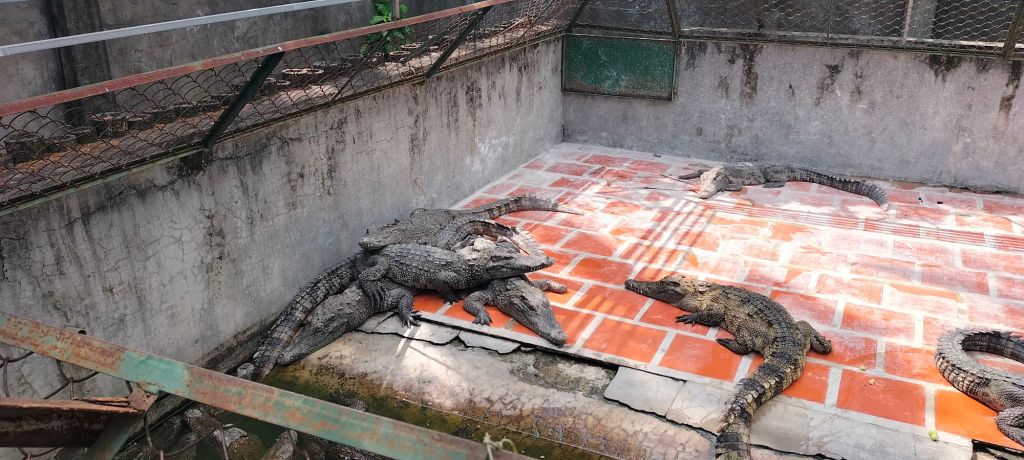
Next – Tra Su, a famous cajuput forest, beckoned with promises of avian spectacles and crocodile encounters (thankfully, on the observation side of the fence). And as if to cap off our odyssey, I dared to venture into uncharted territory and ordered us some barbecued rat. Henry and Grace, bless their adventurous souls, had their doubts, but hey, when in the Mekong Delta, right?
Prior to this trip, I was at a loss for what to explore in the Mekong Delta. But now, it’s crystal clear that birdwatching and navigating the vibrant floating market are absolute musts (and pith helmets encouraged!). Two days proved ample time to soak up the essence of the area, though truth be told, we could have easily traded a bit of adventure for some extra poolside lounging.
(edit: Speaking to Joshua after writing this, he says the delta is also littered with ancient ruins of the Funan civilization that started the canal building, I never knew they left anything behind! It’s not well advertise at all, I’ll have to go back and try and find some…)
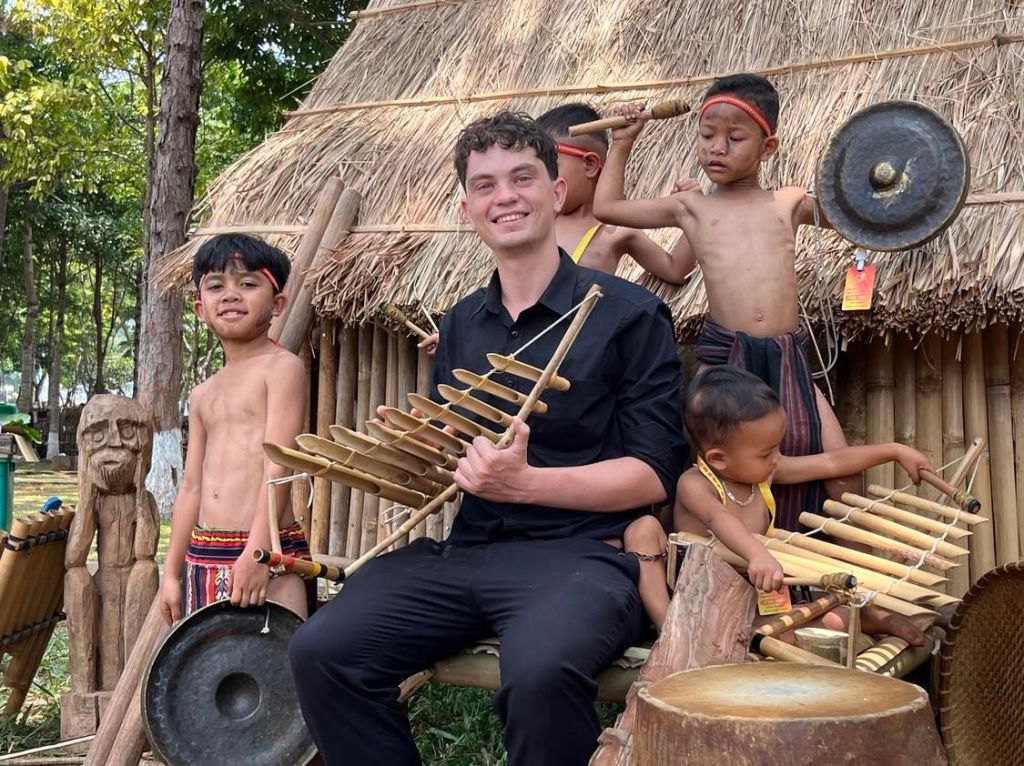
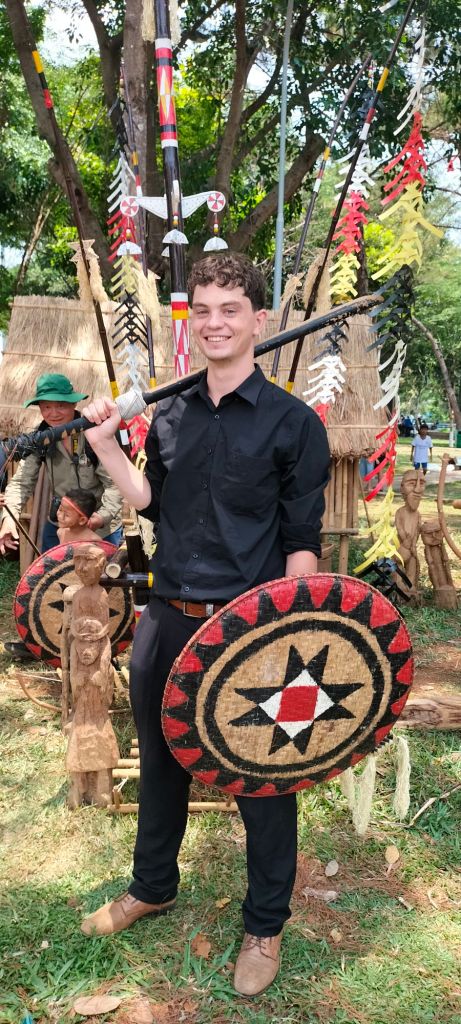
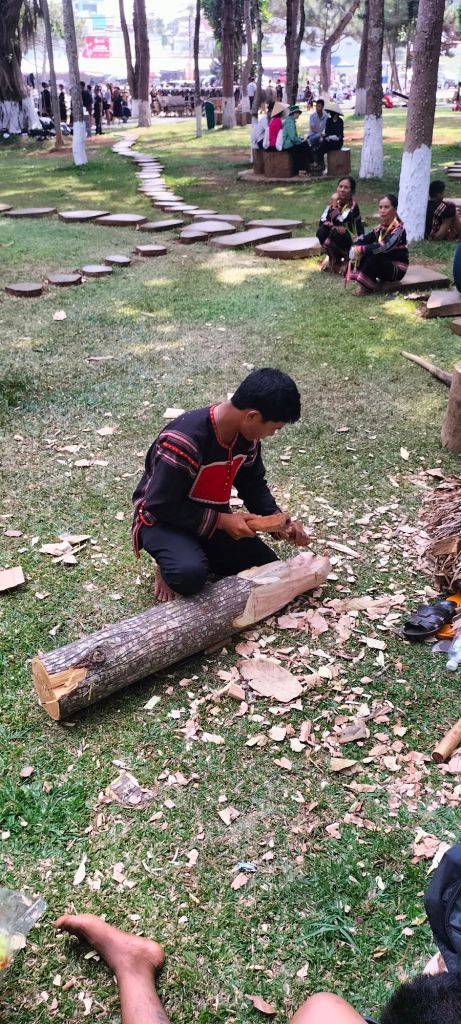
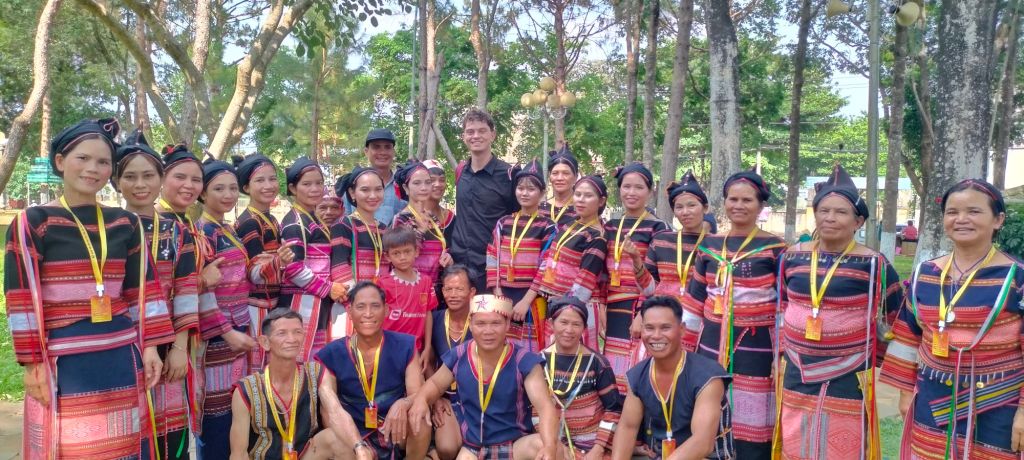
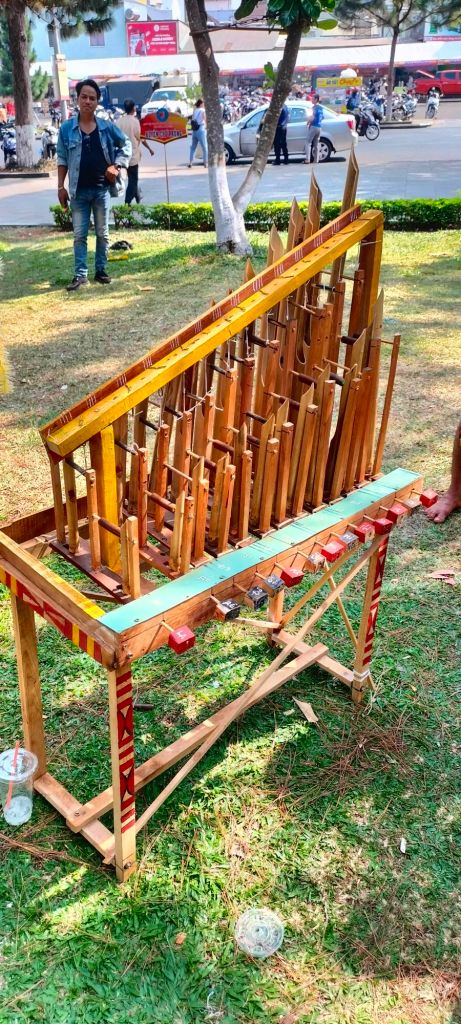
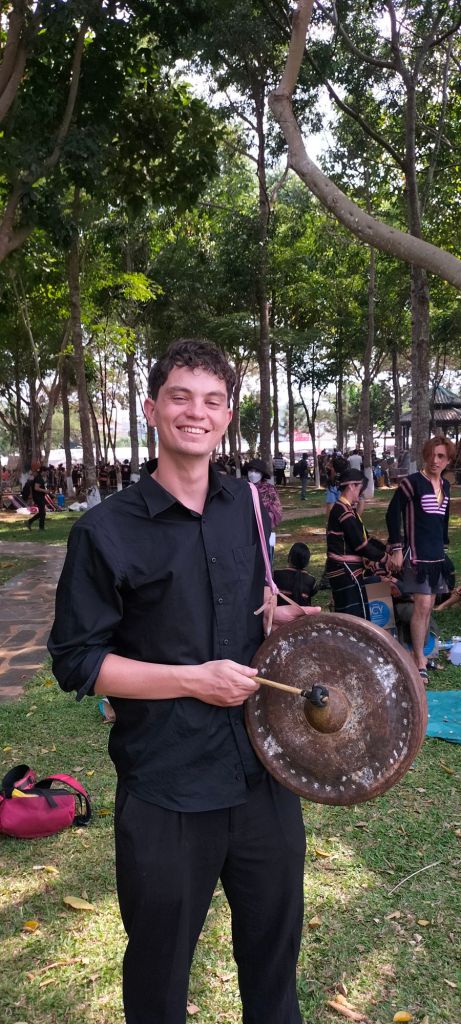
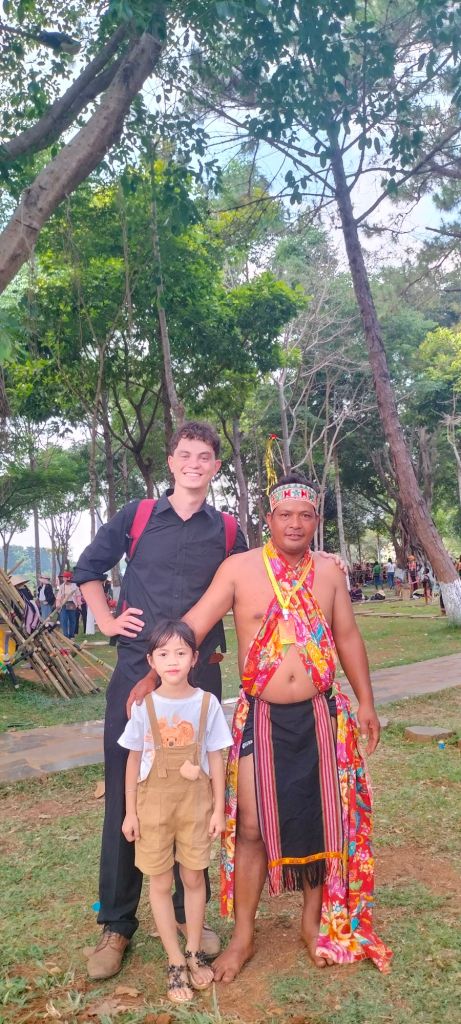
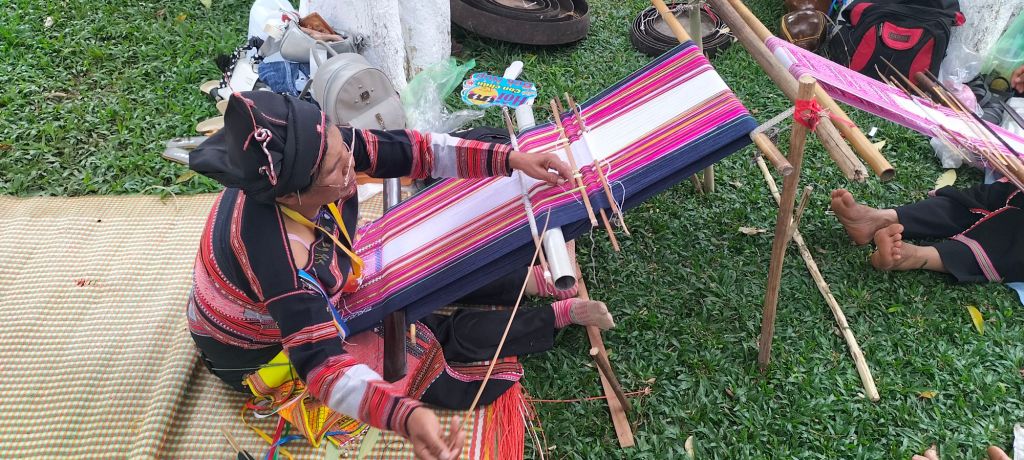
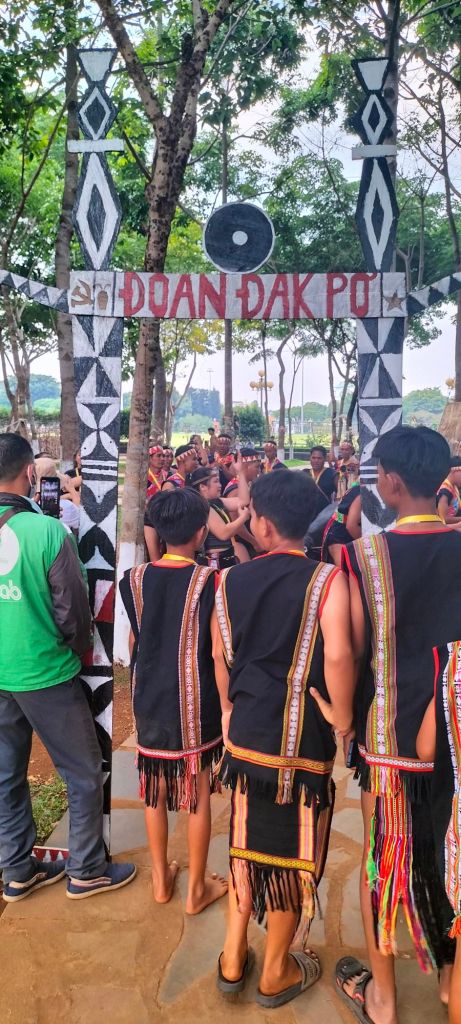
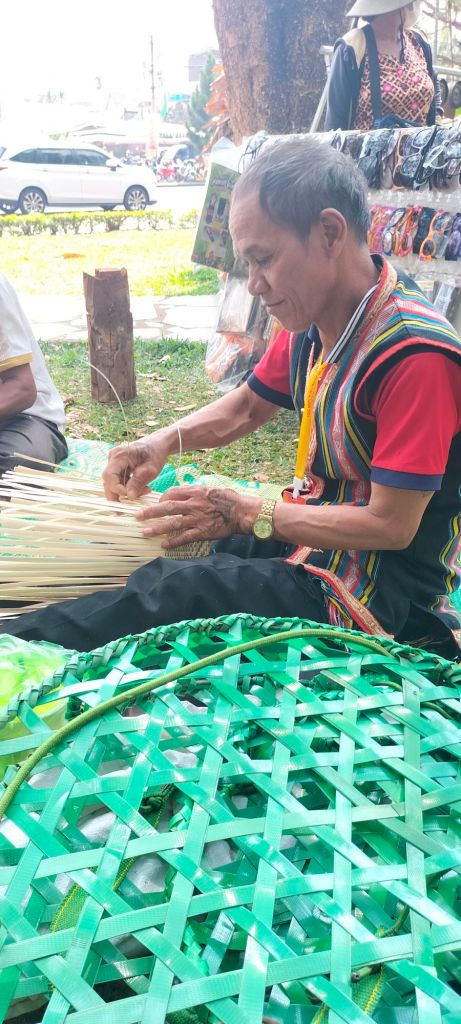
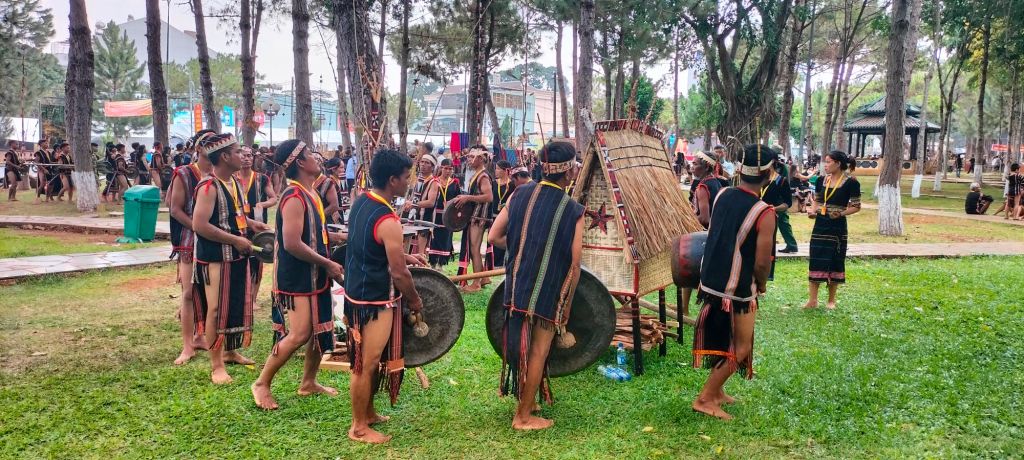
This weekend was the Ngày hội văn hóa các dân tộc tỉnh Gia Lai which was a celebration of the indigenous peoples of Gia Lai province. Each of the province’s 14 districts sent a village to represent their culture. They put on displays of crafts, music and dance. There was also festive food for sale: spit roast pig, grilled chicken and com lam (sticky rice cooked inside bamboo)
Plei Ku Roh (Yumi’s village)Ling tơhang is jrai for warriorK’bang wanted a photo with meAyun Pa brought this really cool instrumentSome young lads from Chu Se spoke good English and let me try the gongDak doa
Yumi’s village was there and they greeted me; there were a lot of familiar faces from the Christmas party as well as one guy who’s a bit of a social media influencer who’s Facebook name is Tarzan, I was surprised to discover he speaks English.
I also caught up with the Dak Doa group, where one of the dancers happened to be a former student of mine from my stint teaching in Dak Doa town. It’s moments like these that make you appreciate the richness of living cultures and the power of self-expression.
Hannah’s Birthday
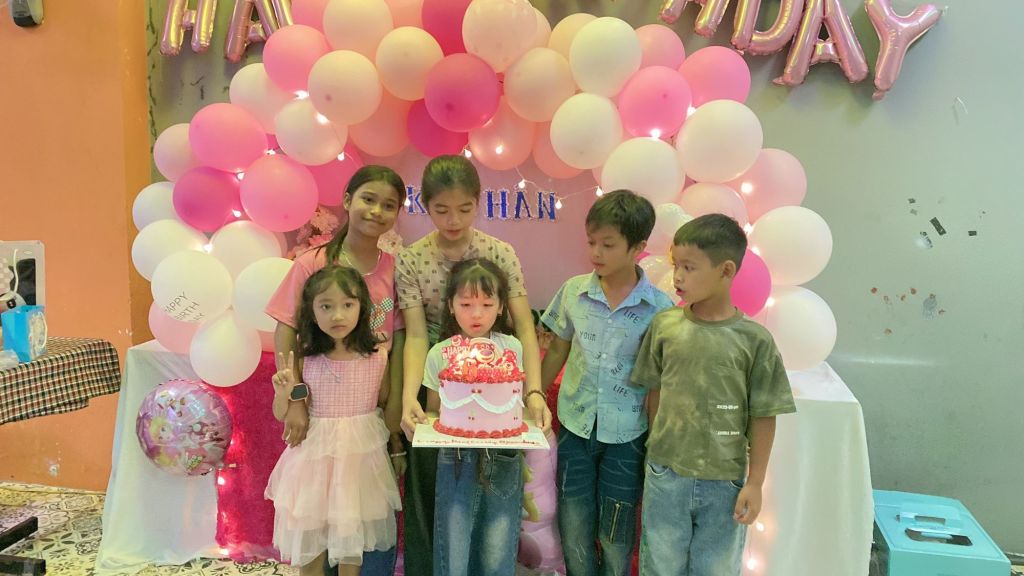
Sunday marked a special occasion: Hannah’s sixth birthday. We went to “Happy Kids” (think Wacky Warehouse) with a group of her cousins where the staff had set up a special birthday display.
Cacao at Grandma’s
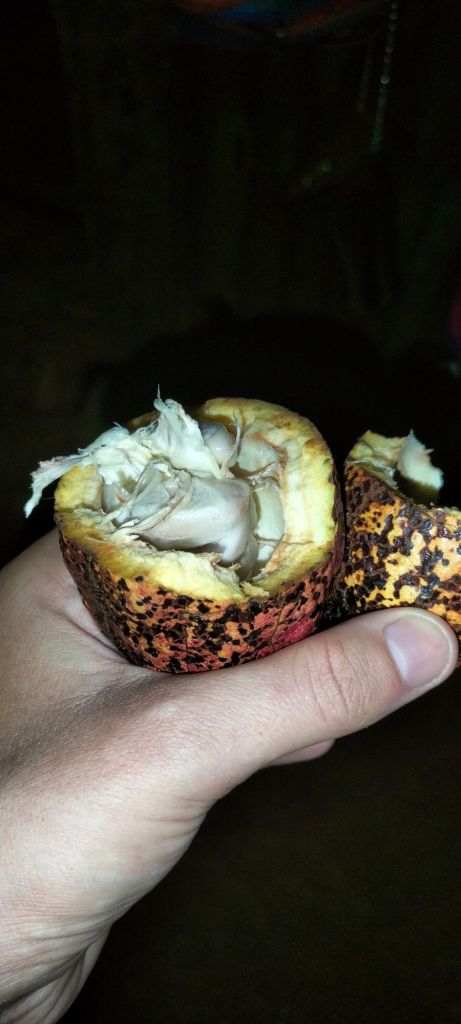
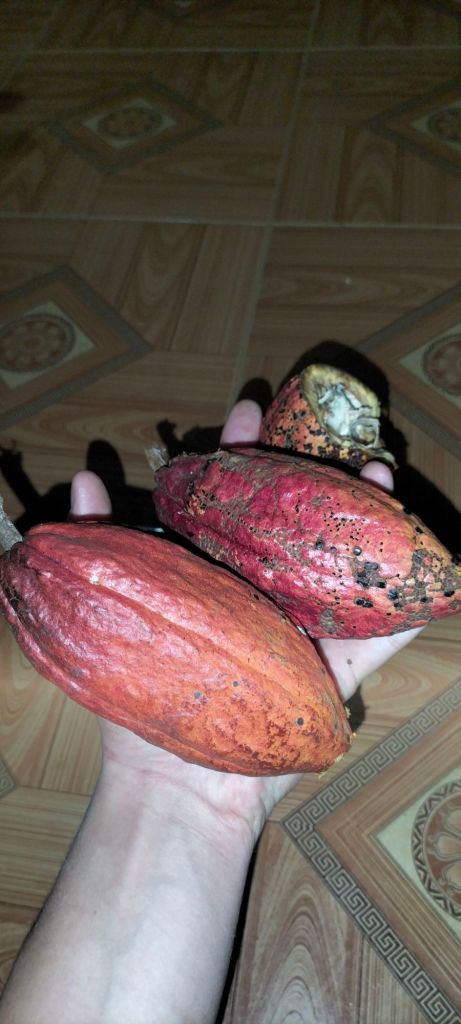
For a birthday present, Hannah got a book about rainforests. While flipping through it, I mentioned to Yumi that I’d never tried cacao fruit before like I saw in the book. She replied that her grandma had a cacao tree brimming with fruit, untouched because nobody really liked them. So that evening, we decided to pay grandma a visit.
Grandma’s cozy home is adorned with cherished family photos and cultural touches like an ethnic woven mat and catholic paintings. Amidst lively chatter in the Jrai language, we embarked on a cacao harvesting adventure in the backyard, disturbing roosting chickens along the way.
Yumi cracked open the cacao fruit’s pumpkin like skin to reveal a cluster of seeds wrapped in white pulp. As I popped one into my mouth, Yumi warned me not to chew the seeds but to suck on them like sweets. Too late! I had already bitten into the seed which was soft like a cashew nut and unpleasantly bitter. We took an armful of fruit back into the living room and I contentedly sucked on the seeds as the women chatted away.
Late night cacao snack
Kontum
Friday was a bit of an adventure. I popped over to Kontum for a couple of reasons. Firstly, to catch up with a mate I met online who’s also teaching English. He’s been busy producing a book of folk stories from the Xodang people (Yumi’s dad is Xodang). He even wrote a paper about it! He kindly gifted me a copy, and you’ll never guess what I gave him in return: cacao fruit! It’s a beautiful book, and I’m itching to dive into it.
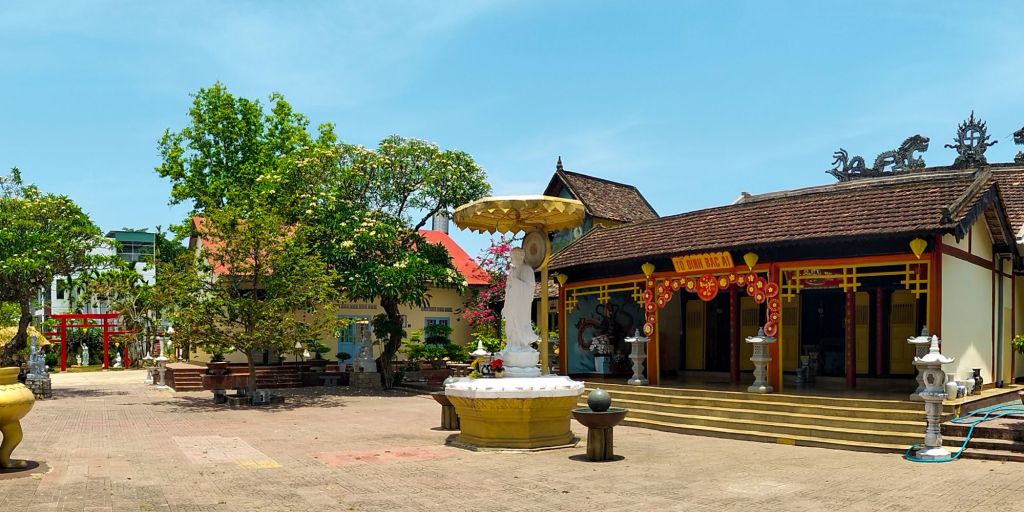
Of course, while in Kontum, I couldn’t resist popping by that temple I mentioned before, the one with the legendary tiger. I was pretty sure I got the right spot because they had the photo on the wall that I included in my last article. When I started asking around about the tiger, people gave me these odd looks, like I’d lost the plot. Nobody knew anything about the legendary beast.
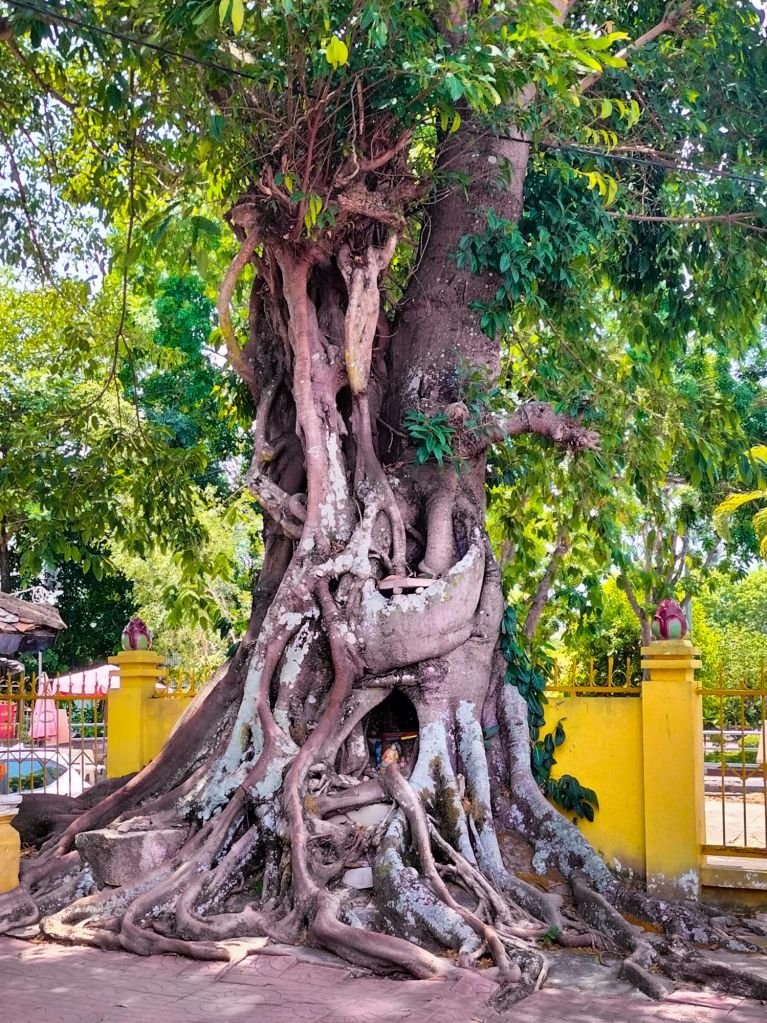
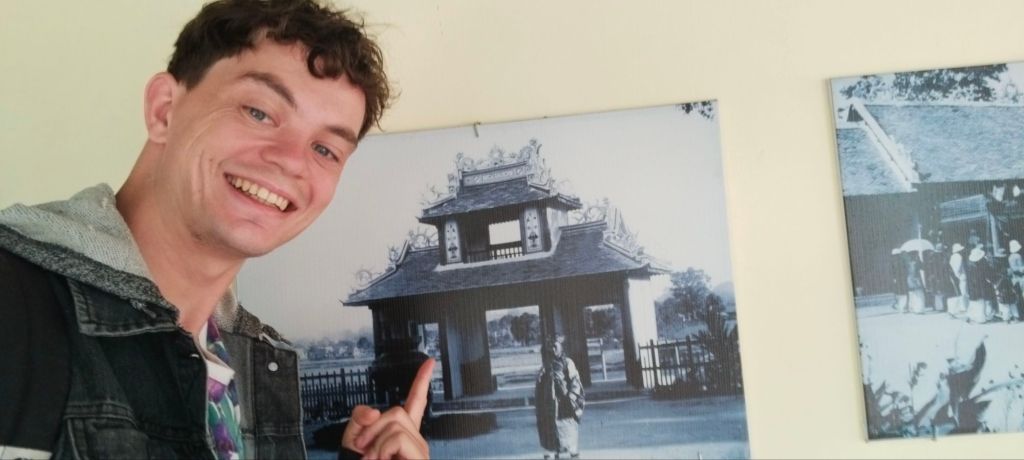
Big old tree on the pagoda’s groundsThe photo I included in my previous article about the tiger. I didn’t see this beautiful gate at the site toda
When I was researching the tiger originally, there were alternate versions saying it wasn’t a Buddhist temple but this Catholic church. Could some rogue Buddhists have coopted the story? I’ll have to go and have a look and speak to people there next time I’m in Kontum.
Our Easter holiday kicked off bright and early at 7am when the car rolled up to whisk us away. Packed inside were Yumi, three excited aunts, a cousin, myself and two other partners, and our ever-patient driver. We were headed to Quy Nhon city. Taking first the infamous Mang Yang pass then the An Khe pass to descend from the heights of Pleiku to the coast.
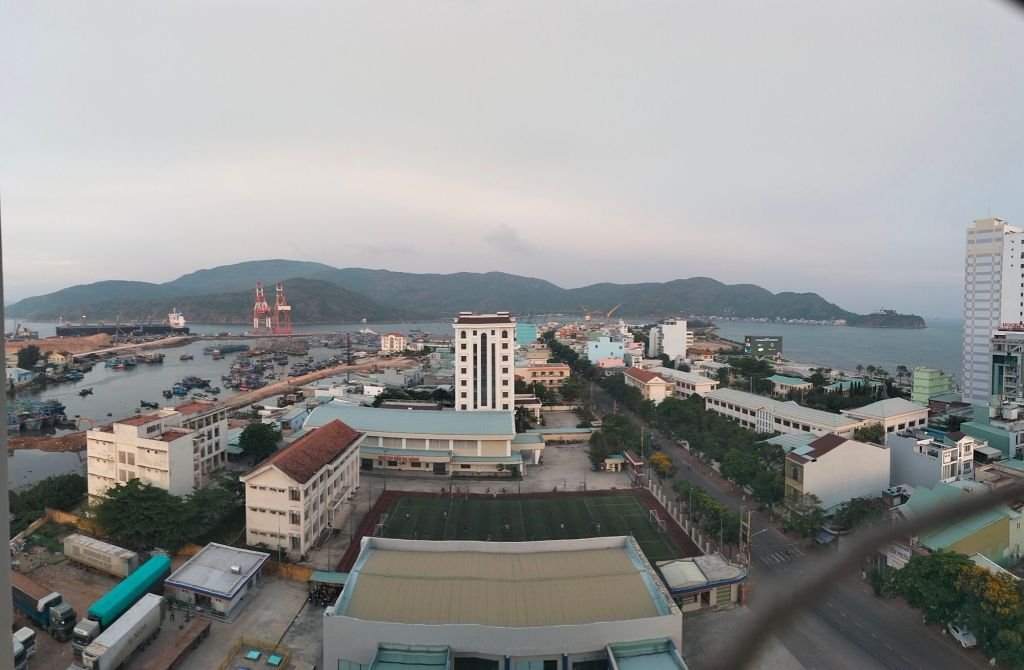
View of Quy Nhơn port from the flat
After a nap in the rented flat we hit the town for a wild Good Friday feast of snails and beer on the seafront. After some pressuring I sang a karaoke song in front of the whole restaurant, then after more pressuring another!
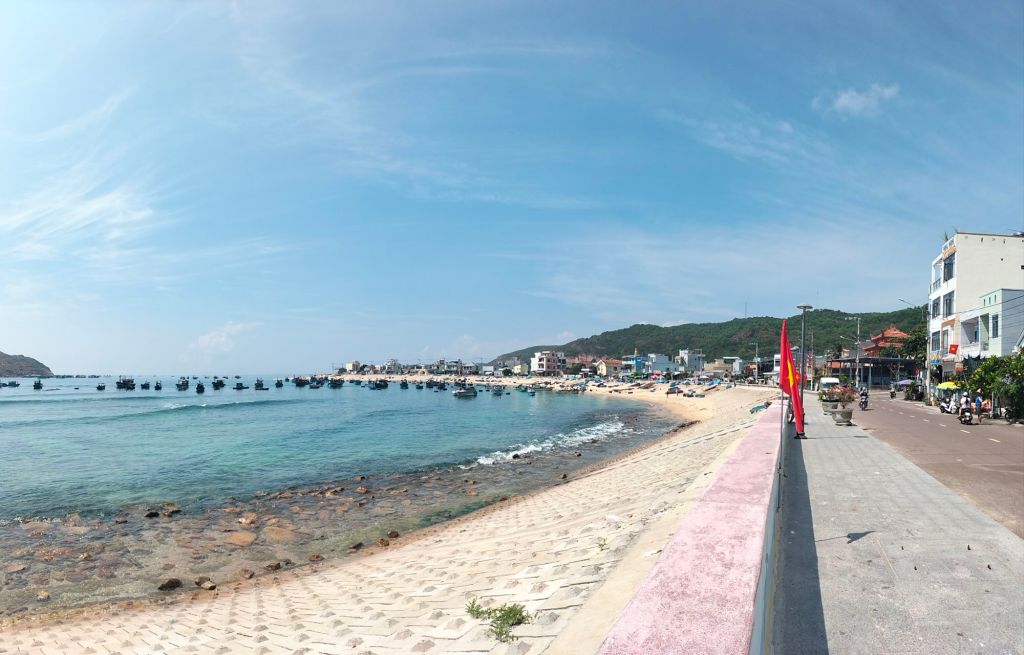
Saturday was a special day, marking Yumi’s aunt’s 32nd birthday bash. With Yumi’s mom being the eldest of a whole troop of sisters, there’s hardly a generation gap between Yumi and some aunts! We decided to celebrate by cruising around the coast to Nhon Hai, a charming fishing village. It’s a hot spot for tourists, thanks to the platforms dotting the shores around a little deserted island called Hon Kho.
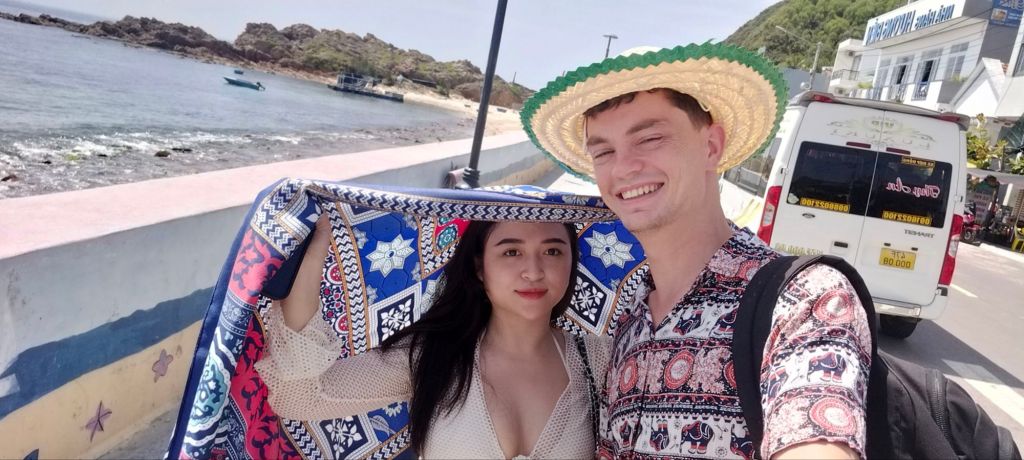
Nhơn Hải villageAll the guys bought matching sombreros!
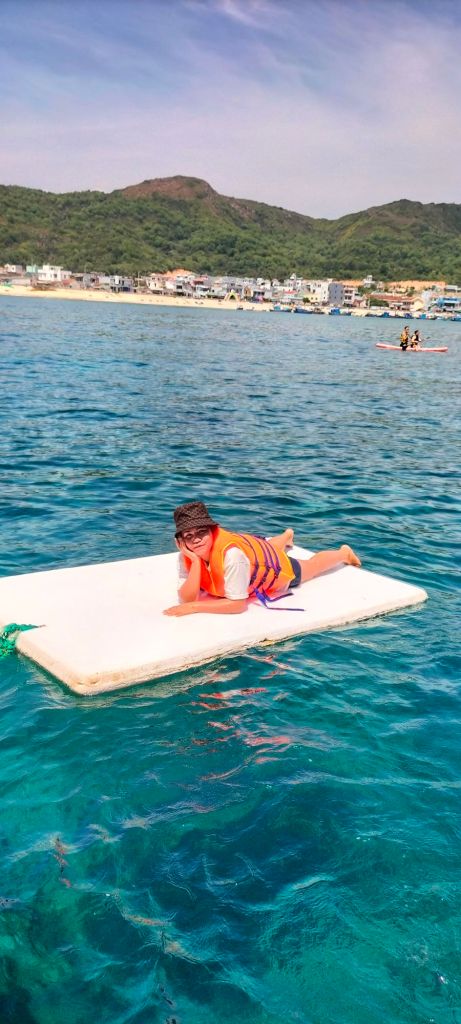
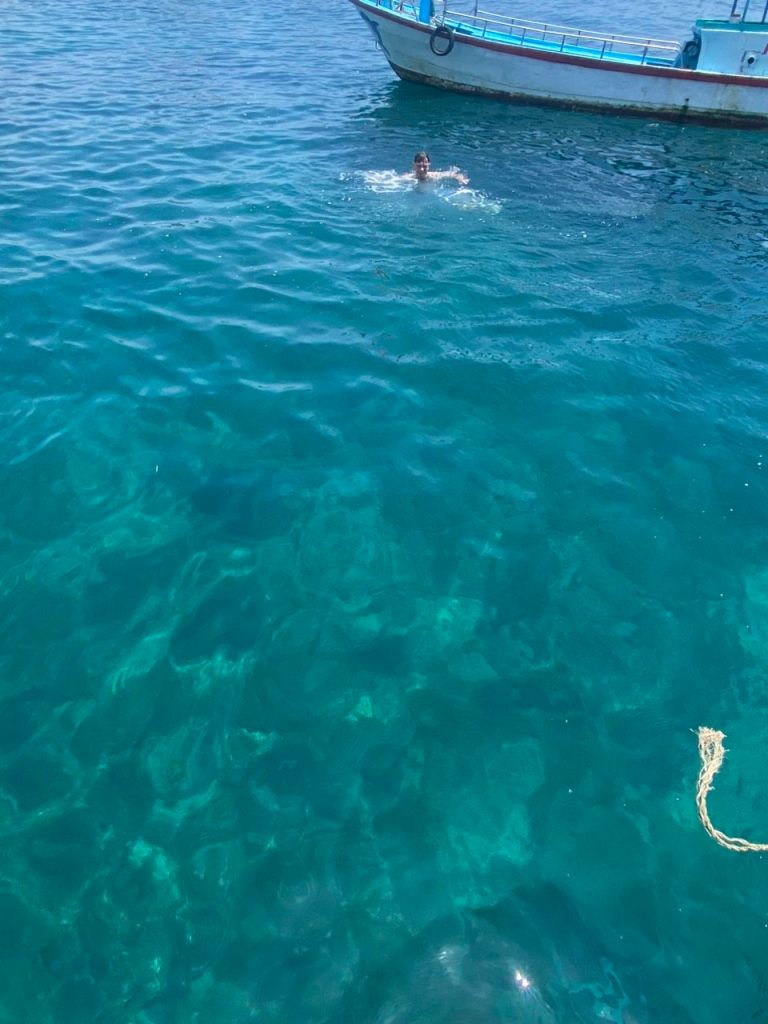
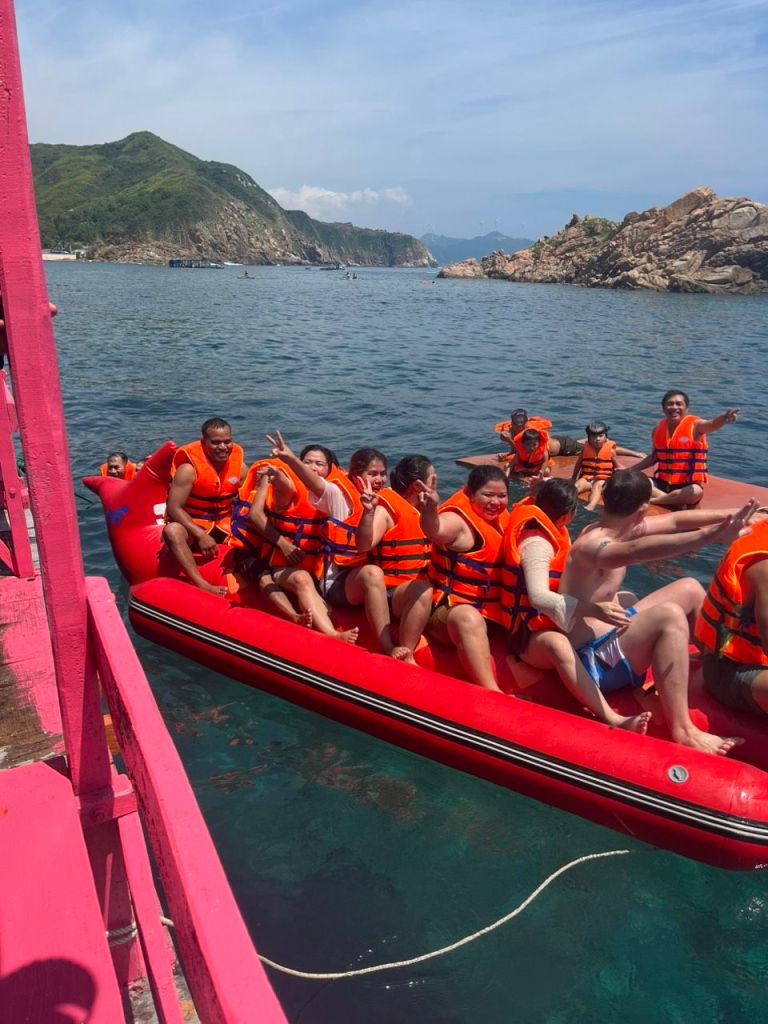
The day was a whirlwind of aquatic adventures—snorkeling, paddleboarding, and even hitching a ride on one of those long inflatable “banana” boats towed by a jetski. Little did we know, our banana boat ride was supposed to end with a splash, courtesy of a jetski trip to flip the boat. But with our crew on board, we were too heavy to tip over!
Cousin
We ate seafood in Nhon Hai then headed out for a surprise birthday dinner which the restaurant had set up with balloons and a photo display then out for more karaoke and more drinking. We came home on Sunday but not before I took the chance in the bigger city to buy a Pikachu chocolate egg for Hannah for Easter.
Plei Boi
Let me tell you about a little village that’s been catching my eye on the map—Plei Boi. Every time I see it, I can’t help but chuckle because it sounds so much like “playboy”. This quaint highland village sits snugly on the west side of my favorite hiking area, and I figured it’d be fun to approach my hike from a new angle.
did you mean…
Plei Boi could be the posterboy (or boi) for highlands villages, with its majestic stilt houses standing tall against the backdrop of the nearby mountains. The air was ripe with the sweet scent of cashew fruit.
Traditional Jrai tomb (after the abandoning ceremony) in Plei Boi
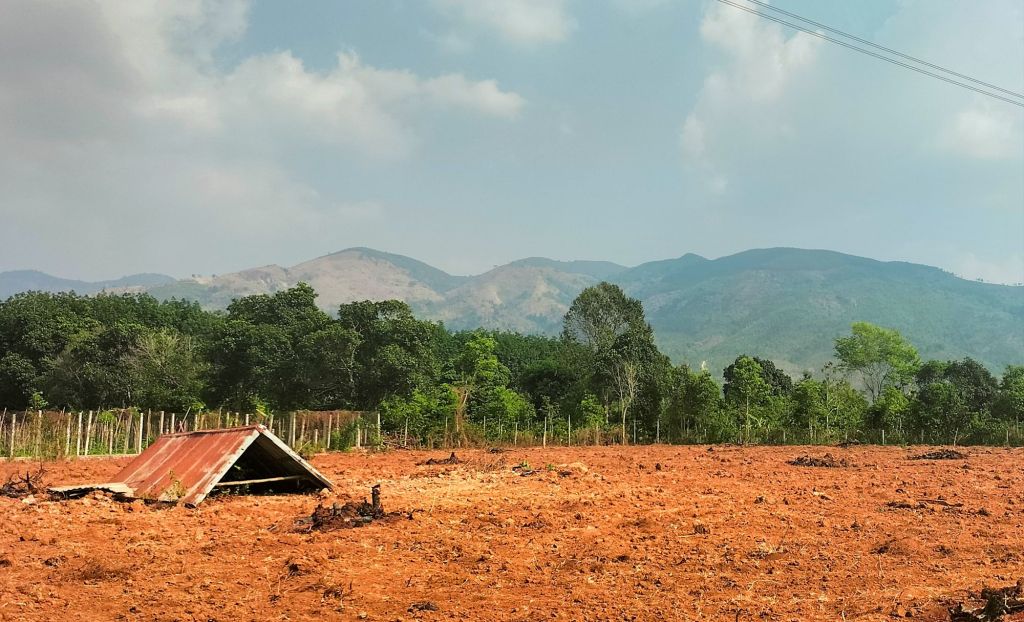
On my trusty Honda Blade moped (highly recommended for steep dirt roads!), I set off into the foothills on dusty dirt roads. All around were rubber and cashew tree fields. From the tracks on the road, it looked like most of the traffic had 4 legs and went “moo”.
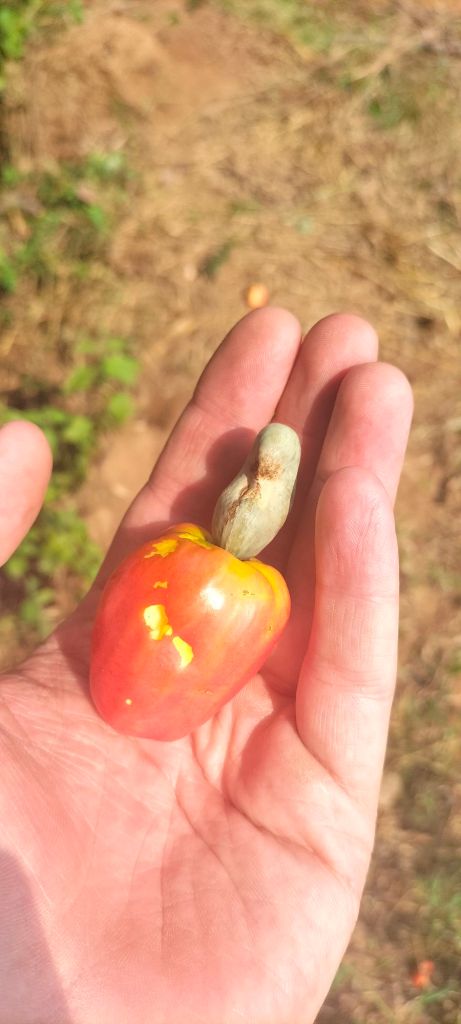
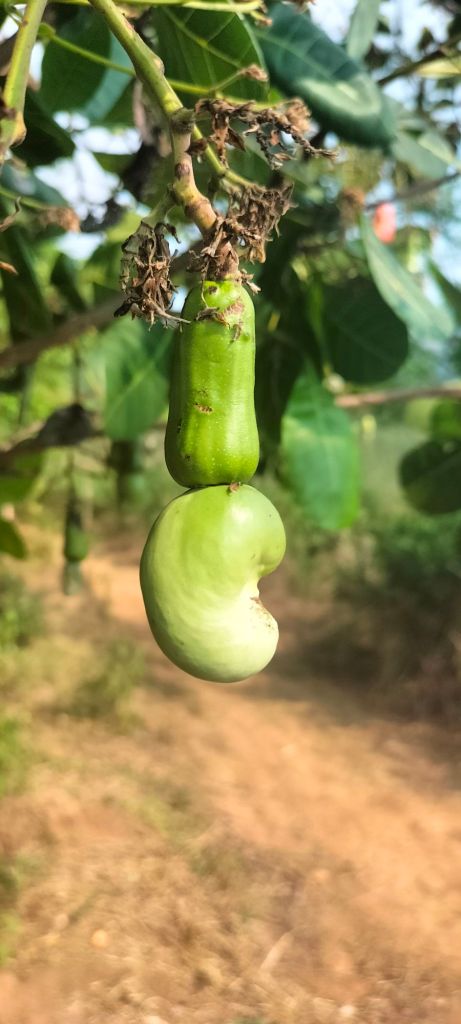
Ripe cashew fruitCashew on the tree
After parking the bike just beyond the last fenced field, I decided to tackle the rest of the journey on foot. It wasn’t exactly a walk in the park lugging my camping gear in the scorching heat. The weather app was saying it “feels like” a sweltering 36 degrees even by 4pm! It was slow progress, to say the least. I’ve been on buses in Cambodia that after a bit of a climb have to stop and open the bonnet; that’s how I felt that day!
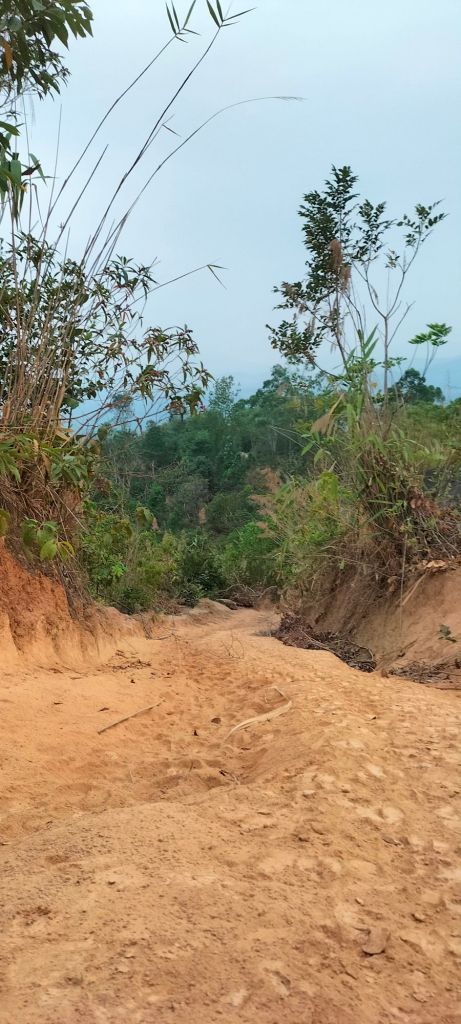
Fancy driving down this road?
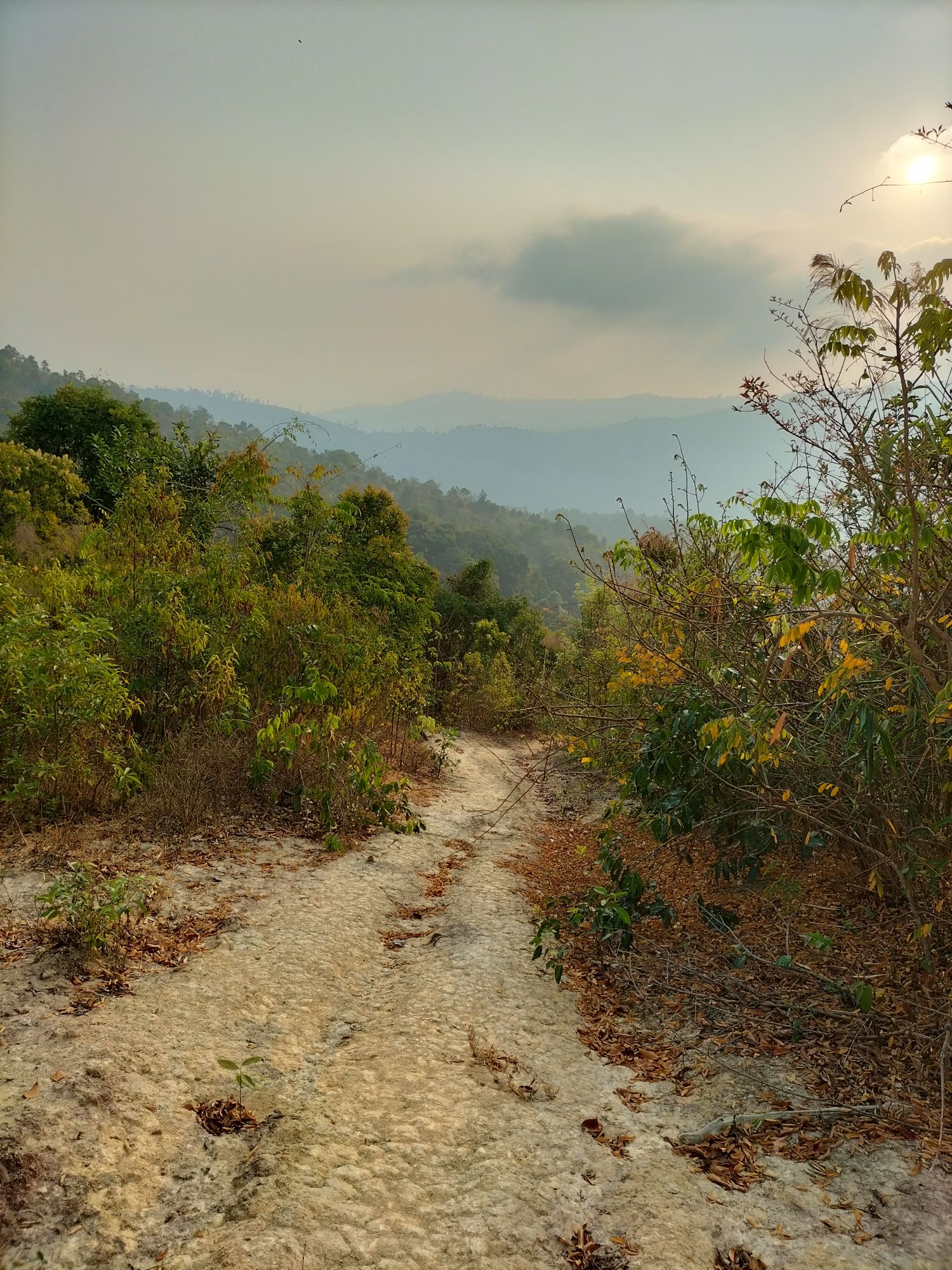
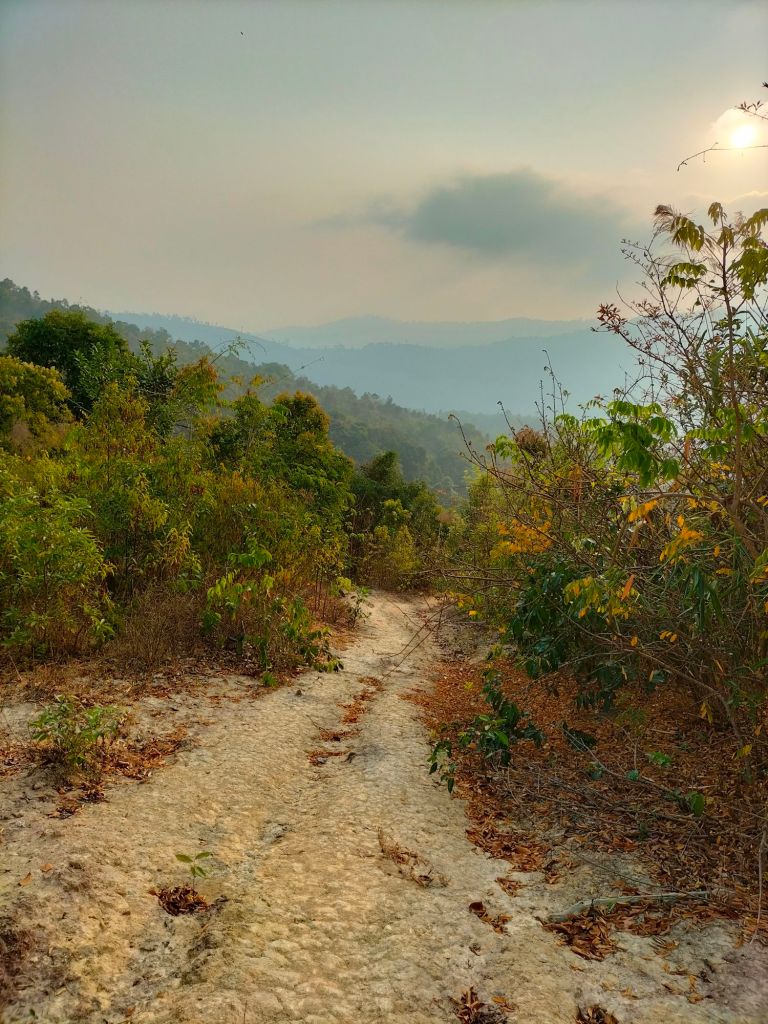
With the melody of cowbells serenading me, I trudged on, barely making it over a kilometer from where I ditched the bike as the crow flies. I think this hike marked the end of the season for me. I’ll have to wait until the rainy season cools things down before I attempt another adventure like that!
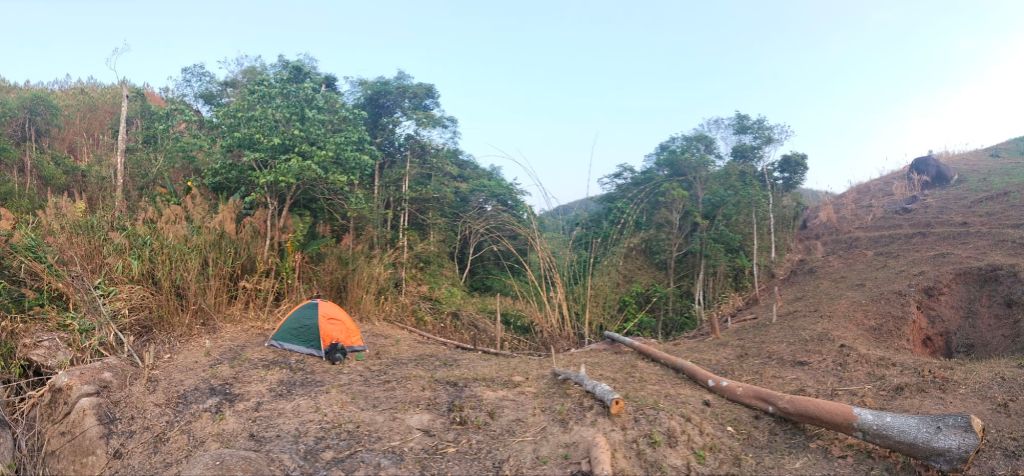
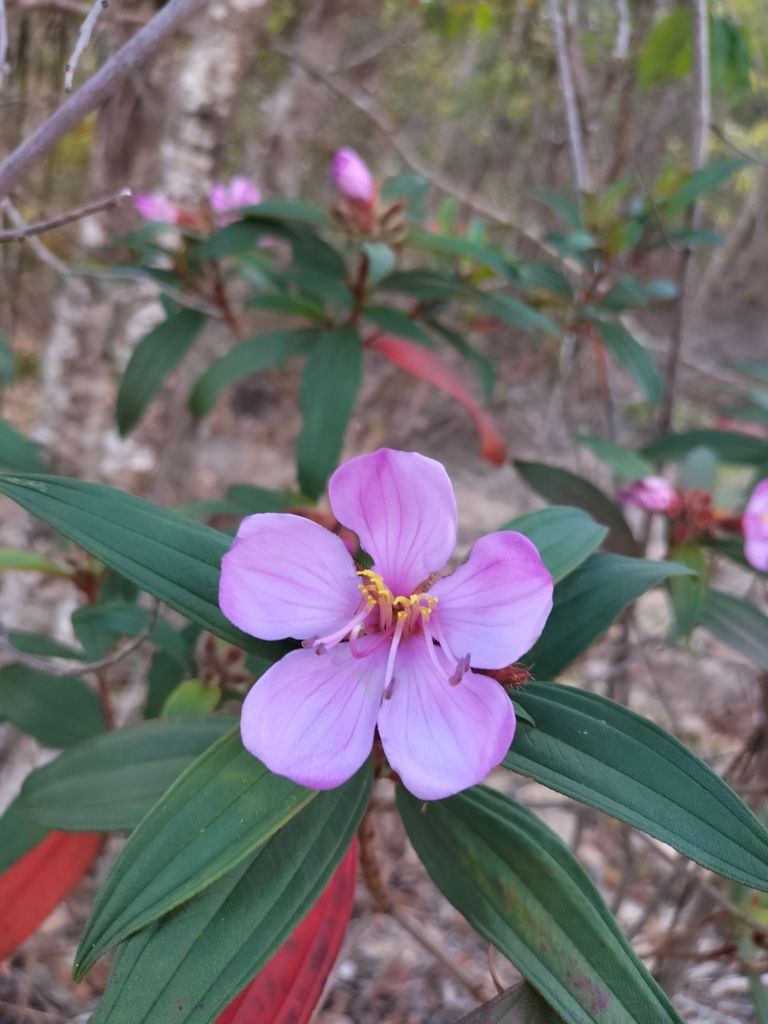
I eventually stumbled upon a nice spot—a flat area in the midst of recently cleared forest, perfect for setting up camp. On the edge of the clearing I stumbled upon something straight out of a horror film—a spooky jungle cave with dangling fig roots. I couldn’t bring myself to go in; I’m a wimp with caves. Naturally, I couldn’t resist making some observations for iNaturalist too.
Campsite
Above all, despite the challenges, it was a peaceful getaway. There’s something magical about drifting off to the symphony of jungle insects under the vast expanse of stars.
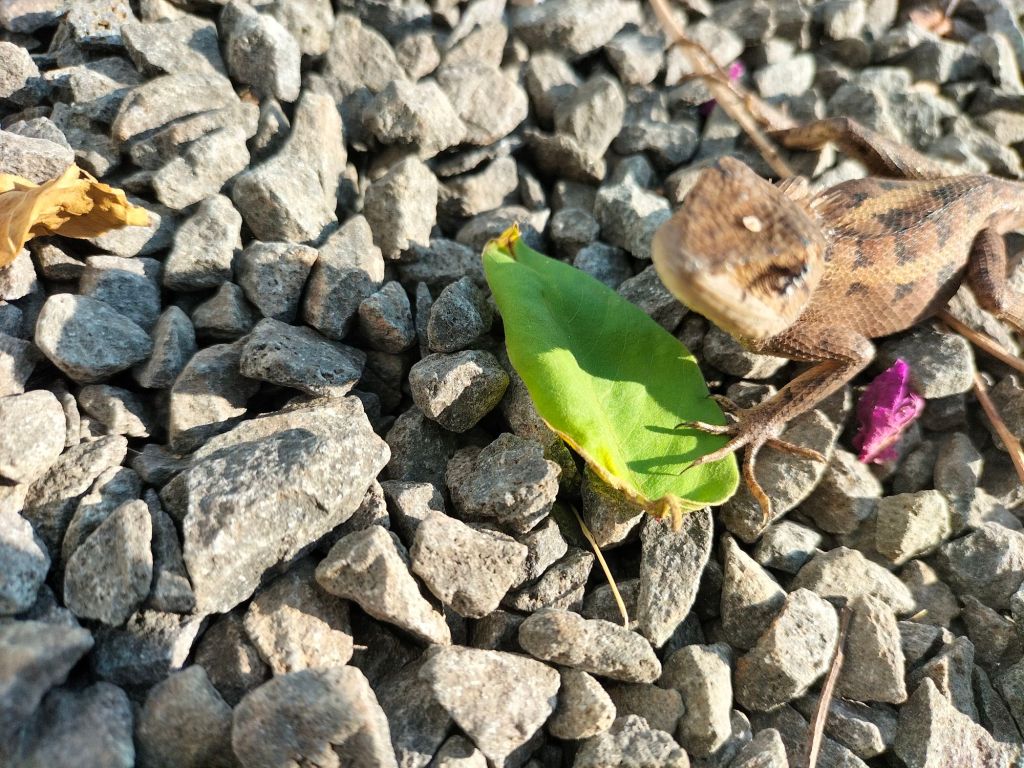
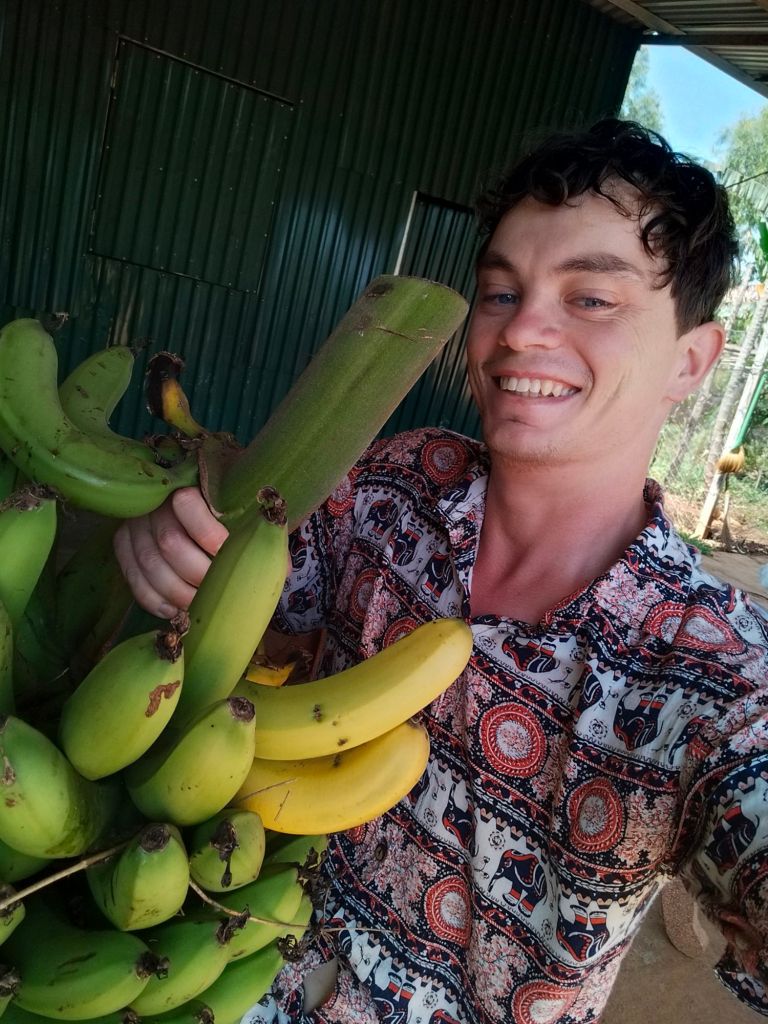
I quite like this snap I took of a cheeky lizard in a cafeBanana harvest
Personal News
Exciting news to kick things off: I finally got my new visa! With a generous two-year validity, it’s a weight lifted off my shoulders. It’s been quite the ordeal, in the past I could always do visas in Saigon but they changed the rules so all visas must be done locally. The adjustment has been a learning curve for everyone involved, even the local immigration department. While the visa saga has kept me busy, sadly my hiking adventures have been on pause. So, apologies, no new nature shots to share at the moment.
In other news, brace yourselves for tales of adventures when my cousin Henry and his partner Grace arrive in Vietnam next month! We plan on meeting down south, maybe seeing some mangroves and Viet Cong tunnels – it should be a good introduction to Vietnam to set it apart from Thailand and Cambodia.
Projects
The Jrai language is the primary language of Yumi’s family and I’ve been spending a lot of time on it recently. I’m passionate about minority languages and I’ve started digitizing the Jrai language books in my possession. I aim to share these treasures with the world by putting them online and uploading them to websites such as Glosbe and Wiktionary among others. I hope to make resources more accessible to learners, native speakers, and fellow enthusiasts.
Glosbe, a great online dictionary, champions numerous minority languages. One of it’s best features is the ability to link translations across languages, so when there is a Vietnamese to Jrai translation, it can show it in English too (or Navajo, Swahili or Basque). Glosbe also has a database of sentences with translations, to provide invaluable context. Already, I’ve begun uploading translations from my Jrai conversation book and I have also contributed approximately 8000 verses from the Bible, enriching Glosbe with Jrai translations.
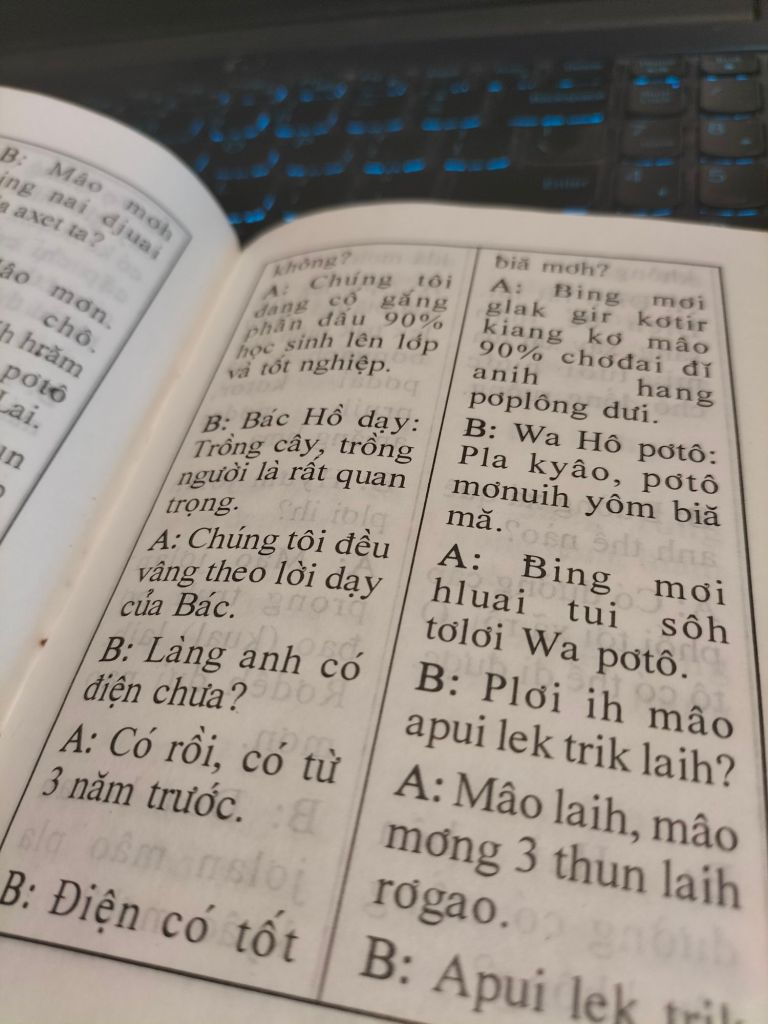
My jrai conversation book. A slim book for learners coming from Vietnamese to see side-by-side conversations. “Uncle Ho (Ho Chi Minh) teaches: cultivating trees, cultivating people are very important” (it’s catchiness pretty much translates into English but is completely lost in Jrai)
I hope to continue digitizing my Jrai books, it will take me quite a while even with the few books I have to type them up. Typing in Jrai was a challenge in itself that I’m going to write about next.
Minority Languages and Technology
Navigating technology in minority languages comes with its own set of hurdles. The Jrai alphabet boasts 41 characters including the standard latin alphabet plus letters like ƀ, ơ̆, and â̆. This presents a challenge when it comes to typing, given the limited number of keys on computer keyboards.
Dedicated individuals have developed innovative solutions to address this challenge. Platforms like Keyman allow users to create and share keyboards customized for various languages, including minority ones. It’s a remarkable project well worth exploring, available both as a web version and an app.
Moreover, some Jrai speakers have drawn inspiration from Vietnamese history, crafting solutions such as TNkey. Taking cues from Vietnam’s development of the telex system in the 1920s, this method involves typing specific sequences of letters to generate desired characters. For instance, typing ‘o’, ‘w’, and ‘r’ consecutively yields “ở”. While telex enjoys widespread support on modern devices, perhaps one day TNkey will follow suit.
Looking ahead, I think the next frontier involves developing a comprehensive modern phone keyboard. Unlike platforms like Keyman, a standard keyboard seamlessly integrates into various apps and offers features like word suggestions and autocorrect. Achieving this entails digitizing the language’s word list, a task I plan to undertake after digitizing my Jrai books.
There’s still a lot more I could write about regarding technology and minority languages. For instance, what happens when you set your phone’s language to Cornish? However, I’m going to save delving into those topics for another time.
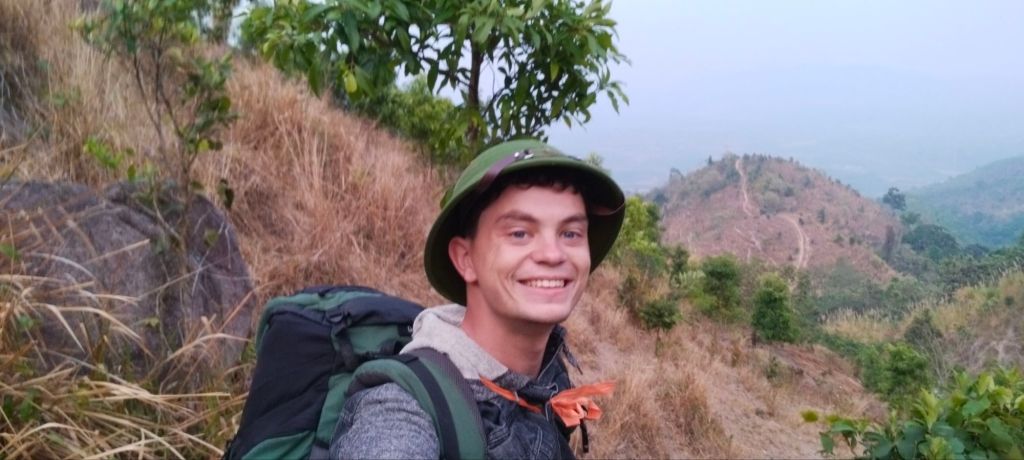
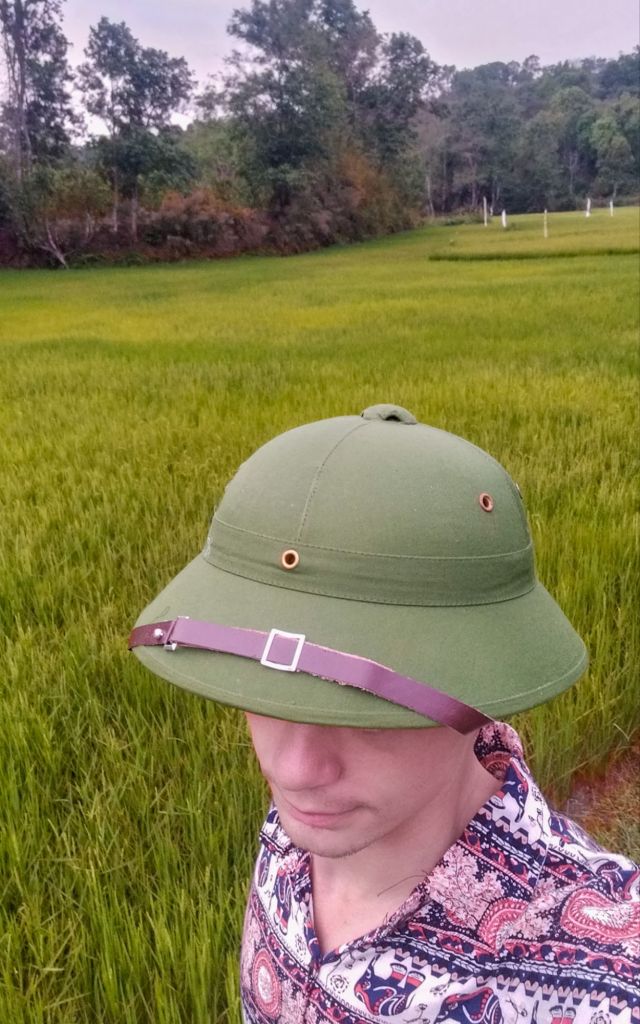
The YouTube algorithm has a knack for surprising me with recommendations for videos I never knew I’d be interested in. A recent suggestion had me watching a fascinating talk on the history of the Pith helmet. Learning about its practical design for sun protection and air circulation, I felt I needed to head to the market right away and get one for my next jungle expedition.
As I donned my fetching new hat, I felt washed with feelings of the age of exploration, when the world seemed unknown, full of fantastical tales and mysteries waiting to be told.
And so today, I want to write about the topic of cryptids – the type of mysterious creatures believed in by many despite a lack of widely accepted scientific evidence. From the Loch Ness Monster to the Abominable Snowman, these elusive beings defy conventional explanation. I enjoy tales about cryptids despite being a non-believer myself.
Vietnam’s Central Highlands with their sparse population and untamed jungle host more cryptids than one might anticipate. Join me as we embark on a journey through the local lore of Gia Lai, where whispers of cryptid sightings add an air of intrigue to the lush landscape.
Người Rừng
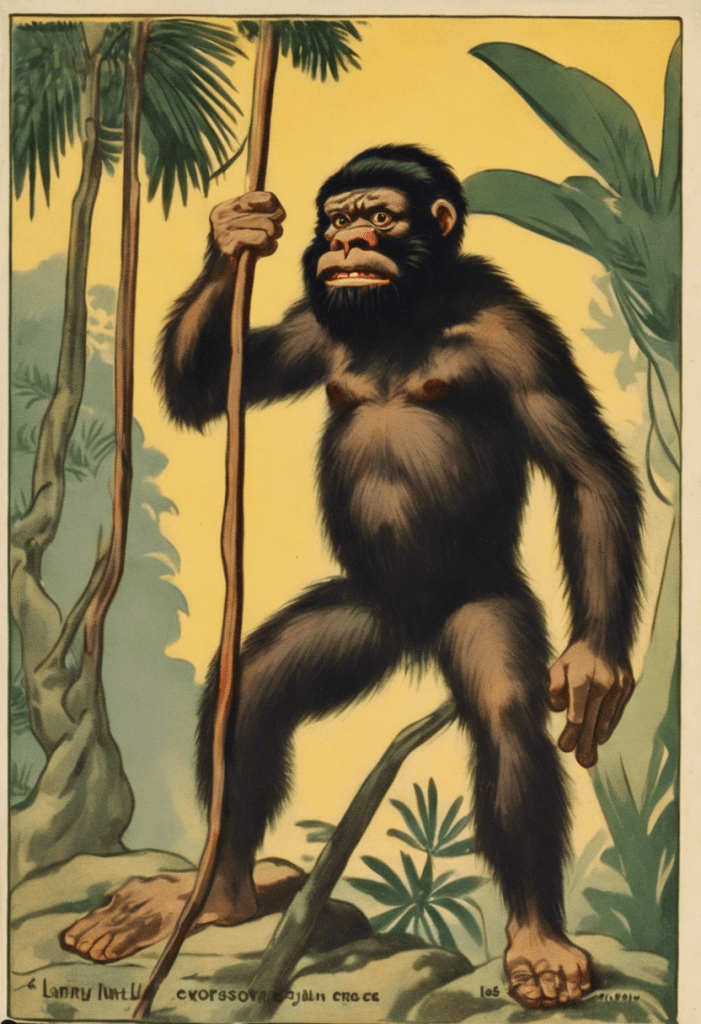
AI illustration
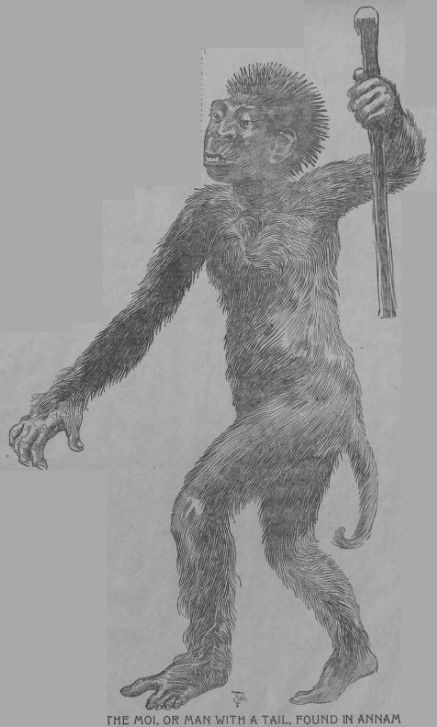
From deep in the untamed jungle comes a creature I am very interested in: Người Rừng, also known as the Rock Ape, Batutut, Ujit and more. These illusive primates are characterized as short hairy humanoids with tails, and have be reported in the west for as long as westerners have been present here. Some French scientists believed they had come across a primitive type of human or a “missing link”.
New York Journal illustration from 6th December 1896 captioned “The moi or man with a tail found in Annam” (based on someone talking about a “discovery” in the Cardamom Mountains
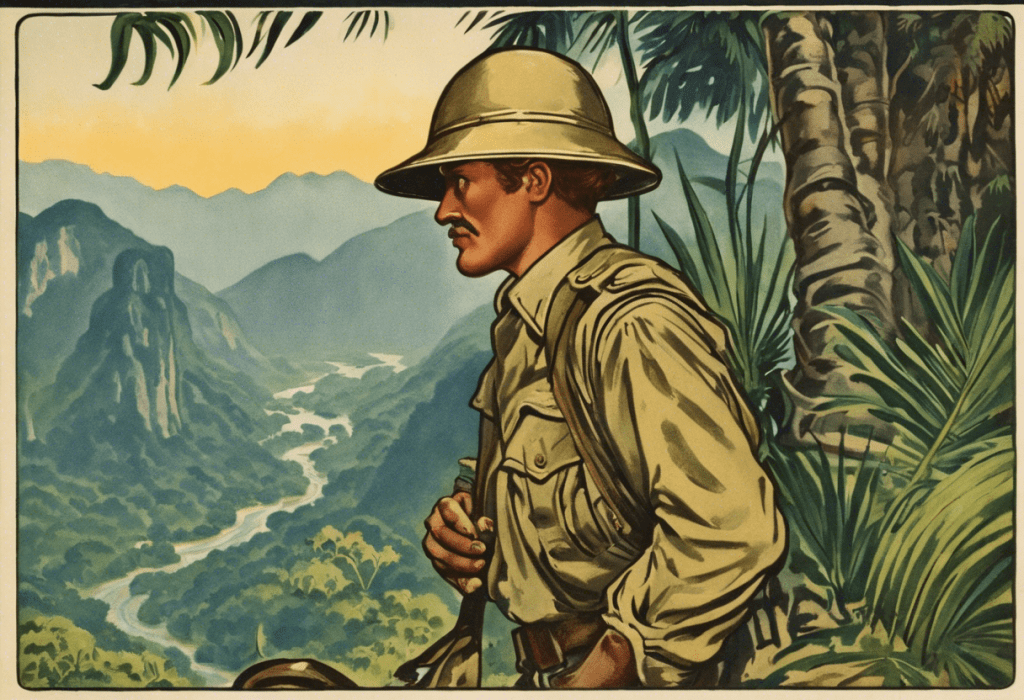
Picture the year 1947, French explorer D’Enjoy dons a pith helmet before venturing deep into the heart of Kontum’s jungle. Amidst the lush foliage, he witnesses beings that defy explanation. The indigenous Jrai people, stewards of the land, speak of these creatures as neither fully human nor monkey and say the creatures have long been known locally.
AI illustration
The Vietnam War brought more people than ever into the untamed Central Highlands and set the stage for further encounters with these inexplicable creatures. Soldiers on both sides share chilling tales of crossing paths with creatures that match the descriptions of Người Rừng. One account from American GIs describes a figure with a long, cucumber-shaped head, draped in fiery red fur. In 1974, a determined North Vietnamese general leads an expedition into the wilderness, driven by the quest to unveil evidence of these elusive beings. He finds unusual footprints deep in the jungle.
Looking ahead, I’m hoping to delve deeper into the fascinating world of Người Rừng in a more comprehensive piece. I plan to gather insights from interviews with some locals. Stay tuned for updates.
On to the next mysterious jungle primate: in 1961, the renowned British biologist Ivan T. Sanderson spun a tale that piqued curiosity. He wrote of a monkey known as Kra-Dhan, that is said to have taken a life in Kontum back in 1943.
Could this Kra-Dhan be linked to the Người Rừng? When I first came across the term Kra-Dhan I thought that it was yet another name for the Người Rừng (as I had seen plenty already). However, Sanderson’s source paints a different picture – Kra-Dhan was explicitly described as a monkey, not a humanoid figure, which is a recurring theme with the Người Rừng.
Unfortunately, the source of Sanderson’s info remains a mystery. Despite my efforts, I’ve not found any earlier source or any source in Vietnamese for the 1943 death. If anybody out there have a lead, don’t hesitate to reach out! Together, let’s unravel the threads of this cryptic jungle puzzle.
K’Ting Voar
In 1888, French explorer Boulangier introduced the world to the deer-like K’Ting Voar. Also known as the Vietnamese Spiral-Horned Ox, this formidable wild ox, captured the imagination with its unique prowess – preying on venomous snakes with apparent impunity. According to local lore, the K’Ting Voar possesses a remarkable ability to repel snake venom and even employs saliva as a projectile to dislodge its arboreal prey. Some Khmer people in the past believed the Kting Voar’s horns held mystical properties, and wore them as talismans against snakebites.
Alleged photo of Kting Voar
The K’Ting Voar’s presence gained wider attention in the West when biologist Wolfgang Peter stumbled upon unusual skulls in a market in Ho Chi Minh City. The extraordinary horns led Peter to speculate that they belonged to a previously undiscovered species. Though subsequent DNA analysis disproved the notion, the discovery sparked a surge of interest, prompting a flurry of scholarly papers (for example this source I used) delving into earlier sightings of Kting Voar. To this day the jury is out regarding the existence of this unusual bovid.
Three Legged White Tiger
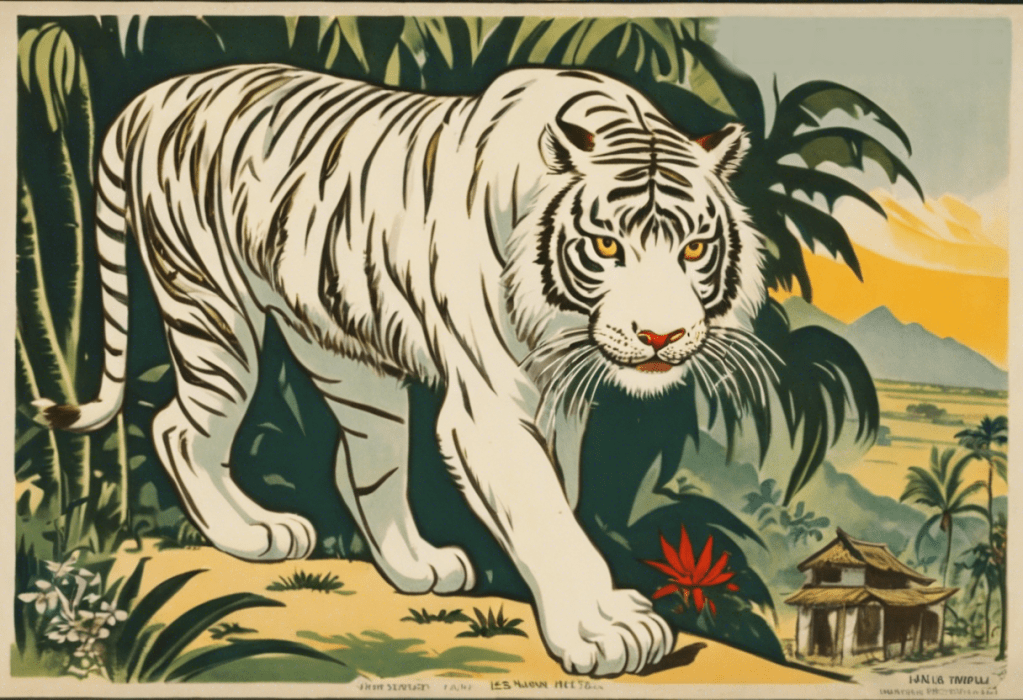
AI Illustration
Amidst the depths of my research into the Annamite Highland’s mysterious cryptids, a fascinating tale emerged – one that may not fit the traditional definition of a cryptid, but certainly captures the essence of intrigue and wonder and reminds me of tales of The Beast of Bodmin that fascinated and terrified me as a child. This tale is of a three-legged white tiger very close to where I now live.
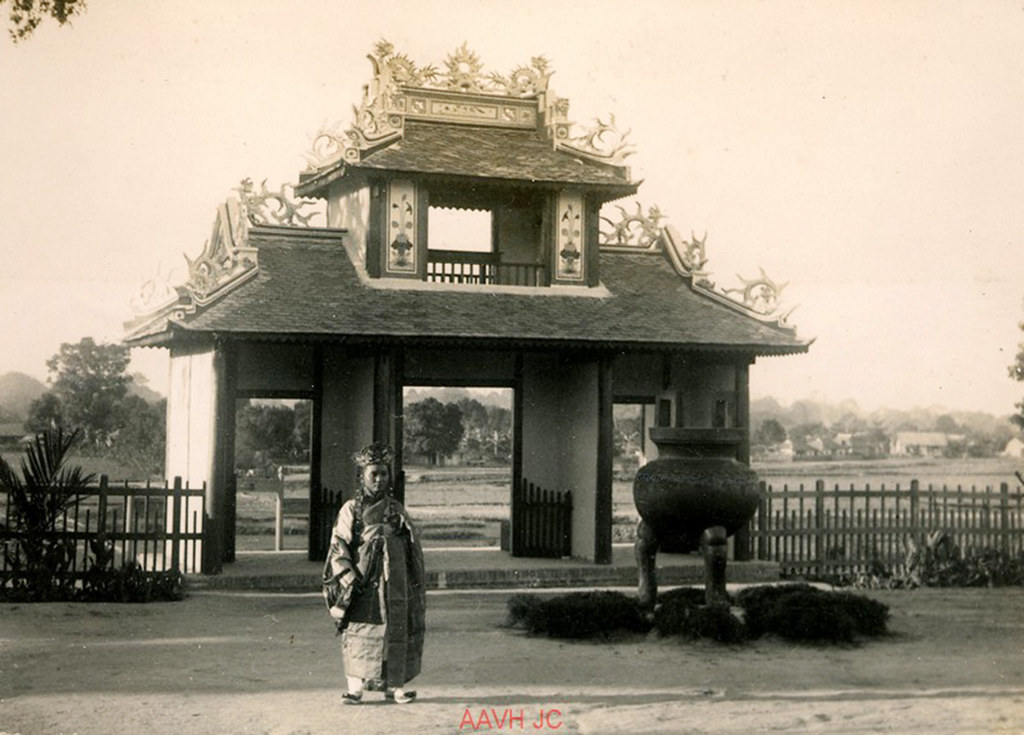
In 1932, a three-legged white tiger began wreaking havoc in Quang Trung in what is now the city of Kon Tum but at the time was on the edge of the wilderness. Its presence struck fear into the hearts of locals as it terrorized livestock until, unexpectedly, it sought refuge within the confines of a Buddhist temple. Miraculously, upon entering the temple, the ferocious beast underwent a profound transformation, its demeanor shifting from aggression to serenity.
The Temple today is said to contain a bas relief of the tiger, I will have to visit soon and see for myself. As recently as 2008 tigers have been reported to bother farmers in Kon Tum.
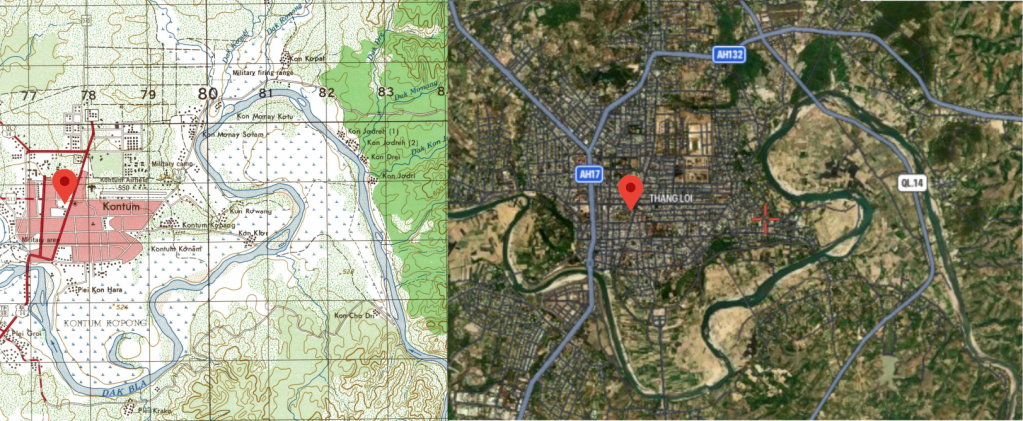
The temple the tiger entered, photographed in 1933Location of the temple in Kontum in 1970 (left) and now. It’s now hard to imagine a tiger wandering so far into the city but even in 1970 Kontum was only a couple of blocks. If anybody has an older map let me know!
Conclusion
“in May 1992 during a joint survey [was] carried out by the Ministry of Forestry of Vietnam and WWF in north-central Vietnam. The team found a skull with unusual long, straight horns in a hunter’s home and knew it was something extraordinary“
For jaded readers like myself, the above excerpt might seem like it comes from a hoax, but this skull turned out to belong to the dear-like Saola, a species that was accepted by the scientific community in 1993. Described as one of the most spectacular zoological discoveries of the 20th century, the Saola serves as a reminder that there could still be mysteries waiting to be uncovered in this part of the world. So, as I set out on my treks and camping trips with my pith helmet, I’m keeping my eyes – and my mind – open.
As a fan of both hiking and the allure of jungle settings, there’s not much that excites me more than embarking on a trek through dense, untamed foliage. Recently, I found myself drawn to the mysterious depths of Chư Păh. . Little did I know, my adventure would be accompanied by a nifty app that has made me rethink the way I interact with the jungle – stay tuned for more on iNaturalist at the end.
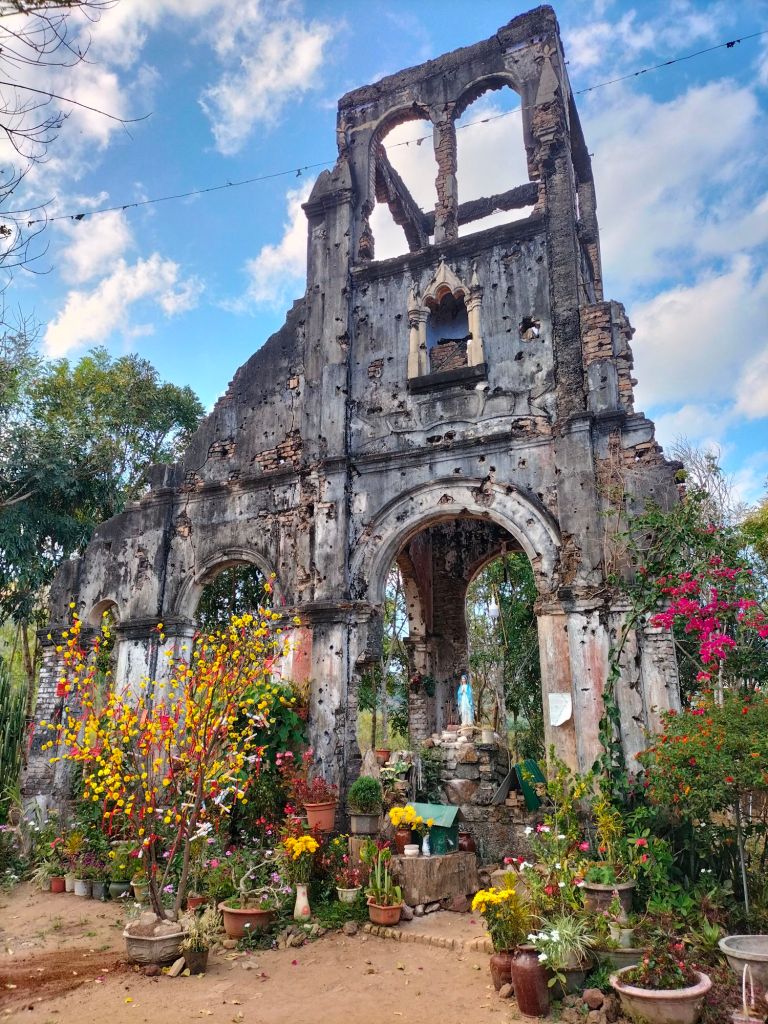
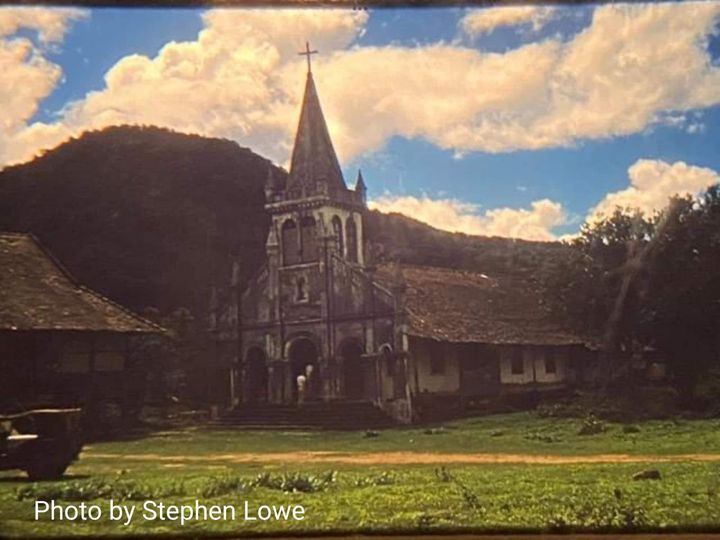
My journey began in a village marked on the old US maps as Dang Rơia, now famous for it’s ruined church (complete with bullet holes). I had a chance encounter with local farmers sat taking a break from their work. Their curiosity piqued by this strange foreinger driving down a dirt road, they asked me what I was up to. I said I was going for a hike and they said there’s nothing this way and I should go to Chi Nam instead. I told them I’d already been up Chi Nam 3 times, they told me to try Chi Dang Ya, I told them I’d already been up there. I told them I was going to continue on that road and see what I could find. They merrily waved me goodbye. Little did I know, this encounter would set the stage for a truly remarkable adventure.
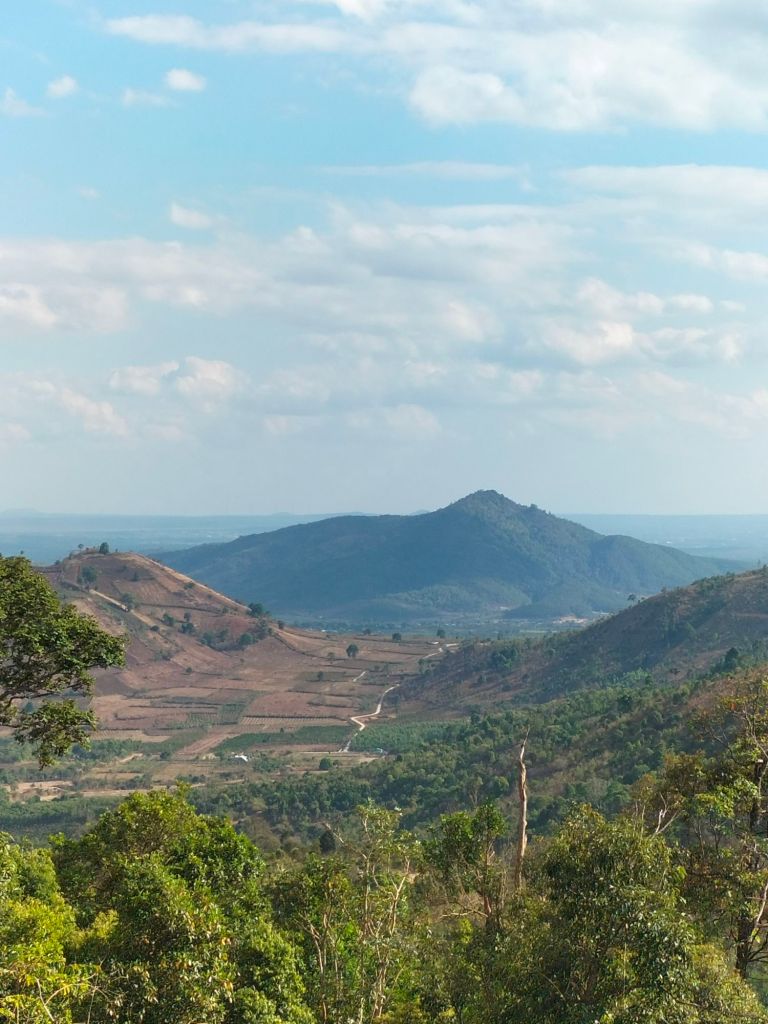
The ruined church still has some new year flowersThe church around 1968View down between chi dang ya and chi nam. Chi jor in the background. (Chi or chư is jrai for mountain)
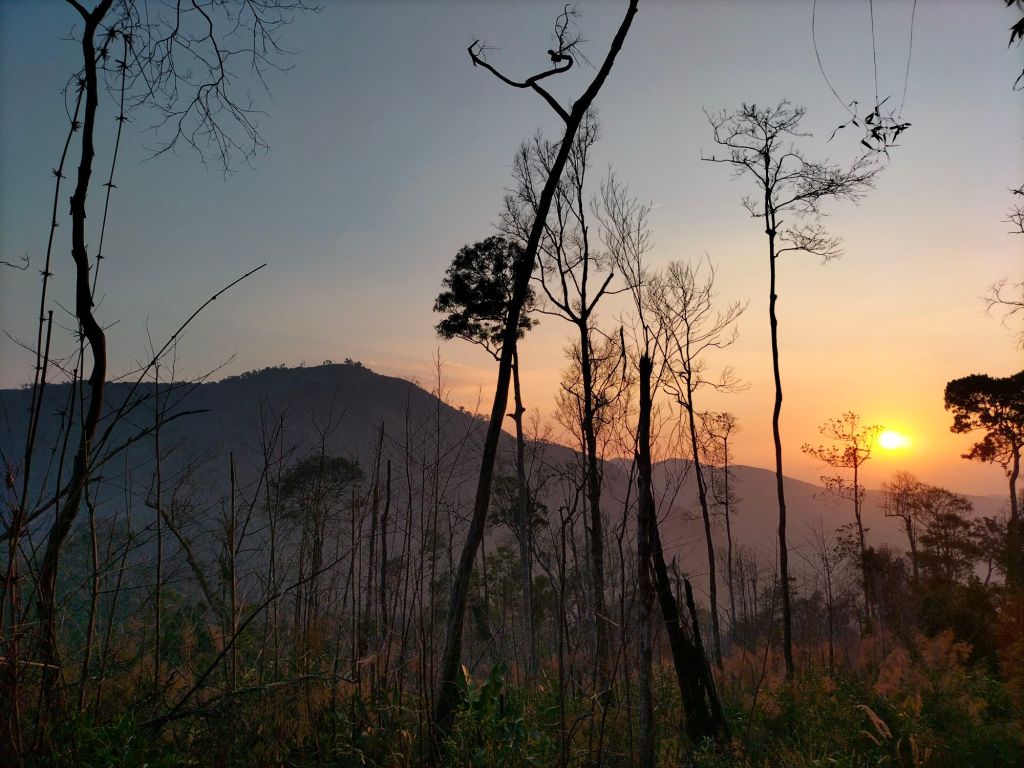
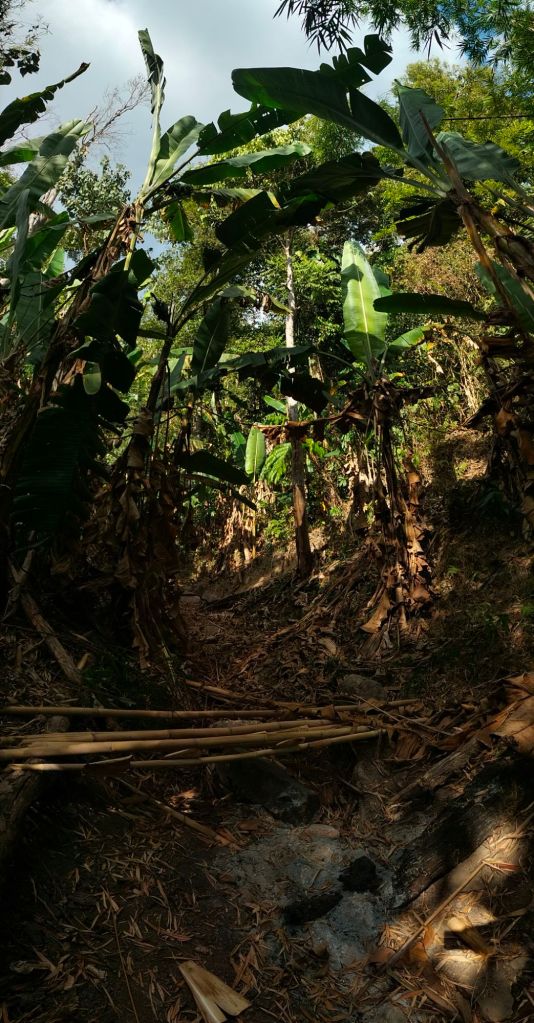
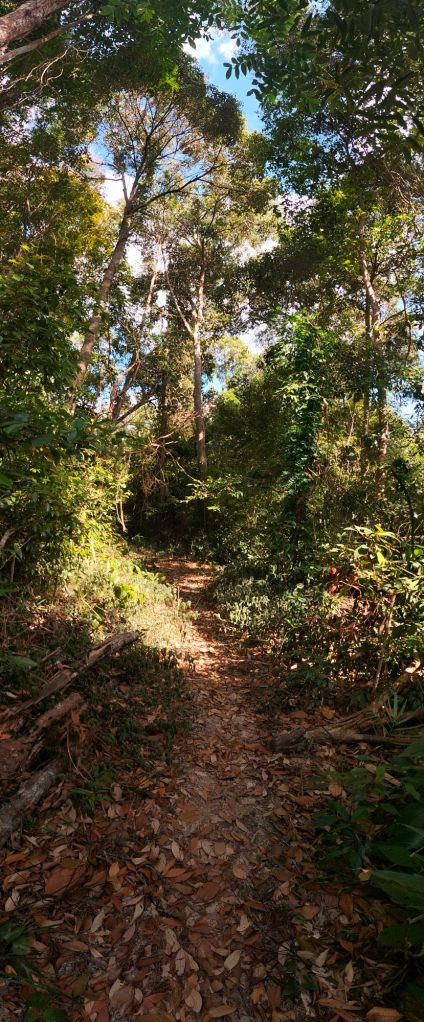
Despite the warnings, I ventured forth, parking my bike near a ford and taking a path that led through the bush into the mountains. As I delved deeper into the wilderness the bush gave way to jungle, the verdant canopy overhead enveloped me in its embrace, shielding me from the harsh sun and immersing me in a world that felt untouched by human hands. What secrets lay hidden beneath the dense foliage, waiting to be unearthed?
I came across a bamboo bench next to an old fire pit. Lots of cow pats around so I think this was made by cowboys man inviting path at the edge of the jungle
I spent two days in the wilderness, carrying a tent that allowed me to explore deeper into the jungle without worrying about losing daylight. Venturing to the top of the mountain ridge and then descending into the denser jungle on the far side seemed like a promising route to the next valley, a familiar terrain I’ve hiked before. However, it quickly became apparent that this was a miscalculation.
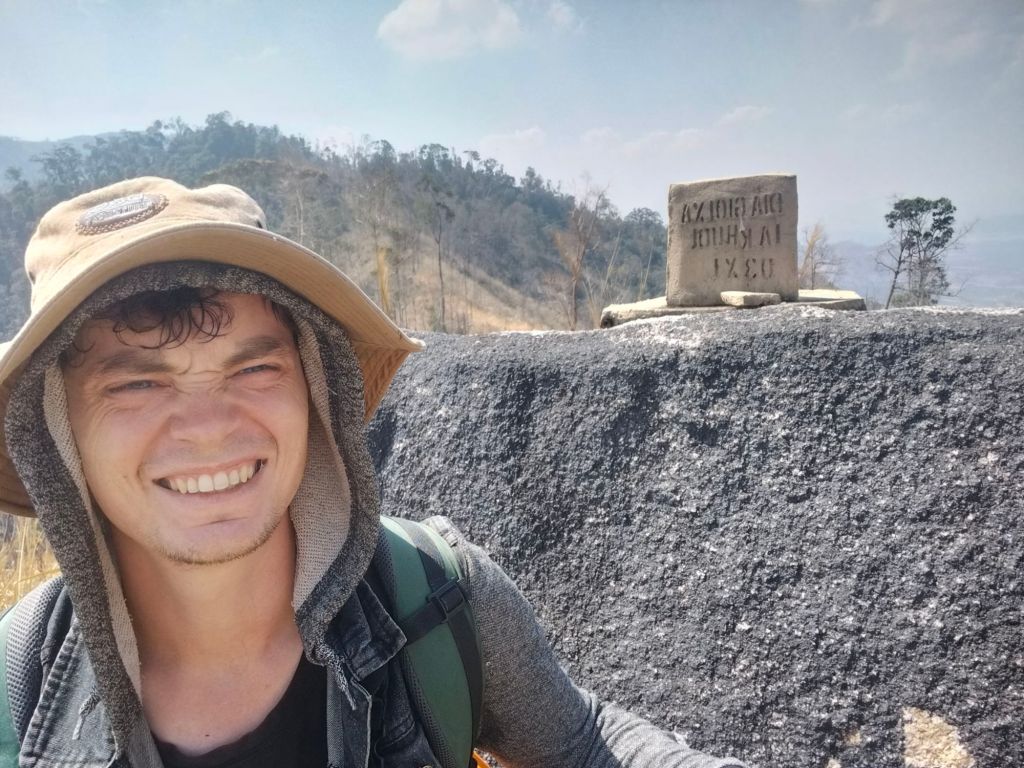
Reached some sort of trig point
The path downward on the far side offered stunning views but proved to be treacherously steep and ultimately led to a dead end. Retracing my steps, hauling my gear uphill at the end of a long day was far from ideal. With just 200 meters left to go and the sun setting, I found myself needing a rest every 100 paces! The thought of a warm meal and a beer at camp helped push me through the exhaustion.
I had an idea to do a vlog but I didn’t plan any of what I’d say and I didn’t edit the videos at all….
Enchanting!Tiger Crystal is quite nice warm actually.
Despite the challenges, those two days in the jungle were a testament to its magnificence. Each moment revealed a new facet of its beauty, from the towering trees to the tranquil babbling brooks. As I reflect on my experience, I can’t help but hope that wilderness like this can continue to thrive in our modern world, preserved as a treasure for future generations to cherish.
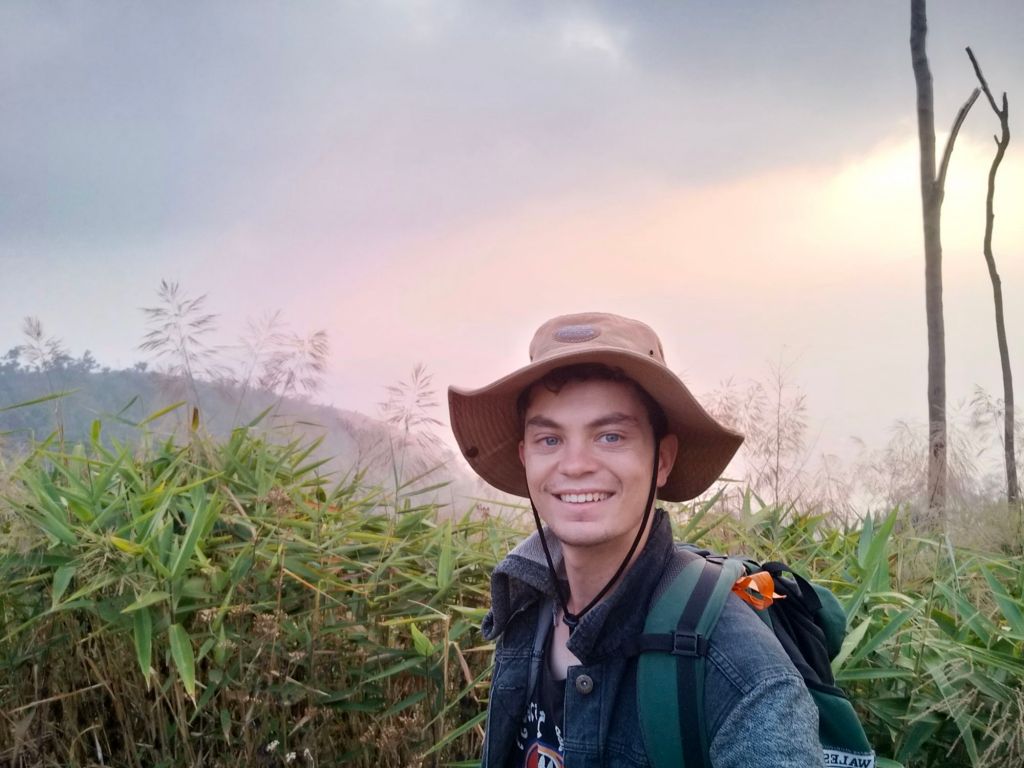
6am in the bush
iNaturalist
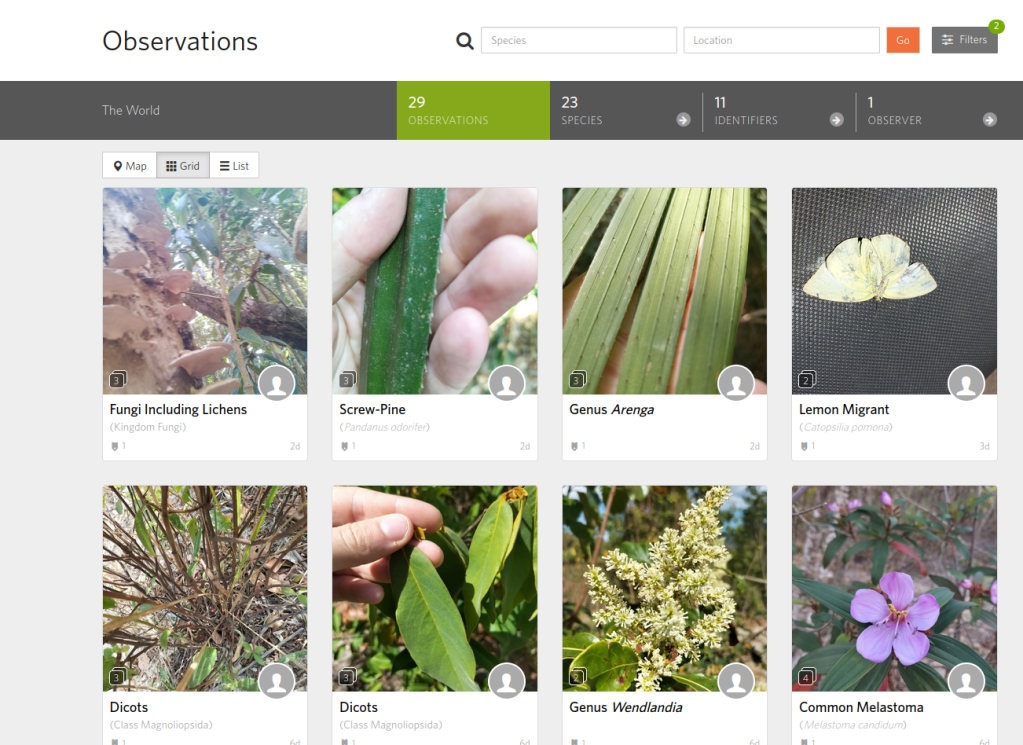
During this expedition, I used a great app that transformed my outdoor experience: iNaturalist. Introduced to me by my friend Joshua, this app offers users the opportunity to capture photos of wildlife specimens they encounter, identify their species., share with the community and contribute to a database for scientific research.
The app quickly became an addictive hobby for me, effectively gamifying my excursions into the wilderness. Every observation I took pulled me deeper into nature, sharpening my eye for plants and bugs. It’s been a real eye-opener, sparking this love for biology and making me feel a lot more connected to the world around me. As I keep using iNaturalist, I can’t help but think about how tech is changing the way we see nature. It’s not just about ID’ing species; it’s about inspiring people, especially younger people, to care about our planet. Embracing the diversity of life around us, from the smallest insect to the tallest tree, fosters a deeper appreciation for the interconnectedness of all living things and the importance of preserving our natural world for generations to come.